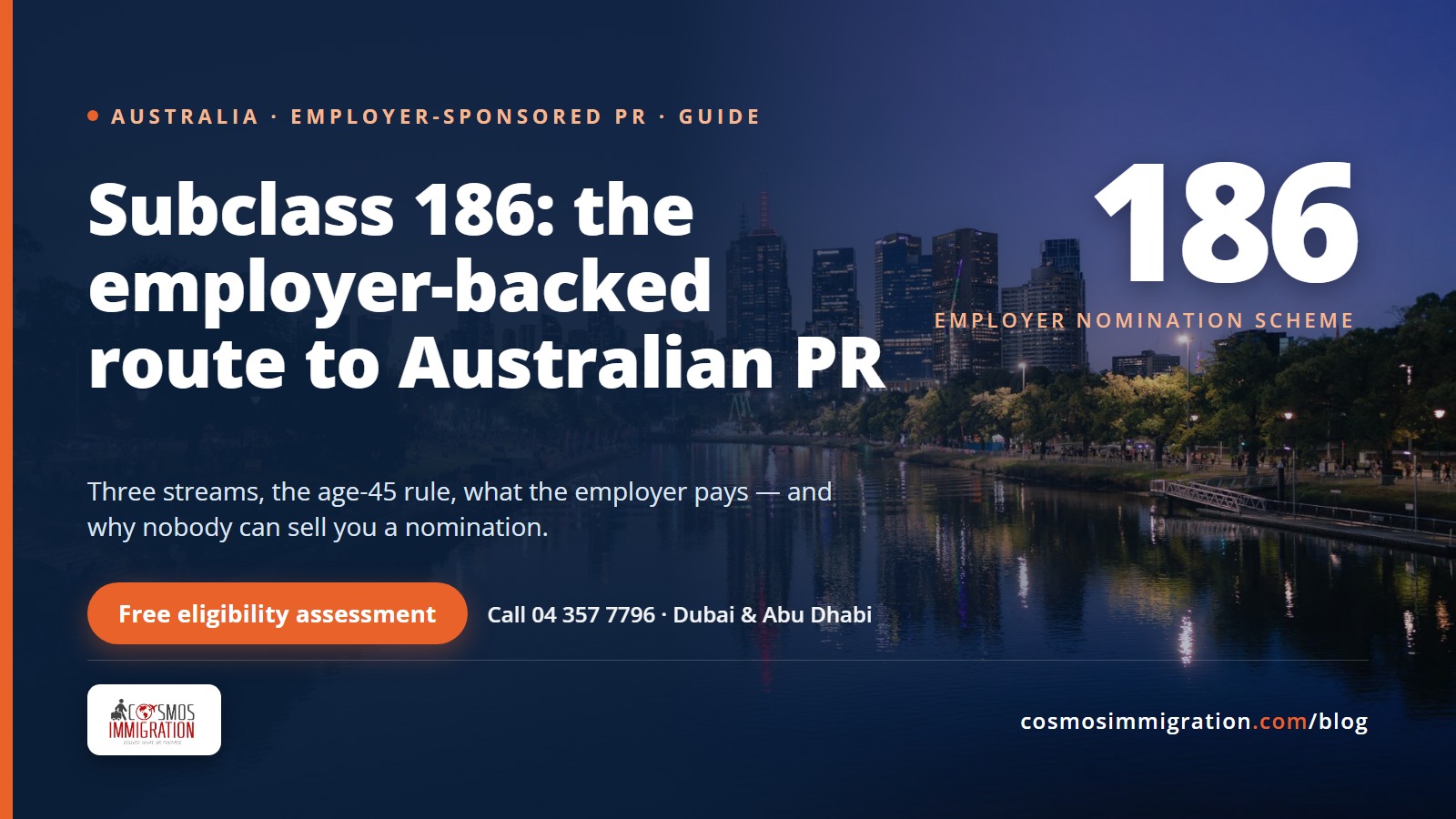
If an Australian employer is prepared to nominate you, the Employer Nomination Scheme visa (subclass 186) gives you permanent residence on grant with no points test. The conditions fall on both sides. The employer must meet nomination rules on salary, genuine need and cost; you must meet rules on occupation, skills assessment, English and age. The salary threshold for nominations rose on 1 July 2026, so anyone planning a nomination this year should work from the current figures. Below we set out the three streams, the rules that most often stop an application, what the employer pays, and how the sequence runs from Dubai or Abu Dhabi.
At a glance
- Subclass 186 is permanent residence on grant, with three streams: Direct Entry, Temporary Residence Transition (TRT) and Labour Agreement.
- Direct Entry needs a Core Skills Occupation List (CSOL) occupation, a positive skills assessment and usually 3 years of experience. TRT has no occupation list; it follows your subclass 482 occupation.
- You must usually be under 45 when you apply. The exemptions are narrow.
- For nominations lodged 1 July 2026 to 30 June 2027, the job must pay at least AUD 79,423 (the Core Skills Income Threshold) and no less than the market rate.
- The visa charge starts at AUD 6,140 for the main applicant. The employer pays a AUD 540 nomination fee plus a one-off Skilling Australians Fund levy of AUD 3,000 or AUD 5,000, and cannot pass those costs to you.
What a subclass 186 visa gives you
You become a permanent resident on the day of grant. The visa lets you stay indefinitely, work and study, enrol in Medicare, sponsor eligible relatives, travel to and from Australia for 5 years, and apply for citizenship once you meet the requirements. Your partner and dependent children or stepchildren can be included in the application.
In return, Home Affairs expects you to work for the nominating employer for at least 2 years. If the visa is granted while you are outside Australia, employment must begin within 6 months of entry; if it is granted while you are in Australia, within 6 months of grant. The points-tested alternatives are covered in our Australia skilled migration guide.
The three streams compared
| Requirement | Direct Entry | Temporary Residence Transition | Labour Agreement |
|---|---|---|---|
| Who it is for | Skilled workers in or outside Australia; no prior sponsored work needed | Subclass 457 or 482 holders who have worked for their sponsor | Workers of an employer with a labour agreement |
| Occupation list | Core Skills Occupation List | None; based on your most recent temporary skilled visa | Occupations in the agreement |
| Skills assessment | Positive assessment before lodging, unless exempt | Home Affairs may ask for one | As set by the agreement |
| Work experience | At least 3 years relevant, unless exempt | 2 years full-time sponsored employment in the 3 years before applying | As set by the agreement |
| Age | Under 45, unless exempt | Under 45, unless exempt | As set by the agreement |
| English | Competent English | Competent English, no exemption | As set by the agreement |
The rules that trip people up
Occupation list
Direct Entry occupations must be on the CSOL, which is benchmarked to the 2022 version of ANZSCO. If your occupation is not on the list, an employer cannot nominate you under Direct Entry. A nomination or visa application that has already been lodged is not adversely affected if the occupation is later removed from the list.
Age 45 and the exemptions
You must usually be under 45 on the date the visa application is lodged. Lodgement is the date that counts, not the date of grant or of nomination approval. The visa application can be lodged with the nomination’s Transaction Reference Number while the nomination is still being processed. For an applicant approaching 45, the practical consequence is that the skills assessment and English result need to be in hand, and the employer’s nomination lodged, early enough for the visa application to go in before the birthday.
The Direct Entry exemptions cover academics nominated by an Australian university; scientists, researchers and technical specialists nominated by a government scientific agency or university; and subclass 444 or 461 holders who have worked for the nominating employer in the nominated position for at least 2 of the last 3 years. TRT adds medical practitioners with at least 2 years in a designated regional area as a 457 or 482 holder, and 457 or 482 holders with 2 years of eligible sponsored employment who earned at least the Fair Work High Income Threshold in each of those years.
Skills assessment and experience
Direct Entry applicants need a positive skills assessment before lodging. It cannot have been issued more than 3 years before the application date, and an assessment obtained for a subclass 485 visa is not accepted. Most applicants also need at least 3 years of relevant work experience; anyone exempt from the skills assessment is also exempt from the experience requirement. For applicants in the UAE, the experience evidence usually means employment references from current and former employers, and these take time to collect.
English
Competent English means, for tests taken on or after 7 August 2025, at least 6 in each of the four IELTS components (Academic or General Training), or at least 47 in listening, 48 in reading, 51 in writing and 54 in speaking in PTE Academic. Cambridge C1 Advanced, CELPIP General, MET, OET, LANGUAGECERT Academic and TOEFL iBT are also approved tests. The result must have been achieved in the 3 years before the visa application and received before you lodge. Tests delivered completely online, such as IELTS Online or TOEFL iBT Home Edition, are not accepted. Family members aged 18 or over who apply with you need at least functional English; otherwise a second instalment of AUD 4,890 applies for each of them.
Salary rules and what the employer pays
Where the worker will earn under AUD 250,000, the employer must show it has determined the annual market salary rate correctly, will pay no less than that rate, and that both the market rate and your pay (excluding non-monetary benefits) meet the Core Skills Income Threshold. The CSIT applies to 186 nominations lodged on or after 7 December 2024. It is AUD 79,423 for nominations lodged between 1 July 2026 and 30 June 2027, up from AUD 76,515 the year before, and it is indexed every 1 July. The position must be skilled, full-time and ongoing for at least 2 years, and the contract must not limit it to 2 years.
| Cost item | Amount (as at August 2026) |
|---|---|
| Subclass 186 nomination fee (employer) | AUD 540, subject to stream and location |
| Skilling Australians Fund levy, turnover under AUD 10 million (employer) | AUD 3,000 one-off |
| Skilling Australians Fund levy, turnover of AUD 10 million or more (employer) | AUD 5,000 one-off |
| Subclass 186 visa application charge (applicant) | From AUD 6,140 for the main applicant, plus a charge per family member |
The levy is paid in full when the nomination is lodged, and Home Affairs states that it must not be passed on to the visa applicant. The same applies to the nomination fee: the employer pays all sponsorship and nomination costs and cannot transfer them to you or your family. The nomination fee is not refunded if the nomination is unsuccessful. Health checks, police certificates and biometrics are costs on your side.
The subclass 482 to 186 route
Many of the people we see move to Australia on a Skills in Demand visa (subclass 482) first and convert to permanent residence through TRT. The 482 lets an employer sponsor a skilled worker for a position it cannot fill with an Australian for up to 4 years, with a visa charge from AUD 4,015. Its Core Skills stream uses the same CSOL and the same CSIT. On the employer’s side, a 482 nomination costs AUD 330 and becoming an approved sponsor costs AUD 420.
To convert, you need a total of 2 years of full-time eligible sponsored employment in Australia within the 3 years before you apply, in the occupation your 482 was granted for, and the employer’s nomination must have been approved in the 6 months before you apply. Time across more than one 457 or 482 counts. If you changed employers, time counts from the date the new employer’s approved nomination was lodged. Your nominating employer must be the last one that sponsored you. Home Affairs may ask for a skills assessment, and there has been no exemption from competent English in this stream since 16 November 2019.
How people in the UAE actually get sponsored
We are regularly asked about offers of “Australian employer sponsorship” in exchange for a fee, usually from a company that cannot be verified. A nomination cannot be bought. Home Affairs states that it is illegal to pay an employer to sponsor you, whether by direct payment, salary deduction or any other benefit, and that anyone who asks for, receives, offers or provides such a benefit may face visa refusal or cancellation, fines or imprisonment. We do not sell jobs.
Two things must be true. An employer in Australia must want to employ you in the nominated position, and its nomination must be approved. For approval, the business must be actively and lawfully operating in Australia with no adverse information against it, have a genuine need for a paid skilled employee, provide labour market testing evidence that it could not find a person in Australia for the vacancy (a small number of occupations are exempt), pay no less than the market salary rate, and pay the levy at lodgement. In practice a nomination follows an employer’s decision to hire; it does not precede it.
Applicants who reach a nomination from the UAE have usually completed the work on their own side first. Confirming that the occupation is on the CSOL and obtaining the skills assessment lets an employer see that a nomination is viable before it commits to the cost. A current English result and references covering the 3 years of experience complete the file.
From the UAE: what this means for you
Documents. Passport, degree certificates and transcripts, and detailed employment references covering at least 3 years in the occupation. If your occupation requires a state or territory licence, registration or professional membership, you must hold it where it is mandatory, and the employer must show at nomination that you are eligible for it.
Tests. Book an in-person sitting of an approved English test in Dubai or Abu Dhabi rather than an at-home version, and keep the result within its 3-year window at lodgement.
Sequence from Dubai or Abu Dhabi. The employer lodges the nomination first and receives a Transaction Reference Number. You can lodge your visa application with that number before the nomination is approved, and you must lodge within 6 months of approval. You can be in or outside Australia when you apply and when the decision is made. The skills assessment and the English test are the two items you can complete without an employer, and each remains valid for 3 years, so both can be done before a job offer exists. Our Australia page lists the other routes if 186 does not fit.
Frequently asked questions
Can I apply for a 186 from Dubai without ever holding a subclass 482?
Yes. That is what Direct Entry is for: an employer willing to nominate you, a CSOL occupation, a positive skills assessment, usually 3 years of experience, competent English and being under 45 unless exempt.
Can I pay an employer or an agent to arrange the sponsorship?
No. Home Affairs treats paying for sponsorship, or accepting a salary deduction for it, as an offence for both sides, with penalties that include visa cancellation. The employer must pay the nomination fee and the levy itself.
I am 46. Is the 186 closed to me?
Usually, yes. The exemptions are limited to specific academic, scientific, regional medical and high-income 482 situations. If none apply, we would look at other options with you.
What to do next
If an Australian employer might nominate you, or you want to know whether your occupation is on the CSOL before applying for roles, request a free eligibility assessment, call us on 04 357 7796, or book a 20-minute review through our contact page. Our Australia consultants are individually registered with MARA. We will tell you where you stand; we do not promise outcomes.
Sources
- Employer Nomination Scheme visa (subclass 186) Direct Entry stream — accessed 27 Aug 2026
- Employer Nomination Scheme (subclass 186) Temporary Residence Transition stream — accessed 27 Aug 2026
- Employer Nomination Scheme (subclass 186) Labour Agreement stream — accessed 27 Aug 2026
- Salary requirements to nominate a worker — accessed 27 Aug 2026
- Cost of sponsoring — accessed 27 Aug 2026
- How to sponsor a worker — accessed 27 Aug 2026
- Competent English — accessed 27 Aug 2026
- Skills in Demand visa (subclass 482) — accessed 27 Aug 2026
- Skilled occupation list — accessed 27 Aug 2026
Cover photo: jhon alexis de arco via Pexels
Not sure which route fits you? Book a free eligibility assessment with our Dubai or Abu Dhabi team. No obligation.
Call +971 4 357 7796WhatsApp us