Every week someone sits across from us in our Dubai office with a printed points estimate and one question: “Should I just take the regional visa?” The Skilled Work Regional (Provisional) visa, subclass 491, is often the route a state is actually offering. But it comes with a condition that shapes the next five years: you live, work and study in a designated regional area. Here is what that really means, as at September 2026.
At a glance
- The subclass 491 is a provisional visa. It lets you stay in Australia for 5 years and live, work and study in a designated regional area.
- “Regional” is a postcode list, not a feeling. Perth and Adelaide are on it. Sydney and Brisbane are not.
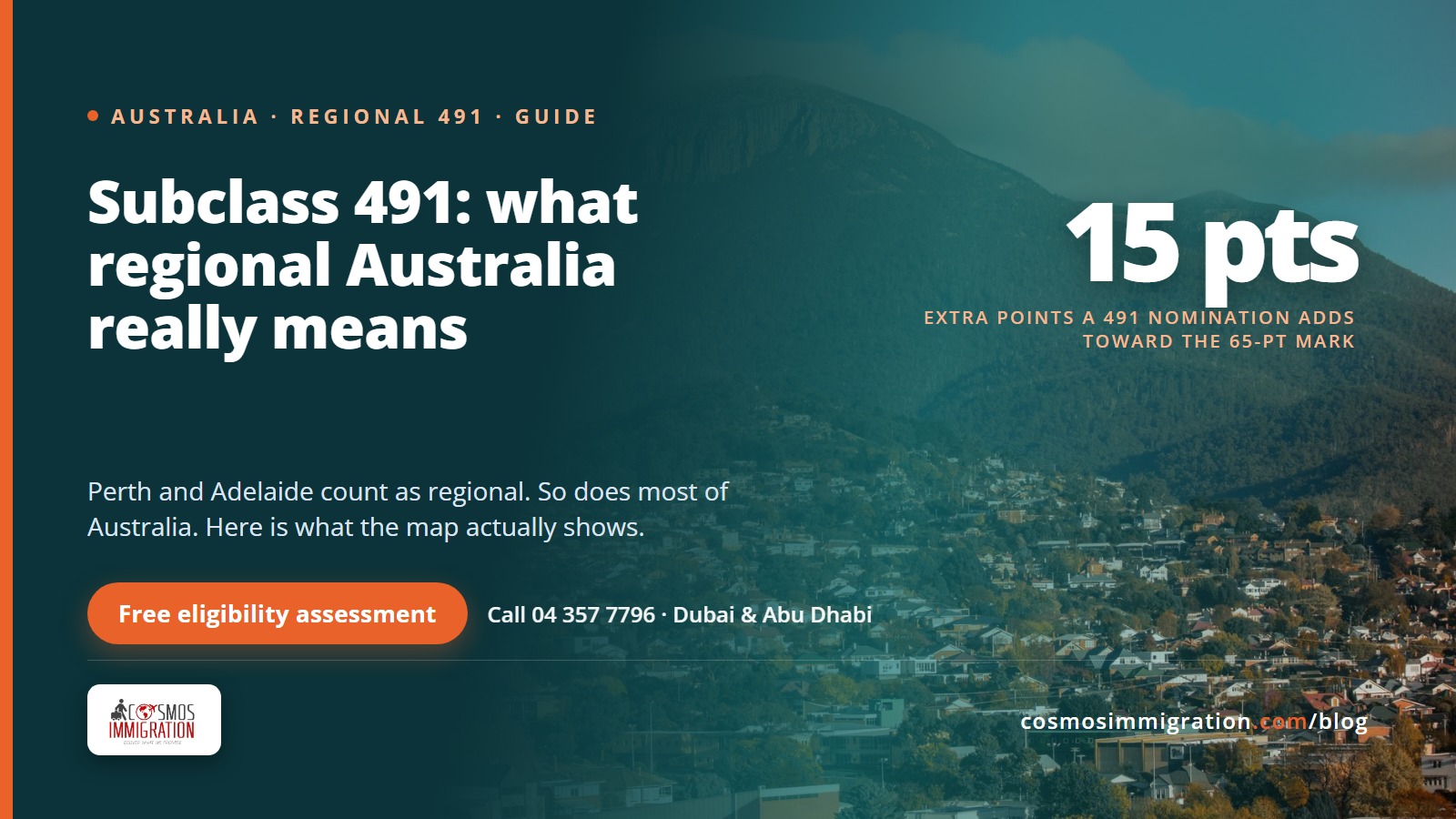
- State nomination for the 491 adds 15 points toward the 65-point pass mark.
- The permanent stage is the subclass 191. Home Affairs currently states no minimum income requirement for its Regional Provisional stream, provided you complied with your 491 conditions.
- For 2025-26 the Australian Government set 7,500 subclass 491 nomination places nationally, out of 20,350 for the 190 and 491 programs combined.
What the 491 is, and what you are agreeing to
Home Affairs describes the subclass 491 plainly: a provisional visa for skilled workers who want to live and work in regional Australia. It lets you stay for 5 years and live, work and study in a designated regional area.
Read that twice. The 491 is not a points bonus with a regional label. Every later step, including the permanent stage, rests on whether you actually lived and worked where you said you would.
For a Dubai reader weighing the 491 against the 189 or 190, the trade is a location commitment in exchange for state nomination and the points that come with it. Whether that suits you depends on your occupation, your family and how you feel about a city that is not Sydney or Melbourne. Our Australia skilled migration page sets out the subclasses side by side.
Where “regional” really is: a postcode list
Many clients picture regional Australia as a mining town or a farm. Home Affairs uses something far more precise: a table of postcodes with 3 categories. Both Category 2 (“Cities and Major Regional Centres”) and Category 3 (“Regional Centres and Other Regional Areas”) count as regional and attract regional incentives.
Perth’s metropolitan postcodes, 6000 to 6038, sit in the “Cities and major regional centres” category. So do Adelaide’s, 5000 to 5171. Every other postcode in those two states falls into Category 3, so all of Western Australia and South Australia is designated regional. Sydney and Brisbane postcodes do not appear in the table at all, while Newcastle and the Hunter (2264 to 2308) and the Gold Coast area (4207 to 4275) are listed as cities and major regional centres.
| Place | Postcode table category | Designated regional? |
|---|---|---|
| Perth (WA 6000 to 6038) | Cities and major regional centres | Yes |
| Adelaide (SA 5000 to 5171) | Cities and major regional centres | Yes |
| Newcastle and the Hunter (NSW 2264 to 2308) | Cities and major regional centres | Yes |
| Gold Coast area (QLD 4207 to 4275) | Cities and major regional centres | Yes |
| Metropolitan Sydney | Not in the table | No |
| Metropolitan Brisbane | Not in the table | No |
One caveat. The list has been amended before: several Queensland postcodes marked with an asterisk, including 4019 to 4022, 4074 and 4300 to 4301, do not apply to visas granted before 5 March 2022. Check the live Home Affairs page for your intended suburb rather than a screenshot shared in a WhatsApp group.
The state’s own conditions: Tasmania as the worked example
Federal conditions are only half the story. Each state runs its own nomination program, and Tasmania’s official page shows clearly how the layers stack.
Migration Tasmania states that nomination from Tasmania for the 491 provides 15 additional points to help meet the Department of Home Affairs points test pass mark of 65 points. To be eligible for Tasmanian nomination for the 491 or 190 you must not yet have turned 45, have nominated an occupation on the relevant skilled occupation list, hold a valid and positive skills assessment, have at least “Competent” English, and score at least 65 points.
Then comes the undertaking you give to the state. If Tasmania nominates you, you undertake to live in Tasmania for at least two years after your nomination is approved. That sits alongside the federal condition to live, work and study in a designated regional area for the life of the visa. After three years on the 491, Tasmania’s page says you may become eligible to apply for permanent residence through the subclass 191.
Think of it as renting a flat in a managed building. Home Affairs writes the building rules; the state writes your particular lease.
Other states set their own criteria, which we did not verify for this guide.
From 491 to permanent residence: the subclass 191
The subclass 191 Permanent Residence (Skilled Regional) visa allows people who have lived and worked in designated regional areas of Australia on an eligible visa, such as the 491, to live and work in Australia permanently.
The pathway is built on actual regional residence and work, not on simply holding the visa. For the Regional Provisional stream, Home Affairs currently states there is no minimum income requirement, but you must have complied with the conditions of the eligible visa you hold or have held.
The decisions you make in year one, where you rent, where you work and whether your family lives with you, become the evidence you rely on later. Our guide to Australia PR from Dubai walks through how the two stages fit together.
How many places exist, and how long the wait is
On 4 November 2025 the Australian Government set state and territory nomination allocations for the 2025-26 program year at 20,350 across the subclass 190 and 491 programs. Of those, 7,500 are subclass 491 places, split as follows.
| State or territory | Subclass 491 nomination places, 2025-26 |
|---|---|
| New South Wales | 1,500 |
| Western Australia | 1,400 |
| South Australia | 900 |
| Australian Capital Territory | 800 |
| Northern Territory | 800 |
| Queensland | 750 |
| Victoria | 700 |
| Tasmania | 650 |
| Total | 7,500 |
These are nomination places, not visa grants. On timing, Home Affairs publishes a median of 8 months for the broader “Skilled (Permanent)” category as of July 2026. That figure bundles points-tested and state-nominated general skilled migration visas together, so it is not a 491-specific number; Home Affairs points applicants to its separate processing times tool for a subclass-level estimate.
The points test is changing, but not yet
The Australian Government has said it is reforming the permanent migration points test, which applies to subclasses 189, 190 and 491, to select better educated, higher-skilled and younger migrants. The review began with a discussion paper on 24 April 2024, with submissions closing on 24 May 2024. As of the 2026-27 Budget the reform had not been legislated, and no new point values, pass mark or commencement date appear on an official page.
Social media is full of confident dates and new pass marks; we do not repeat them because Home Affairs has not published them. Run your numbers on today’s rules with our Australia points calculator, and plan for the regional nomination points to be re-weighted later.
From the UAE: what this means for you
A 491 file built in Dubai or Abu Dhabi has the same spine as any skilled visa file, with the state’s own requirements layered over it.
Skills assessment first. Tasmania’s criteria require a valid and positive skills assessment for your nominated occupation. For a UAE professional that usually means chasing reference letters from former employers, some of whom have moved on, and getting degree documents into the form your assessing body asks for. Nothing else moves without it.
English next. “Competent” English is the floor for Tasmanian nomination. Book your test early so the result is in hand when a state invites you.
Then the question of place. If your partner’s career depends on a capital city, look hard at Perth and Adelaide, both inside the regional postcode list. If a smaller city appeals, remember the state’s own residence undertaking, two years in Tasmania’s case, in addition to the federal condition.
Finally, age. Tasmanian nomination requires that you have not yet turned 45. If you are in your early forties, the calendar matters more than any other factor.
We work with clients across Dubai and Abu Dhabi on this exact question every week, and the regional trade-off comes up constantly. If you are still deciding between countries, start with our Australia immigration overview.
Frequently asked questions
Is Perth really counted as regional for the 491?
Yes, on the Home Affairs postcode table. Perth’s metropolitan postcodes 6000 to 6038 are listed under “Cities and major regional centres”, which counts as designated regional. The same applies to Adelaide’s 5000 to 5171.
Do I need a minimum income to move from 491 to 191?
For the Regional Provisional stream of the subclass 191, Home Affairs currently states there is no minimum income requirement. You must, however, have complied with the conditions of the eligible visa you hold or have held.
How long do I have to stay in the regional area?
The federal condition is to live, work and study in a designated regional area for the life of the 5-year visa. Tasmania adds an undertaking of at least two years in the state after nomination is approved; after three years on the 491 you may become eligible to apply for the 191.
What to do next
Start with a free eligibility assessment so we can look at your occupation, points and family situation together. Call us on 04 357 7796 or book a 20-minute review through our contact page. We never promise an outcome; visa decisions rest with the Department of Home Affairs and the nominating state.
Sources
- Department of Home Affairs – Designated regional area postcodes — accessed 13 Sep 2026
- Department of Home Affairs – Skilled Work Regional (Provisional) visa (subclass 491) – Main applicant — accessed 13 Sep 2026
- Department of Home Affairs – Permanent Residence (Skilled Regional) visa (subclass 191) — accessed 13 Sep 2026
- Migration Tasmania – Skilled Workers and Graduates living in Tasmania — accessed 13 Sep 2026
- Department of Home Affairs – State and territory nomination allocations — accessed 13 Sep 2026
- Department of Home Affairs – Visa processing times — accessed 13 Sep 2026
- Australian Government Budget 2026-27 Overview — accessed 13 Sep 2026
- Department of Home Affairs – Review of the points test discussion paper — accessed 13 Sep 2026
Not sure which route fits you? Book a free eligibility assessment with our Dubai or Abu Dhabi team. No obligation.
Call +971 4 357 7796WhatsApp us