Most families in the UAE don’t start with “Australia or Canada?” They start with two browser tabs and a nagging feeling that one country’s points system might suit their household better than the other’s. We see this every week in our Dubai office: a spouse with a strong degree but average English, a child about to turn 22, a couple wondering whether their savings will stretch through a health-insurance gap after they land. The honest answer is that both countries score you against a national points system, and the details of your own family — ages, English scores, work history, who else is applying — decide which one actually favours you.
At a glance
- Australia’s Skilled Independent (189) and Skilled Nominated (190) visas use the same points test, out of a mix of factors including age, English, work experience and education; a state or territory nomination adds a further 5 points on the 190.
- Canada’s Express Entry system covers three federal programs and ranks candidates on the Comprehensive Ranking System (CRS), scored out of 1,200; a provincial nomination adds 600 CRS points on its own.
- A spouse’s own English and skills can add points to an Australian application, and a spouse’s own age, education, language and Canadian work experience are scored separately in Canada’s CRS.
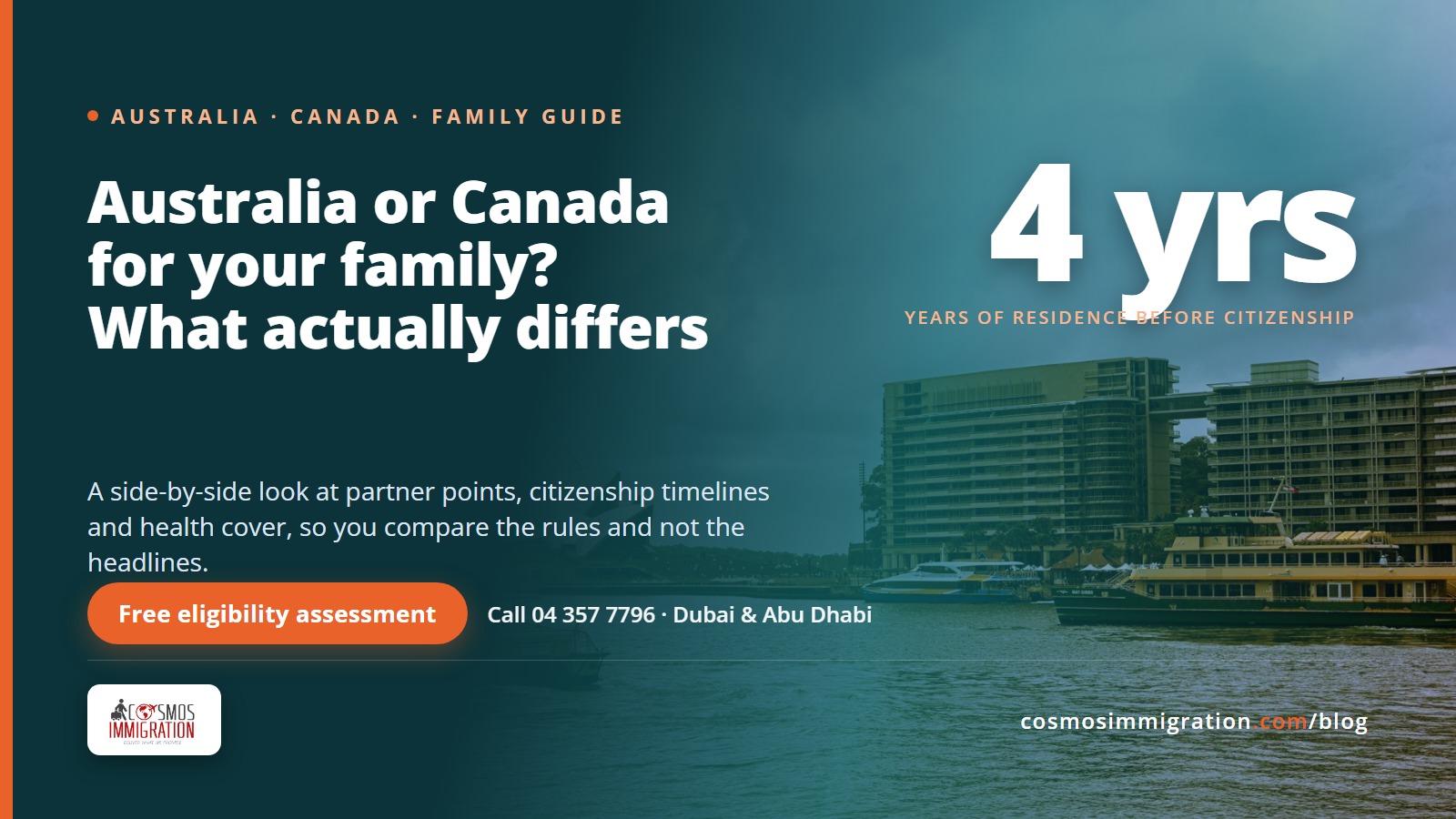
- Citizenship timing differs: Australia requires 4 years living in the country on a valid visa, including the last 12 months as a permanent resident; Canada requires 1,095 days of physical presence within the 5 years before you apply.
- Health cover starts differently too — Australian Medicare enrolment is available from the date you apply for permanent residency in most streams, while some Canadian provinces apply a waiting period of up to 3 months for new permanent residents.
Two different points systems, one shared purpose
Australia’s Skilled Independent (subclass 189) and Skilled Nominated (subclass 190) visas both run on the same points test: age (up to 30), English (up to 20), skilled employment experience combining overseas and Australian time (up to 20), educational qualifications (up to 20), a specialist STEM or ICT postgraduate qualification (10), the Australian study requirement (5), a completed Professional Year in Australia (5), a credentialled community language (5), and study in regional Australia (5). Under the 190, a state or territory nomination adds a further 5 points once you’ve secured it and been invited.
Canada’s Express Entry system manages online applications for three federal programs: the Federal Skilled Worker Program, the Canadian Experience Class (at least 1 year of eligible Canadian work experience in the last 3 years), and the Federal Skilled Trades Program (which requires a job offer or certificate of qualification in a trade). Every eligible profile is then ranked on the Comprehensive Ranking System, scored out of a maximum 1,200 points.
| Factor | Australia (points test) | Canada (CRS) |
|---|---|---|
| Age | Up to 30 points | Up to 110 (100 if a spouse is also assessed) |
| Language | Up to 20 points | Up to 160 (150 if a spouse is also assessed) |
| Work experience | Up to 20 points (overseas + Australian combined) | Up to 80 (70 if a spouse is also assessed) |
| Education | Up to 20 points | Up to 150 (140 if a spouse is also assessed) |
| State/provincial nomination | 5 points (subclass 190 only) | 600 points — the largest single factor, well ahead of 15 for a sibling in Canada or up to 50 for French |
The scales aren’t comparable in absolute terms — Australia’s test maxes out far lower than Canada’s 1,200-point CRS — but the shape of the decision is similar in both countries: your core profile earns a baseline score, and a state, territory or provincial nomination is the single biggest lever you can pull beyond it.
What your spouse brings to the application
In Australia, a spouse or de facto partner can add points to a points-tested application if they’re also included as an applicant and aren’t already an Australian citizen or permanent resident. A partner under 45 with competent English, a skilled occupation on the same list, and a suitable skills assessment adds 10 points; competent English alone adds 5. If you’re applying as a single person, or your partner already holds citizenship or permanent residency, you receive 10 points on that basis instead.
Canada takes a different structural approach. If your spouse or common-law partner isn’t applying as a separate candidate, your own CRS maximums drop slightly, but their own age, education, language ability and Canadian work experience are then scored separately and added to your household total. In practice, a spouse with a decent language score or Canadian work history can meaningfully lift a combined CRS score — it’s just counted through a different mechanism than Australia’s.
Bringing children into the picture
Canada’s dependent child rule is specific: a child can be included on the application if, on the date the complete application is received, they are under 22 years old and do not have a spouse or common-law partner. That age is locked in on the date IRCC receives the complete application — so a child who turns 22 partway through processing doesn’t lose their place. Children 22 or older can still qualify only if they’ve depended substantially on a parent for financial support since before turning 22 and can’t be financially self-supporting because of a physical or mental condition.
Australia also allows dependent children on a points-tested application, but its own age and study conditions are defined separately from Canada’s and are worth checking carefully against your child’s exact circumstances before you plan around a particular age cut-off.
Citizenship: how long until it’s officially home
Both countries ask for a period of genuine residence before citizenship is on the table, and the shape of that requirement differs. In Australia, the general residence requirement for citizenship by conferral is 4 years living in the country on a valid visa immediately before you apply, including the last 12 months as a permanent resident. You also can’t have been absent from Australia for more than 12 months in total during those 4 years, and no more than 90 days in the 12 months right before you apply.
In Canada, adult citizenship applicants need to have been physically present in the country for at least 1,095 days (3 years) within the 5 years immediately before applying, to have filed Canadian income taxes for at least 3 of those 5 years where required, and — if you’re between 18 and 54 on the day you sign your application — to demonstrate adequate knowledge of English or French and pass the citizenship test.
Health cover from day one — or not quite
This is where the two systems genuinely diverge in timing. Australia’s Medicare is a national scheme, and permanent residence visa holders can enrol — in most streams, from the date you applied for permanent residency, not only once it’s granted. That includes people who have applied for a combined partner visa, for example. There’s no separate multi-month waiting period built into the enrolment rule itself.
Canada’s public health care is administered provincially and territorially rather than federally. You apply for a health card in the province or territory where you live, and in some provinces, newcomers — including new permanent residents — may face a waiting period of up to 3 months before their public health insurance coverage actually starts. Private health insurance is recommended to bridge that gap, and it’s worth checking the specific rule for the province you’re planning to land in, since it isn’t the same everywhere.
From the UAE: what this means for you
Whichever country you’re weighing, the early groundwork looks similar from Dubai or Abu Dhabi: booking and sitting an English test, having your degree assessed by the right body for your occupation, and gathering reference letters from current and former employers that actually match the duties your occupation code expects. Families juggling this alongside full-time jobs often underestimate how much back-and-forth is involved in chasing an old employer for a properly worded letter, or getting a document attested through the right channel before it can be submitted.
If your spouse’s points matter to your total, it’s worth having their English test and skills assessment (Australia) or language test and credential assessment (Canada) organised in parallel with your own, since both add real time to the calendar. And if a state, territory or provincial nomination is realistically within reach for your occupation, that’s usually the step worth prioritising first.
Frequently asked questions
Can our whole family apply on one application in both countries?
Yes — a spouse or partner and eligible dependent children can generally be included in both systems, though the age and eligibility conditions for dependants differ between Australia and Canada, so check your child’s exact circumstances against the current rules.
Does my spouse’s English or work experience actually change our score?
In both countries, yes. Australia adds points directly for a partner’s English and skilled occupation, and Canada scores a spouse’s own age, education, language and Canadian work experience separately, in addition to the primary applicant’s core points.
Will we have health insurance as soon as we arrive?
Australia’s Medicare enrolment is generally available from the date you apply for permanent residency, in most streams. Canada’s coverage is arranged provincially, and some provinces apply a waiting period of up to 3 months for new permanent residents, when private health insurance is recommended.
What to do next
If you’re weighing which pathway fits your family’s ages, occupations and timeline, a free eligibility assessment is the fastest way to see where your numbers land under each system. Call us on 04 357 7796, book a 20-minute review, or start with our contact page. You can also run your own numbers using our Australia points calculator or Canada CRS calculator, or browse more comparisons in our tools section. We don’t promise a particular outcome for any family — every profile is different, and the honest next step is checking yours against the current rules.
Sources
- Department of Home Affairs — Points table for Skilled Independent visa (subclass 189) — accessed 1 Sep 2026
- Department of Home Affairs — Points table for Skilled Nominated visa (subclass 190) — accessed 1 Sep 2026
- Department of Home Affairs — Form 1300t, Application for Australian citizenship: General eligibility — accessed 1 Sep 2026
- Services Australia — Enrolling in Medicare if you’re an Australian permanent resident — accessed 1 Sep 2026
- IRCC — Express Entry: Who can apply — accessed 1 Sep 2026
- IRCC — Comprehensive Ranking System (CRS) criteria — accessed 1 Sep 2026
- IRCC — Who you can include as a dependent child on an immigration application — accessed 1 Sep 2026
- IRCC — Apply for Canadian citizenship: adults and minor children — Who can apply — accessed 1 Sep 2026
- Government of Canada — Health care in Canada: Access our universal health care system — accessed 1 Sep 2026
Not sure which route fits you? Speak to a licensed consultant — CICC (Canada) and MARA (Australia) regulated. No obligation.
Call +971 4 357 7796WhatsApp us