The visa is approved, the flights are booked, and now you are standing in your Dubai apartment wondering whether the dining table is worth shipping to Toronto, or whether it should go to the neighbour who has been eyeing it since the villa barbecue. We hear a version of this question every week in our Dubai office: what should travel with you, what can follow later, and what should simply stay behind so it does not turn into an unexpected customs problem on the other side.
At a glance
- Canada lets settlers bring personal and household goods in duty-free if they owned, possessed and used them abroad before arriving — but selling them within 12 months of importing forfeits the exemption.
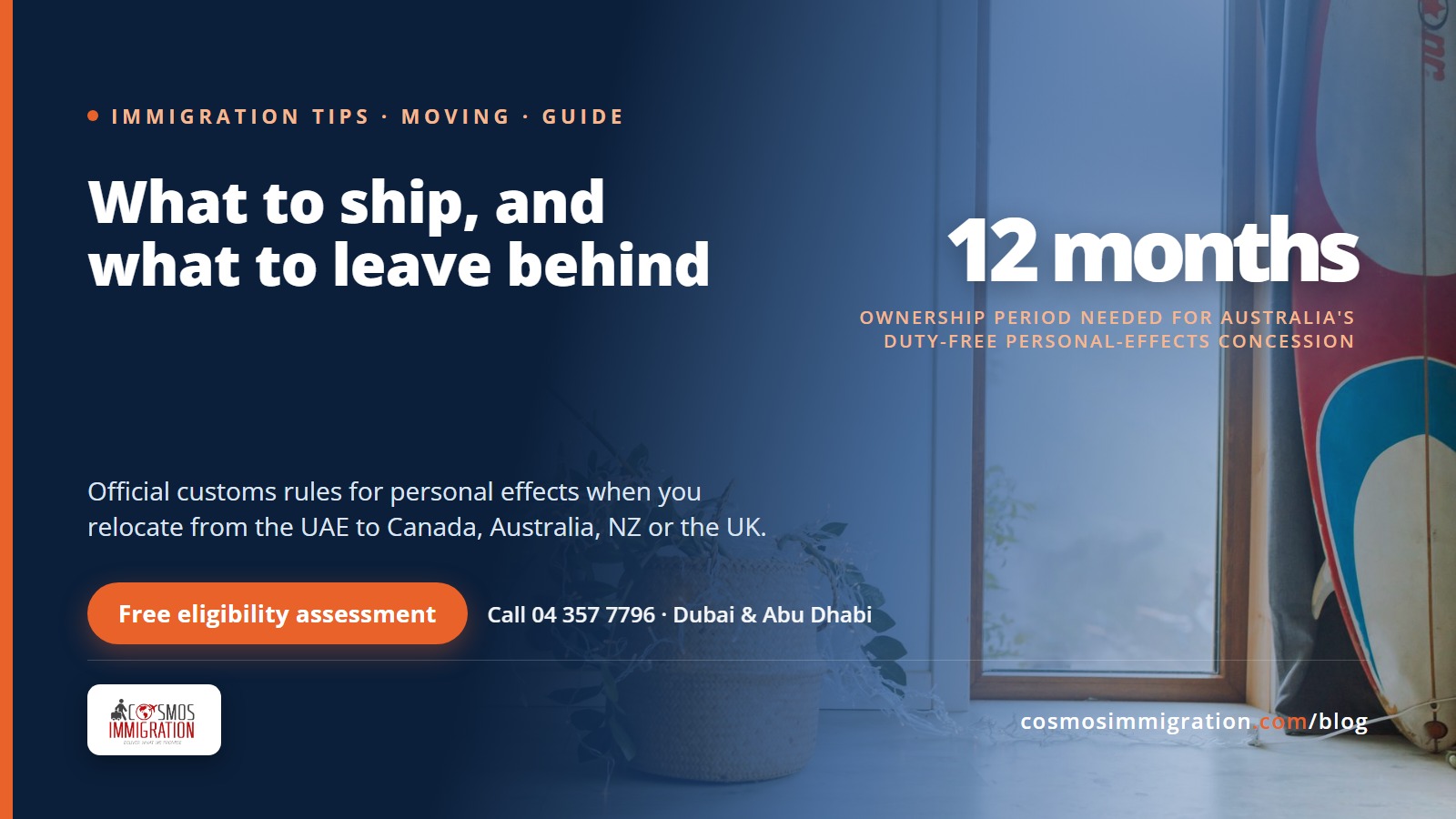
- Australia’s unaccompanied personal effects (UPE) concession covers goods shipped separately from you, though most items need 12 months of prior ownership; clothing, footwear and toiletries do not.
- Every UPE shipment into Australia goes through a biosecurity check, and anything carrying animal, plant, water or soil residue can be held, treated or destroyed at the owner’s own cost.
- New Zealand treats “personal effects” and “household effects” as two separate categories, each with its own conditions — and anything meant for resale or as a gift does not qualify either way.
- The UK’s Transfer of Residence (ToR) relief needs an application before or as you move, backed by proof of both your new UK address and the UAE address you are leaving.
Canada: the settlers’ effects rule
Canada Border Services Agency (CBSA) allows a person settling in Canada to bring in personal and household goods without paying customs duty under what is officially called the settlers’ effects provision, Tariff Item No. 9807.00.00. The core condition is straightforward to state and easy to overlook in practice: the goods must have been actually owned, possessed and used by you abroad before you arrived, and they must accompany you at arrival, or be reported to CBSA at that time even if they follow later.
The part that catches people out is what happens afterwards. Goods brought in duty-free under this rule stop qualifying if they are sold or otherwise disposed of within twelve months of importation. In other words, this is a concession for things you genuinely intend to keep and use, not a loophole for bringing in new furniture to sell once you land. If you are weighing up whether to ship a sofa or buy a new one once you arrive, that twelve-month clock is worth keeping in mind before you decide either way. For readers still mapping out the wider move, our Canada and Canada skilled migration visa pages cover the pathway itself.
Australia: unaccompanied personal effects and the biosecurity check
Australia’s equivalent is the unaccompanied personal effects (UPE) concession, run by the Australian Border Force (ABF). It covers household and personal items sent separately from you — by air, sea cargo or international mail — and, if both you and the goods meet the eligibility criteria, the concession clears the goods without customs duty, GST or other taxes and charges. Shipping and brokerage fees are explicitly excluded from that concession and remain payable regardless.
Eligibility depends heavily on how long you have owned the item. The table below, drawn directly from the ABF’s own categories, shows the split:
| Category of goods | Minimum ownership period before departure |
|---|---|
| Personal clothing, footwear, hygiene articles and personal grooming products (excluding fur apparel or perfume concentrates) | No minimum requirement |
| Fur apparel, other personal effects, furniture and household goods | 12 months of personal ownership and use immediately before departure |
Timing matters too. The ABF requires that unaccompanied effects be arranged for transport before you arrive in Australia, and that there be a demonstrable link between the shipment and your actual travel — evidence such as an airline ticket or a work contract. And every UPE shipment, regardless of category, goes through a biosecurity assessment by the Department of Agriculture, Fisheries and Forestry (DAFF), which pays close attention to anything made from or containing animal or plant material, or that has been in contact with animals, plants, water, food or soil. Clean wooden furniture, sports equipment and similar items thoroughly before they leave the UAE, since DAFF can require cleaning, treatment, export or destruction at your own expense before release. Readers exploring this route can start with our Australia and Australia skilled migration visa pages.
New Zealand: personal effects and household effects are not the same thing
New Zealand Customs Service draws a clear line between “personal effects” and “household effects” as two distinct categories with different rules, so it is worth knowing which bucket your belongings fall into before you pack. Personal effects, as defined by Customs, include wearing apparel, jewellery and watches, personal grooming devices, mobility and medical devices, personally owned medications (up to three months’ supply, in line with Ministry of Health guidelines), toiletries, bags, protective equipment and personal electronic devices such as phones and laptops.
To qualify for the duty concession, personal effects must have been personally owned by you while you were overseas, be for your own use, and not be intended for anyone else or for gift, sale or exchange. They can generally be new, except for personal electronic devices. If any one of these conditions is not met, Customs applies duty and GST to that item — so a brand-new phone bought specifically to bring into the country, for example, would not qualify the way a laptop you have already been using would. If you are also planning your onward pathway, our New Zealand page is a useful next stop.
The UK: Transfer of Residence (ToR) relief
Anyone moving or returning permanently to the UK can apply for Transfer of Residence relief, which relieves the customs charges that would otherwise be due on personal belongings and other goods brought in when you change your place of residence to the UK. The application, known as the ToR1, also lets you declare goods before they are actually shipped, which is useful if your belongings are travelling separately from you.
HM Revenue & Customs asks applicants to submit a list of the items being brought in — quantities are acceptable, such as “110 books”, rather than itemising every single object — along with a passport photo page, proof of a UK address (or evidence of temporary accommodation if you do not have one yet), and proof of the non-UK address you are leaving. Because HMRC updates this guidance periodically, always check the current version of the ToR1 page before you apply rather than relying on a saved copy from months earlier. Our UK and UK Skilled Worker visa pages cover the visa side of the move.
From the UAE: what this means for you
If pets are travelling with the family, treat that as a separate process from the household shipment. The UAE Ministry of Climate Change and Environment (MOCCAE) issues a veterinary health certificate for exporting or re-exporting live animals, and that certificate is valid for only 30 days from the date of issuance. That is a tight window, and it sits alongside — not instead of — whatever import paperwork Canada, Australia, New Zealand or the UK requires on their end for pets. Get the sequencing wrong and you can end up with a UAE certificate that has expired before the destination country’s requirements are satisfied.
For the household shipment itself, the practical lesson from all four countries is the same: start earlier than feels necessary. Australia specifically requires that unaccompanied effects be sent before you arrive, with evidence tying the shipment to your actual travel, so leaving it until after you land is not an option there. Keep receipts or photographs of higher-value items, since the ABF may ask for evidence of how long you have owned something. And because each country also publishes its own detailed list of prohibited and restricted items, it is worth checking the relevant customs authority’s page directly for anything unusual you plan to bring, rather than assuming the rules are the same everywhere.
Frequently asked questions
Can I bring new items or gifts in duty-free as part of my move?
Generally no. These concessions exist for things you already own and use, not new purchases. New Zealand excludes anything meant as a gift, sale or exchange. Australia’s no-ownership-period exception covers only clothing, footwear and grooming items; other personal effects, furniture and household goods need 12 months of prior ownership. Canada requires goods to have been owned and used by you abroad before arrival.
What happens if I sell something I brought in duty-free?
In Canada, goods imported duty-free as settlers’ effects lose that status if they are sold or otherwise disposed of within twelve months of importation. The safest approach is to only bring in, duty-free, what you genuinely intend to keep and use for at least that long.
Do my pets and my household shipment follow the same export process from the UAE?
No. Live animals need a separate veterinary health certificate from MOCCAE, valid for 30 days from issuance, which is distinct from the paperwork involved in shipping household goods. Plan the two processes, and their respective deadlines, separately.
What to do next
If you are trying to work out which of these rules applies to your own move, a free eligibility assessment is a good starting point, and it costs nothing to ask. Call us on 04 357 7796, or book a 20-minute review through our contact page. You can also browse our tools and wider guides while you plan. We do not promise outcomes on any visa or customs matter — every case depends on your own documents and circumstances — but we can help you get the sequencing right.
Sources
- Canada Border Services Agency — Memorandum D2-2-1, “Settlers’ Effects — Tariff Item No. 9807.00.00” — accessed 13 September 2026.
- Australian Border Force — “Unaccompanied Personal Effects” — accessed 13 September 2026.
- New Zealand Customs Service — “Personal effects and wearing apparel” — accessed 13 September 2026.
- GOV.UK, HM Revenue & Customs — “Application for transfer of residence relief (ToR1)” — accessed 13 September 2026.
- UAE Ministry of Climate Change and Environment — “Request for a veterinary health certificate for exporting or re-exporting live animals” — accessed 13 September 2026.
Not sure which route fits you? Book a free eligibility assessment with our Dubai or Abu Dhabi team. No obligation.
Call +971 4 357 7796WhatsApp us