A Schengen visa lets you visit Europe, not work there. That single sentence, straight from the European Commission’s own visa guidance, trips up more travel plans from Dubai than any other Schengen rule. Below are the myths we hear most often, and what the official pages actually say, as at September 2026.
At a glance
- A Schengen visa is a short-stay visa: no more than 90 days in any 180-day period across the Schengen States together, not per country.
- The European Commission’s FAQ states that a Schengen visa is not appropriate if you wish to take up employment or establish a business, trade or profession.
- Stays over 90 days are subject to national procedures, so the route to a job in Europe is a national visa such as the EU Blue Card.
- Since 10 April 2026 the Entry/Exit System records entries and exits digitally and is designed to detect overstayers automatically.
- ETIAS is a travel authorisation for visa-exempt travellers, not a visa, and the EU states it is currently not in operation.
Myth 1: “A Schengen visa lets me go and look for work”
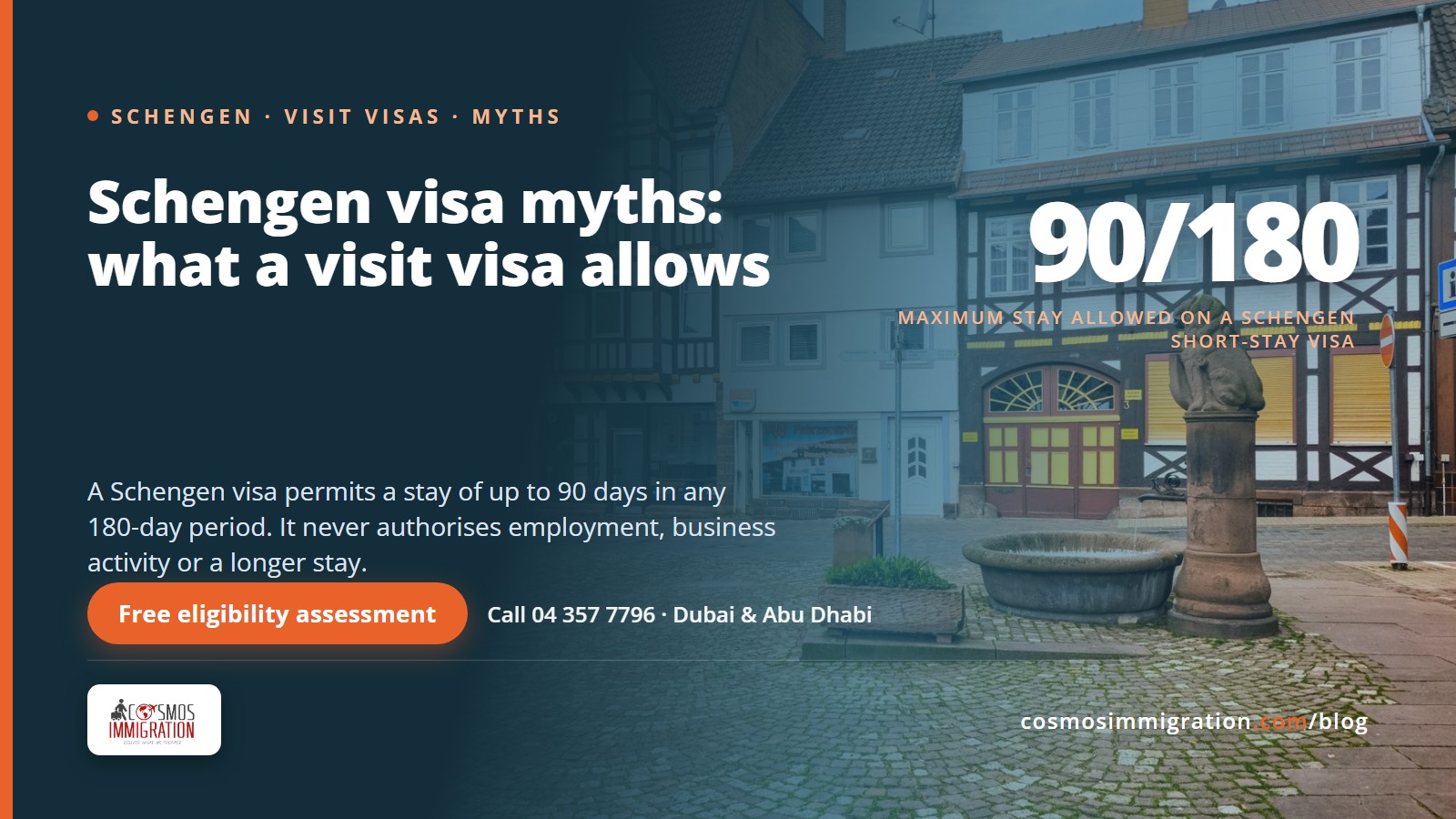
This is the one we hear most. The European Commission defines the Schengen visa as a “short stay visa”: a transit through, or an intended stay in, the Schengen States of no more than 90 days in any 180-day period.
The same FAQ then says, in plain words, that a Schengen visa is not appropriate if you wish to remain in a Schengen country for longer than 90 days, take up employment, or establish a business, trade or profession.
Germany’s Federal Foreign Office makes the same point: non-EU citizens holding a residence permit from another Schengen State may visit Germany for up to 90 days in any 180 days only “when not taking up work”.
If your goal is a job in Europe, the honest starting point is the national work visa of the country you want, not the visit visa you already hold. Our Schengen visa from Dubai page covers the short-stay visa itself, and our countries we serve page lists the work routes we handle.
Myth 2: “I have a business visa, so I can work”
“Business” on a Schengen visa does not mean employment. Spain’s Ministry of Foreign Affairs describes the purposes of a Schengen visa as tourism, business, visiting family, medical treatment, studies, training placements or volunteer activities lasting under three months, “or for other non-gainful activities”. The words to notice are “non-gainful”. Meetings and conferences fit. A salary does not.
The European Commission’s FAQ puts it more bluntly: the visa is not appropriate for taking up employment. It can get you into the room with an employer, not onto their payroll.
Myth 3: “I can convert it into a residence permit once I am there”
The European Commission’s visa policy page states that non-EU nationals need a visa for a visit of up to 90 days in any 180-day period, and that stays exceeding 90 days are subject to national procedures – a separate system from the short-stay visa.
What about simply extending the visit? The FAQ is specific. When applying for an extension you must show that force majeure, humanitarian reasons or serious personal reasons make it impossible to leave before the visa expires. As a rule, an extension is only possible if you have stayed less than 90 days in the past 180 and your visa has not yet expired. It is not a bridge to a job search.
Myth 4: “It’s 90 days per country”
People sometimes plan 90 days in Portugal followed by 90 days in Spain. That is not how it works. The European Commission’s FAQ defines “short stay” as a total of 90 days in any 180-day period, generally covering every Schengen State on the same trip. The 90 days are counted across the whole area.
The Schengen area covers 29 countries, including non-EU members Iceland, Liechtenstein, Norway and Switzerland. Days in Zurich and days in Oslo count towards the same 90.
Myth 5: “Overstaying a few days is fine”
On consequences, the Netherlands’ Immigration and Naturalisation Service (IND) sets out national rules on its entry-ban page. Overstaying is one of the situations that leads to a return decision and can result in an entry ban. The length depends on the situation: one year for an overstay of over 3 and up to 90 days, two years as the usual period where a person has not left after a return decision, ten years for a danger to public order, and twenty years for a danger to national security. The IND states that an alert for the ban is entered in an EU information system, and that being in the Netherlands during a ban is punishable by a prison sentence of up to 6 months or a fine of a few thousand euros. Those are Dutch national figures; other Schengen States apply their own laws.
On detection, the European Commission states that from 10 April 2026 the Entry/Exit System (EES) replaces passport stamping, recording entries, exits and refusals of entry digitally, including facial images and fingerprints, allowing the automatic detection of overstayers.
Myth 6: “EES and ETIAS are new visas”
Neither is a visa. EES is a border-recording system: the European Commission describes it as replacing passport stamps with digital records of entries, exits and refusals of entry, and it does not grant anyone permission to enter or work.
ETIAS is a pre-travel authorisation for travellers who do not need a visa at all. As at September 2026, the EU’s official travel portal states that ETIAS “is currently not in operation and no applications for travel authorisations are collected at this point”, and that the EU “will inform about the specific date for the start of ETIAS several months prior to its launch”.
The six myths side by side
| Myth | What the official page says | Source |
|---|---|---|
| A Schengen visa lets me look for work | Not appropriate for employment or establishing a business, trade or profession | European Commission FAQ |
| A business visa means I can work | Purposes are tourism, business, family visits, medical treatment, study, training or volunteering – “non-gainful activities” only | Spain Ministry of Foreign Affairs |
| I can convert it in-country | Stays over 90 days are subject to national procedures; extensions only for force majeure, humanitarian or serious personal reasons | European Commission visa policy page and FAQ |
| 90 days per country | Total stay is a maximum of 90 days in any 180 days across the Schengen States | European Commission FAQ |
| Overstaying a few days is fine | Overstay can lead to a return decision and entry ban; EES detects overstayers automatically from 10 April 2026 | IND Netherlands; European Commission EES page |
| EES or ETIAS is a visa | EES records border crossings; ETIAS is a travel authorisation for visa-exempt travellers and is currently not in operation | European Commission EES page; EU travel portal |
From the UAE: what this means for you
If you are reading this in Dubai or Abu Dhabi with a European job in mind, here are the national routes we work on most, each with one line from the official page.
- EU Blue Card. The European Commission states it lets highly-qualified non-EU workers live and work in a Member State, with the right qualifications and an employment contract or binding job offer of at least six months, paying at least the country’s average salary but no more than 1.6 times it. It applies in 25 of the 27 EU Member States, not Denmark or Ireland.
- Germany’s Opportunity Card (Chancenkarte). The Berlin state service portal describes it as a residence permit for seeking gainful employment or completing recognition of foreign qualifications. The job-search version permits up to 20 hours of work a week and two-week trial employment periods; self-employment is not allowed. See our Germany page for the routes we support.
- Netherlands highly skilled migrant. The IND states that to work in the Netherlands as a highly skilled migrant you need a residence permit, and only an employer recognised by the IND can apply for it on your behalf.
- France “passeport talent”. France-Visas states this multi-year residence permit was created to help foreign employees and self-employed persons develop France’s economic attractiveness. The employment contract and stay must exceed three months, and it allows a stay of up to four years from the date of arrival.
Each route has its own national procedure and evidence. Our how we work page explains the steps from assessment to filing.
The Schengen visa still has a role. It is the right document for the interview trip, the conference or the visit to family. Just keep it in its lane.
Frequently asked questions
Can I do my Dubai job remotely from a café in Europe on a Schengen visa?
The official wording does not support it. Spain’s Ministry of Foreign Affairs limits the Schengen visa to “non-gainful activities”, and its page for the long-stay non-lucrative residence visa states that even that visa “does not constitute a work permit and does not allow any type of work or professional activity, including remotely (online)”.
If my Schengen visa is refused, do I get the fee back?
No. The European Commission’s FAQ states that the visa fee is not refunded if the visa is refused, because it covers the cost of examining the application. You may appeal following the procedure of the Member State concerned, including where one country processed your application on behalf of another.
Does my Schengen visa cover Switzerland, Norway and Iceland?
Yes. The Schengen area covers 29 countries applying the same short-stay visa policy, and the European Commission’s list includes non-EU members Iceland, Liechtenstein, Norway and Switzerland. Days spent there count towards your 90 in 180.
What to do next
If a European job is the goal, start with a free eligibility assessment so we can match you to the right national route, not the visit visa in your passport. Call 04 357 7796 or book a 20-minute review at cosmosimmigration.com/contact. We will tell you honestly which routes are open to you. We never promise an outcome; decisions rest with the immigration authorities of each country.
Sources
- European Commission, Directorate-General for Migration and Home Affairs — Schengen visa FAQ (PDF) — accessed 13 Sep 2026
- European Commission — Visa policy — accessed 13 Sep 2026
- Spain Ministry of Foreign Affairs, European Union and Cooperation — Schengen Visas — accessed 13 Sep 2026
- Spain Ministry of Foreign Affairs, European Union and Cooperation — Non-Working (Non-Lucrative) Residence Visa — accessed 13 Sep 2026
- Federal Foreign Office of Germany — Visa FAQ — accessed 13 Sep 2026
- European Commission — Entry/Exit System (EES) — accessed 13 Sep 2026
- European Union official travel portal — ETIAS — accessed 13 Sep 2026
- Immigration and Naturalisation Service (IND), Netherlands — Entry ban — accessed 13 Sep 2026
- European Commission — EU Blue Card — accessed 13 Sep 2026
- Berlin.de Service Portal — Opportunity card (Chancenkarte) — accessed 13 Sep 2026
- Immigration and Naturalisation Service (IND), Netherlands — Highly skilled migrant — accessed 13 Sep 2026
- France-Visas — International talents and economic attractiveness — accessed 13 Sep 2026
Not sure which route fits you? Book a free eligibility assessment with our Dubai or Abu Dhabi team. No obligation.
Call +971 4 357 7796WhatsApp us