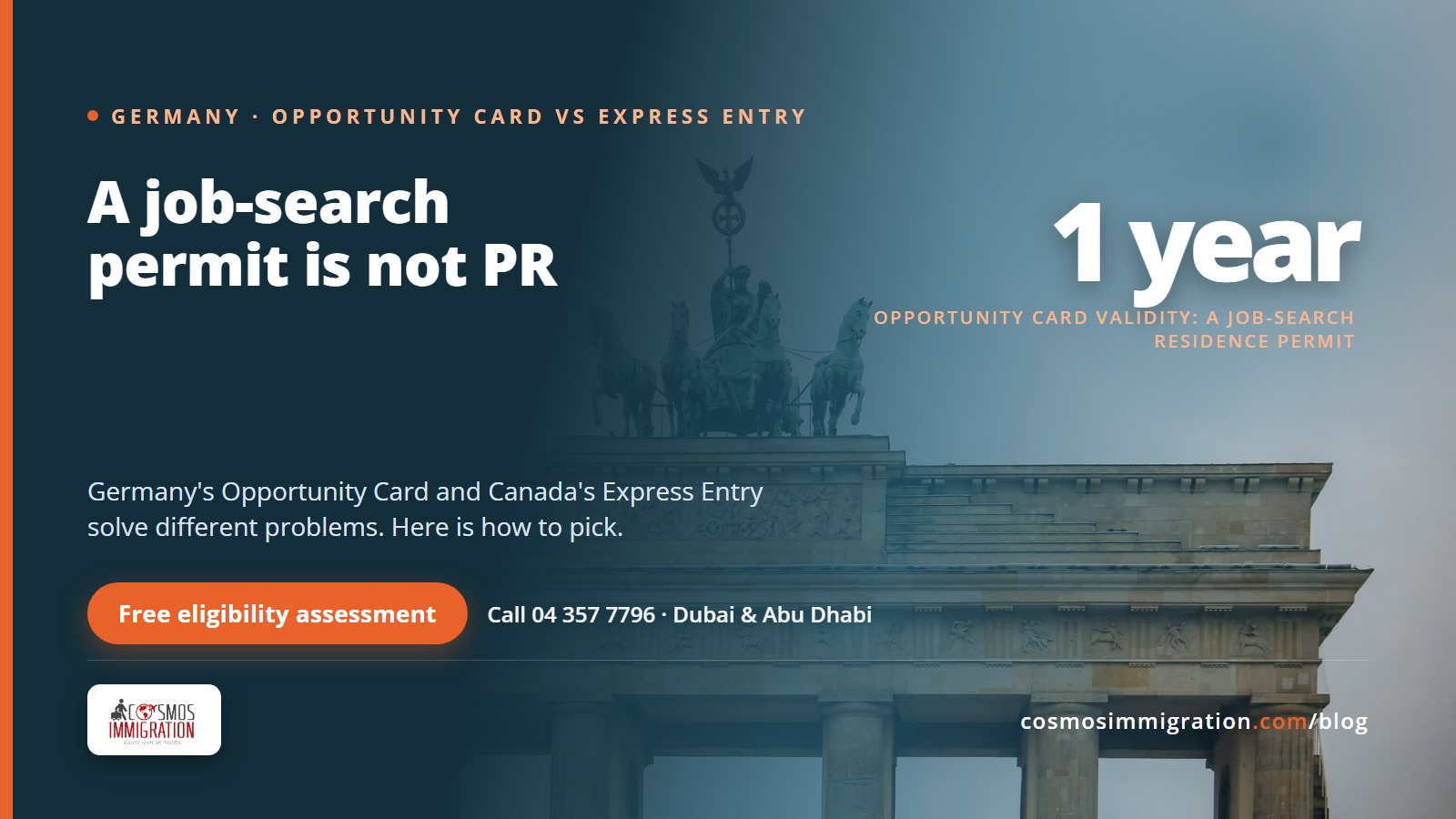
Germany’s Opportunity Card and Canada’s Express Entry often get mentioned in the same breath, as if they were two versions of the same thing. They are not. Under Section 20a of Germany’s Residence Act, the Opportunity Card is “a temporary residence permit granted for the purpose of seeking employment”. Express Entry, if you are invited and approved, ends in Canadian permanent residence. One gives you time to find a job. The other gives you status before you have one.
We see this mix-up every week in our Dubai office. Here are the two routes side by side, as at September 2026, using only official German and Canadian sources.
At a glance
- The Opportunity Card is a job-search residence permit for up to one year, not permanent residence.
- Express Entry leads to Canadian permanent residence, but you can only apply if you are invited.
- Germany asks for a qualification recognised in Germany or at least six points, plus funds (a blocked account of at least EUR 1,091 net per month, the 2026 figure).
- Canada’s Federal Skilled Worker Program asks for CLB 7, one year of continuous skilled work in the last 10 years, and 67 grid points.
- In Germany, permanent status comes later, through work. In Canada, it comes first.
How do the two routes compare side by side?
Germany gives you time to search in person; Canada ranks you in a pool and, if invited, lets you apply for permanent residence straight away.
| Germany Opportunity Card | Canada Express Entry (FSW) | |
|---|---|---|
| What you get | Temporary residence permit to look for work | Permanent residence, if invited and approved |
| Job offer needed? | No, finding one is the purpose | No; job offers no longer earn CRS points (since 25 March 2025) |
| Entry test | Recognised qualification, or at least 6 points | 67 points on the FSW grid, then ranked by CRS |
| Language | None for fully recognised qualifications; otherwise German A1 or English B2 | CLB 7 |
| Qualification check | anabin result or Statement of Comparability (degrees) | Educational Credential Assessment (ECA) |
| Funds | Blocked account of at least EUR 1,091 net per month (2026), or a declaration of commitment | Settlement funds; CAD 15,263 for one person as published by IRCC (table updated 7 July 2025) |
| Time limits | Card issued for up to one year | Profile expires after 12 months; an invitation is valid for 60 days |
Is the Opportunity Card a form of permanent residence?
No. It is a temporary permit to look for work, and permanent status in Germany is something you build afterwards.
This is the misconception we correct most often. The card is issued initially “for a maximum of one year”. During that year you can look for work, take part-time jobs totalling up to 20 hours a week, and do trial work of up to two weeks with each employer. It does not, on its own, lead to settlement.
Once you find a job, you apply to the local foreigners authority for a residence permit for work. If the job counts as qualified employment but you do not fit any other residence title, the card can be extended by up to two years. The law ties that follow-up card to an employment contract or binding job offer and consent from the Federal Employment Agency.
Permanence then runs through the job. EU Blue Card holders can obtain a settlement permit after 27 months with German at A1, or after 21 months with B1. Other skilled workers can apply after holding a skilled-worker residence title for three years, with 36 months of pension contributions and German at B1.
Think of the card as a visitor’s pass to the job market rather than a key to the house. It gets you into the room where hiring happens. What you do there decides the rest.
Two more points. The card is optional: Germany’s official portal says you can search for a job from your home country and, with an offer of qualified employment, apply for another type of visa. And the Residence Act lets the federal government limit how many cards are granted to people abroad. We have found no official page saying such a limit is in force as at September 2026.
How do you qualify for each?
Germany looks at recognition, points and funds; Canada sets a minimum threshold, then ranks you against everyone else in the pool.
Germany: two ways in
The first route: hold a vocational qualification or academic degree that is recognised in Germany. You do not need to prove language skills, although German is recommended if you want to find work.
The second route is the points system, where you need at least six points. You also need German at A1 or English at B2, and a qualification recognised in the country where you earned it (vocational training must have lasted at least two years). For a degree, a positive anabin result or a Statement of Comparability supports your application. Points are awarded as follows:
- Partial recognition of your foreign qualification in Germany: 4 points
- Qualification in a shortage occupation: 1 point
- Work experience: 2 points for at least two years in the last five, or 3 points for at least five years in the last seven
- German: 1 point at A2, 2 at B1, 3 at B2 or above; English at C1 or native speaker: 1 extra point
- Age: 2 points up to 35, 1 point between 35 and 40
- A legal stay in Germany of at least six continuous months in the last five years: 1 point (tourism and visits do not count)
- A partner who also meets the card’s requirements: 1 point
Our Opportunity Card page walks through how these fit together.
Canada: a threshold, then a ranking
Express Entry covers the Canadian Experience Class, the Federal Skilled Worker Program and the Federal Skilled Trades Program. For most people living in the UAE, the Federal Skilled Worker Program is the one to look at: CLB 7, one year of continuous skilled work in the last 10 years, and 67 points on its selection grid. A job offer is not required.
Those 67 points only get you into the pool. Your profile is then ranked by a separate Comprehensive Ranking System (CRS) score, and IRCC is clear that entering the pool does not mean you will be invited. A provincial nomination adds 600 CRS points, and French skills can add up to 50. Our Canada PR points calculator gives you a starting estimate.
How much money do you need to show?
Both countries want proof that you can support yourself, but they measure it differently.
For Germany, you show funds for the job search itself: a blocked bank account holding at least EUR 1,091 net per month (the 2026 figure), or a declaration of commitment. The amount is published as applicable in 2026, so expect it to change.
For Canada, Federal Skilled Worker and Federal Skilled Trades candidates show settlement funds. As published by IRCC, the figure for a single person is CAD 15,263, in a table last updated on 7 July 2025. IRCC updates this table each year, so check the live page before you prepare statements. Canadian Experience Class candidates, and those with a valid job offer and authorisation to work in Canada, are exempt.
Which should you choose?
It depends on whether you want status first or to be on the ground job-hunting first.
Lean towards Germany’s Opportunity Card if:
- Your degree or trade is already recognised in Germany, or you can reach six points.
- You are ready to move and search in person, with funds in place.
- You are willing to learn German, which adds points and is needed for settlement later.
- Your profession is non-regulated. Most in Germany are, so formal recognition is not needed to practise.
Lean towards Canada’s Express Entry if:
- You would rather hold permanent residence before you resign from your UAE job.
- You meet CLB 7 and can score well on the CRS, or could add points through French or a provincial nomination.
- You would rather stay in your current role while your profile sits in the pool.
Some people explore both, since each country wants your qualifications checked and your work history documented. Our Germany and Canada skilled migration pages cover each route in more detail.
From the UAE: what this means for you
Much of the early work is shared, and you can start it from Dubai or Abu Dhabi. Begin with qualifications. For Germany, check your degree’s anabin result or request a Statement of Comparability. For Canada, you need an Educational Credential Assessment from an IRCC-designated organisation. IRCC refuses applications made with an expired ECA, so watch its date.
Next, work history. Reference letters from former employers, especially ones back home, are often the slowest documents to collect. Ask for letters with clear dates and duties.
Then language: CLB 7 for Canada’s Federal Skilled Worker Program; German A1 or English B2 for Germany’s points route, with extra points for German at A2 and above.
Finally, money. For Germany, the blocked account or declaration of commitment is how you show funds during the visa process. For Canada, keep bank statements tidy and consistent. We cannot quote processing times: IRCC says they vary by program, and we found no official figure for German missions in the UAE.
Frequently asked questions
Can my partner help my Opportunity Card score?
Yes, in one specific way. If your partner also meets the requirements for an Opportunity Card, you receive one point. Wider family questions depend on your situation, so raise them in an assessment.
Does a job offer help my Express Entry ranking?
Not any more. Since 25 March 2025, job offers no longer earn CRS points. A valid job offer can still matter in other ways, such as the settlement funds exemption.
What to do next
If you are weighing Germany against Canada, start with a free eligibility assessment through our contact page, call us on 04 357 7796, or book a 20-minute review with our team in Dubai or Abu Dhabi. We will check your qualifications, language scores and funds against both sets of rules. Every decision rests with the German and Canadian authorities, and we never promise an outcome.
Sources
- Residence Act (AufenthG), official English translation — accessed 26 Sep 2026
- Make it in Germany: Opportunity Card — accessed 26 Sep 2026
- Make it in Germany: EU Blue Card — accessed 26 Sep 2026
- Make it in Germany: Settlement permit — accessed 26 Sep 2026
- Make it in Germany: Who needs recognition? — accessed 26 Sep 2026
- IRCC: Express Entry — accessed 26 Sep 2026
- IRCC: Submit an Express Entry profile — accessed 26 Sep 2026
- IRCC: How Express Entry works — accessed 26 Sep 2026
- IRCC: Federal Skilled Worker Program eligibility — accessed 26 Sep 2026
- IRCC: Comprehensive Ranking System criteria — accessed 26 Sep 2026
- IRCC: Educational credential assessment — accessed 26 Sep 2026
- IRCC: Proof of funds — accessed 26 Sep 2026
- IRCC: Apply for permanent residence through Express Entry — accessed 26 Sep 2026
Not sure which route fits you? Book a free eligibility assessment with our Dubai or Abu Dhabi team. No obligation.
Call +971 4 357 7796WhatsApp us