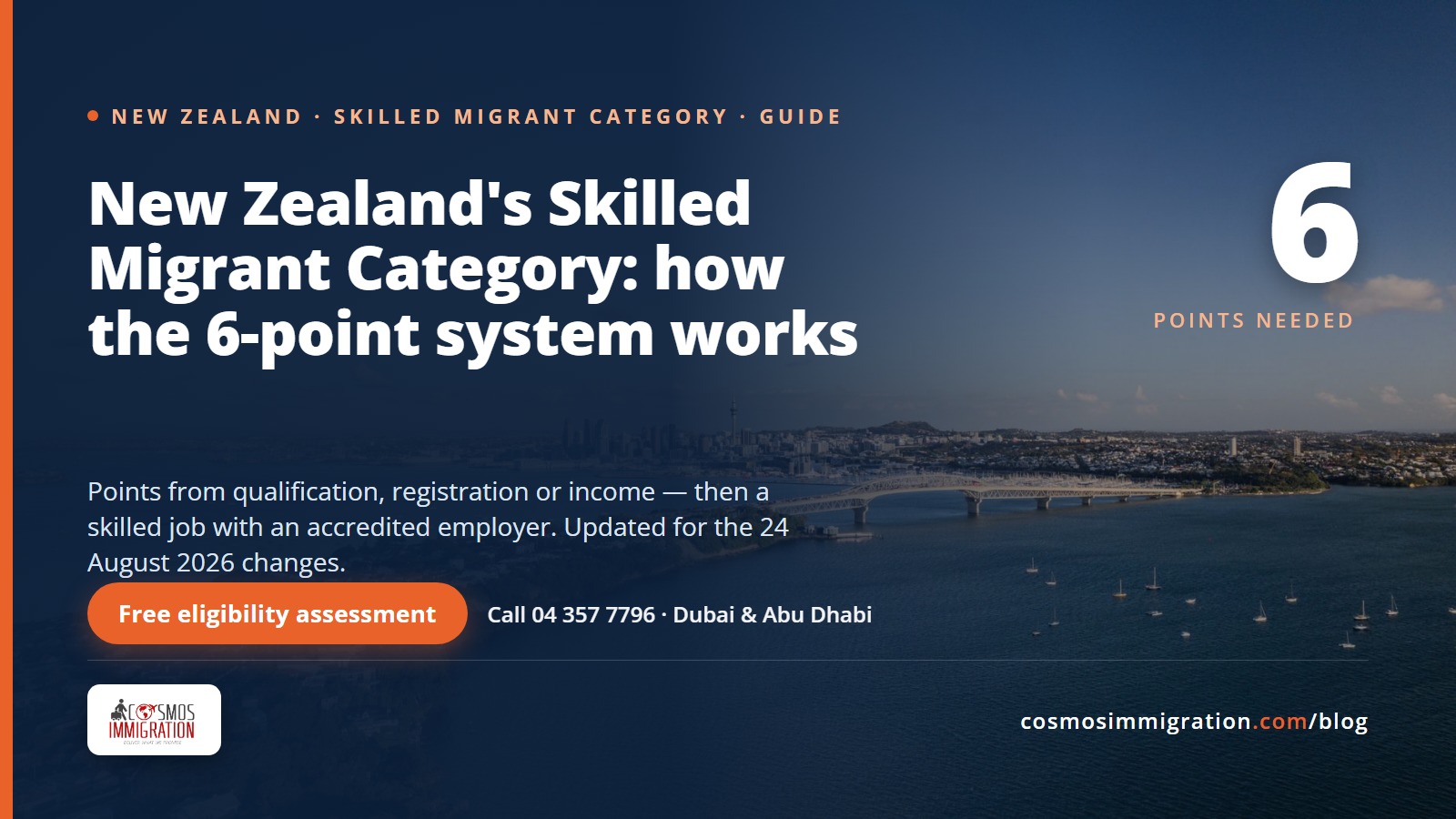
As at August 2026, New Zealand’s Skilled Migrant Category (SMC) awards residence on a 6-point scale, and the rules changed on 24 August 2026. Most of your points come from a single category, and you cannot lodge an expression of interest under any pathway until you hold a skilled job or job offer with an accredited employer. This guide sets out the system as Immigration New Zealand (INZ) publishes it today, including the two new pathways for people who do not hold a degree or a registration.
At a glance
- The Skilled Migrant Category (SMC) Resident Visa now has 3 pathways: Points-based, Skilled Work Experience, and Trades and Technician. You need only one.
- Points-based pathway: 6 points, with 3 to 6 from a single category (qualification, occupational registration or income) plus up to 3 from skilled work in New Zealand.
- Every pathway needs a skilled job or job offer with an accredited employer, at least 30 hours a week, and you must be aged 55 or younger.
- The SMC wage threshold is NZD $35.00 an hour (the 2025 median wage) from 9 March 2026; 1.5 times is $52.50, 2 times is $70.00, 3 times is $105.00.
- English: IELTS 6.5 overall (or equivalent) for the principal applicant, test no more than 2 years old, sat in person. Visa fee from NZD $6,450.
How the 6-point system works
You claim 3 to 6 points from one skill category. If that leaves you short, you add 1 to 3 points for skilled work experience in New Zealand. The categories cannot be combined, so a bachelor’s degree and a high salary do not stack; INZ counts whichever single category you nominate.
Qualification points
| Qualification level | Gained in New Zealand | Gained overseas |
|---|---|---|
| Level 10 doctoral degree | 6 | 6 |
| Level 9 master’s degree | 6 (30 weeks full-time in NZ plus a bachelor’s) or 5 | 5 (bachelor’s required) |
| Level 8 honours, postgraduate diploma or certificate | 5 (bachelor’s required) | 4 (bachelor’s required) |
| Level 7 bachelor’s degree | 5 | 4 |
An overseas qualification needs an International Qualification Assessment (IQA) from NZQA unless it appears on INZ’s exempt list. Since 24 August 2026 a bachelor’s degree is worth 4 points rather than 3, and level 8 and level 9 qualifications only score if a bachelor’s sits underneath them. Non-degree qualifications at level 7 or below earn no points.
Occupational registration points
If your registration is on INZ’s eligible list, the points depend on how much training or experience the registration itself requires: 6 points where 6 years are required, 5 for 5 years, 4 for 4 years, and 3 for 2 years. Only New Zealand work gained after registration can add extra points.
Income points
Income is measured against the SMC wage threshold, currently NZD $35.00 an hour. You get 6 points at 3 times the threshold ($105.00 an hour), 4 points at 2 times ($70.00) and 3 points at 1.5 times ($52.50). An annual salary is converted to an hourly rate using the hours you work.
Skilled work experience in New Zealand
You can claim 3 points for 2 years of skilled work in New Zealand, 2 points for 1.5 years, and 1 point for 1 year. The work must be full-time, at least 30 hours a week, and closely match your ANZSCO occupation. It must also be paid at least the threshold for ANZSCO skill level 1 to 3 jobs, or 1.5 times the threshold for level 4 to 5 jobs.
Four profiles reach 6 points without New Zealand work: a doctorate, a master’s with 30 weeks of full-time study in New Zealand in addition to a bachelor’s, a registration that requires 6 years of training, or pay at 3 times the threshold. Every other profile needs skilled work in New Zealand to make up the difference.
The job comes before the points
We often see the points worked out before the job requirement has been checked. An overseas master’s built on a bachelor’s shows 5 points on paper, and that figure is correct, but it cannot be used until there is a job or job offer from an employer on INZ’s accredited list.
Under every SMC pathway you must be working in, or hold an offer for, a skilled job with an accredited employer. The job must be at least 30 hours a week, permanent or fixed-term for at least 12 months (or contracts totalling at least 6 months), and paid according to the rule for your pathway. The job itself earns no points; it is a condition of applying. For most people the first practical step is therefore the job search, and the usual route into the country is an Accredited Employer Work Visa.
The SMC wage threshold, explained
INZ bases the threshold on the median wage and updates it each year. From 9 March 2026 it is NZD $35.00 an hour; between 18 August 2025 and 8 March 2026 it was $33.56. The threshold that applies to you is the one in place when you started gaining skilled work experience in New Zealand, and once set it does not change, even if the median wage rises before you apply. If you are claiming 6 points without New Zealand work experience, the threshold in place when you are invited to apply is the one used.
There is also a grace period. If you begin skilled work within 5 months of your work visa being granted, INZ uses the threshold that applied on the day the visa was granted.
The two new pathways from 24 August 2026
Skilled people without a degree or registration now have two routes into residence.
Skilled Work Experience pathway. You need a job or job offer in an ANZSCO skill level 1 to 3 occupation paid at least 1.1 times the threshold ($38.50 an hour), at least 3 years of relevant work experience, and an additional 2 years of skilled work in New Zealand. Amber List occupations need 5 years of relevant experience in New Zealand including 2 years at 1.2 times the threshold ($42.00). Red List occupations, retail manager and hairdresser among them, cannot use this pathway. Self-employment does not count.
Trades and Technician pathway. You need a job in an eligible trades or technician occupation paid at least the threshold, a relevant qualification at level 4 or higher (an IQA confirms this for overseas qualifications), at least 2.5 years of relevant post-qualification experience, and an additional 1.5 years of skilled work in New Zealand. INZ’s eligible list, which we counted at 109 ANZSCO codes on 27 August 2026, includes refrigeration mechanics, carpenters, diesel mechanics, fitters, welders and lift mechanics. Self-employment is excluded here as well.
Age, English, health and character
You must be 55 or younger when you apply. A partner and dependent children aged 24 or younger can be included. The principal applicant needs IELTS 6.5 overall, TOEFL iBT 79, PTE Academic 58, Cambridge B2 First 176, or OET grade C+ in all four skills. Partners and children aged 16 or older need IELTS 5 or equivalent, or you can pay for their English lessons in New Zealand instead. Tests must have been sat in person and be no more than 2 years old.
Everyone aged 15 or older needs a chest X-ray and medical examination less than 3 months old. Everyone aged 17 or older needs police certificates less than 6 months old from every country of citizenship and every country where they spent 12 months or more in the last 10 years.
SMC or the Green List: which route fits you?
Before working through the points, check whether your occupation is on INZ’s Green List. A large share of the enquiries we receive about SMC points turn out to involve a Green List role, and Tier 1 roles do not use the points system at all.
The Green List is INZ’s list of occupations New Zealand needs. A Tier 1 Green List job lets you apply for a Straight to Residence Visa with no expression of interest and no points, and the application can be made from outside New Zealand. Tier 2 roles lead to a Work to Residence Visa after 24 months of work in New Zealand. See our Green List guide and our New Zealand skilled migration page.
| SMC Points-based | Green List Tier 1 (Straight to Residence) | |
|---|---|---|
| Occupation list | Any skilled job with an accredited employer | Must be a Tier 1 Green List role |
| Points or EOI | 6 points, expression of interest first | None |
| New Zealand work needed | Usually, unless you hold 6 points outright | No, can apply from overseas |
| Age limit | 55 or younger | 55 or younger |
| Pay rule | SMC wage threshold, higher for income points | Rate set for the role, or $35.00 an hour |
From the UAE: what this means for you
Lodge the IQA early. A standard IQA costs NZ$445 and NZQA currently reports average wait times of 10 weeks, while INZ needs the IQA reference number in your expression of interest. Applying while you are still employed in the UAE means the assessment is ready before a job offer arrives rather than after it.
Start with the job: target employers on INZ’s accredited list and expect a work visa before residence. Sit IELTS or PTE Academic in person at a test centre in Dubai or Abu Dhabi, because “at home” versions are not accepted. Police certificates from the UAE and your home country must be less than 6 months old when you apply, so time them for the residence application rather than the job search.
A realistic timeline runs as follows: a job search of several months, a work visa, then 1 to 2 years of skilled work in New Zealand before most degree holders reach 6 points. More on our New Zealand immigration page.
Frequently asked questions
Can I apply for the SMC from Dubai without a job offer?
No. Every SMC pathway requires a skilled job or job offer with an accredited employer when you submit your expression of interest.
Does my Indian or Pakistani bachelor’s degree score points?
If NZQA’s IQA places it at level 7, it is worth 4 points, so you need 1.5 years of skilled work in New Zealand to reach 6. A recognised master’s is worth 5 points and needs 1 year.
How much does the SMC Resident Visa cost?
INZ lists the fee as from NZD $6,450, depending on where you apply from. The expression of interest is free, and once invited you have 4 months to lodge the application.
What to do next
To find out which pathway your profile fits, request a free eligibility assessment, call us on 04 357 7796, or book a 20-minute review through our contact page. We do not promise outcomes; Immigration New Zealand decides every application on its own evidence.
Sources
- Skilled Migrant Category Resident Visa — Immigration New Zealand — accessed 27 Aug 2026
- Getting New Zealand residence through the Skilled Migrant Category (SMC) — Immigration New Zealand — accessed 27 Aug 2026
- Pay rates for the Skilled Migrant Category Resident Visa — Immigration New Zealand — accessed 27 Aug 2026
- Further changes to the Skilled Migrant Category to come into effect on 24 August 2026 — Immigration New Zealand — accessed 27 Aug 2026
- Final details about changes to the Skilled Migrant Category Resident Visa and work to residence visas — Immigration New Zealand — accessed 27 Aug 2026
- Eligible occupations for the SMC Trades and Technician pathway — Immigration New Zealand — accessed 27 Aug 2026
- English language requirements for skilled residence visas — Immigration New Zealand — accessed 27 Aug 2026
- Straight to Residence Visa — Immigration New Zealand — accessed 27 Aug 2026
- Green List pathway to residence — Immigration New Zealand — accessed 27 Aug 2026
- Qualification evaluation fees — NZQA — accessed 27 Aug 2026
- Apply for an International Qualification Assessment — NZQA — accessed 27 Aug 2026
Cover photo: Ollie Craig via Pexels
Not sure which route fits you? Book a free eligibility assessment with our Dubai or Abu Dhabi team. No obligation.
Call +971 4 357 7796WhatsApp us