The first year in Auckland or Wellington usually goes the same way. You find a flat, you settle into the job, and around the second winter you start counting the months since you last sat at your parents’ table in Sharjah or Kochi. That is when the question changes from “how do I get to New Zealand” to “how do I bring the people I left behind”. This guide walks through the partner and parent routes as at September 2026, using only what Immigration New Zealand publishes.
At a glance
- Partner of a New Zealander Resident Visa: at least 12 months living together in a genuine and stable relationship, 80% decided within 7 months.
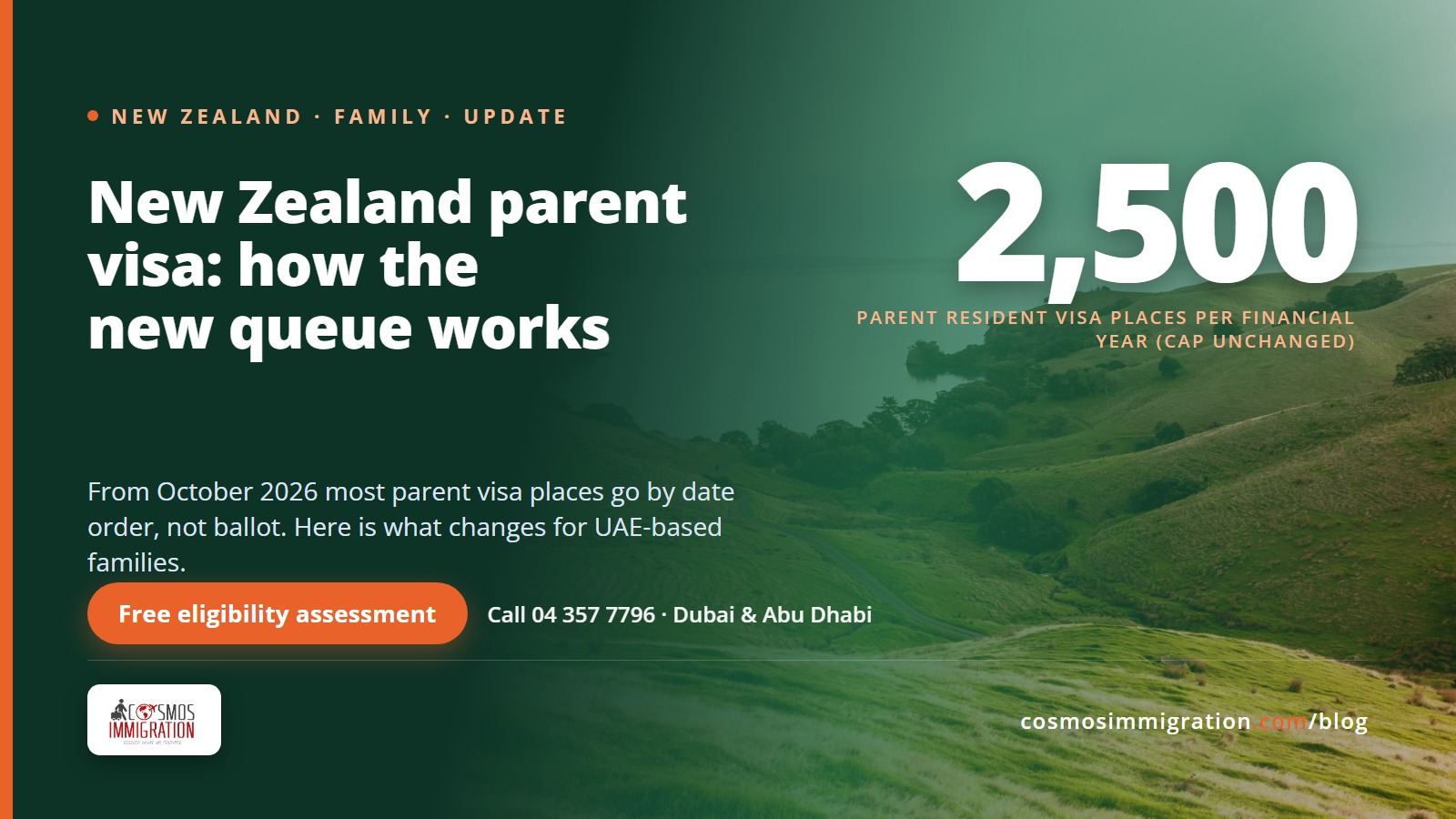
- Parent Resident Visa: capped at 2,500 visas per financial year. From 5 October 2026 about 90% of expressions of interest are selected in date order and about 10% by ballot.
- Sponsoring a parent needs at least 3 years as a New Zealand resident and income of 1.5 times the median wage for one parent: NZD $109,200 for a single sponsor as of 30 April 2026.
- Parent Boost Visitor Visa: temporary, up to 5 years multi-entry, no pathway to residence.
- Parent and Grandparent Visitor Visa: up to 6 months at a time, 80% processed within 3 months.
Start with your own status in New Zealand
Every family route below hangs off your own position. A partner can only be sponsored by a New Zealand citizen or resident. A parent can only be sponsored by a citizen or resident who has held residence for at least 3 years.
If you are still in Dubai or Abu Dhabi planning the move, read our New Zealand immigration overview and the guide on moving to New Zealand from Dubai first. The New Zealand points calculator shows where your own skilled application stands before you think about who follows you.
Partner of a New Zealander Resident Visa
This is the route for a husband, wife or de facto partner of a New Zealand citizen or resident. The core requirement is simple to state and hard to prove: you must be living with your partner in a genuine and stable relationship for at least 12 months when you apply. You also need to be in good health and of good character, and your partner supports the application through the Partnership Support Form for Residence, form INZ 1178.
Immigration New Zealand states that 80% of applications are decided within 7 months, as displayed on the official visa page on 13 September 2026.
What the visa gives you
Once granted, the holder can live, work and study in New Zealand indefinitely. Dependent children aged 24 or younger can be included in the application. After holding the resident visa for at least 2 years in a row, the holder can apply for a Permanent Resident Visa.
The sponsorship limit people miss
A New Zealand partner must not have acted as the partner in an approved resident visa application within the past 5 years, or in more than 1 approved resident visa application at all. Immigration New Zealand notes this is a common reason genuine applications are declined when overlooked. For partner routes in other countries, see our spouse and partner visa page.
Parent Resident Visa: the cap and the new selection model
The Parent Resident Visa is a 2-stage process. Your parent first submits an expression of interest, known as an EOI. Only after Immigration New Zealand issues an invitation to apply, an ITA, can a residence application be lodged, and it must be lodged within 4 months of the ITA being issued. The category is open as at 13 September 2026, but it is capped and mid-transition.
The cap
From 1 July 2025 the annual limit is 2,500 approvals in principle per year ended 30 June, resetting each 1 July. In the 2025/26 financial year Immigration New Zealand approved exactly 2,500 Parent Resident Visas: 2,103 from the ballot pool and 483 from the queued pool. The cap is unchanged by the changes described next.
What changes on 5 October 2026
On 8 August 2026 Immigration New Zealand announced a hybrid selection model taking effect from 5 October 2026. Approximately 90% of EOIs will be selected in chronological date order from the queue, and around 10% by ballot. The Immigration Minister confirmed the same split and the 2,500 cap in an official government statement.
The last selection under the old settings ran on 11 August 2026. The first selection under the new model is scheduled for 10 November 2026. Existing EOI holders transition automatically, do not need to reapply, and will be told their position in the new chronological queue in October 2026.
A second change removes an old irritation. EOIs will no longer expire after 2 years. Applicants instead confirm every 2 years that they wish to remain in the pool, with no additional fee.
Sponsor requirements for a parent
This is where most UAE families stall, so we will be plain. Sponsors must be New Zealand citizens or residents who have been residents for at least 3 years. They must also meet a minimum income test in 2 of the 3 years before the parent’s EOI was selected.
The threshold is pegged to the New Zealand median wage. It starts at 1.5 times the median wage for 1 parent and rises by half the median wage for each additional parent. As of 30 April 2026 the median wage used is NZD $72,800, which puts the threshold at NZD $109,200 for one sponsor supporting one parent.
Two joint sponsors, for example you and your partner, start at 2 times the median wage: NZD $145,600 for 1 parent as of 30 April 2026. A joint-sponsor couple must also show they have lived together for at least 12 months. Immigration New Zealand updates the median wage each year, so check the current figure first.
Temporary options while you wait
Immigration New Zealand describes 2 visa options for parents: the Parent Resident Visa and the Parent Boost Visitor Visa. A shorter visitor visa sits on its own page. Here is how the family routes compare.
| Visa | Who it is for | Key requirement, as Immigration New Zealand states it |
|---|---|---|
| Partner of a New Zealander Resident Visa | Partner of a New Zealand citizen or resident | Living together in a genuine and stable relationship for at least 12 months; 80% decided within 7 months |
| Parent Resident Visa | Parent of a New Zealand citizen or resident | EOI then ITA; sponsor resident for at least 3 years with income of 1.5 times the median wage for 1 parent; 2,500 places per financial year |
| Parent Boost Visitor Visa | Parent wanting a long temporary stay | Up to 5 years multi-entry; around 4 months processing; no pathway to residence |
| Parent and Grandparent Visitor Visa | Parent or grandparent for short visits | Up to 6 months at a time, 18 months total in any 3-year period; 80% processed within 3 months |
Parent Boost Visitor Visa
This temporary visa lets a parent visit New Zealand for up to 5 years on a multi-entry basis. Immigration New Zealand shows an expected processing time of around 4 months. Immigration New Zealand is explicit that it does not give a pathway to a resident visa. A parent can hold a maximum of 2 Parent Boost Visitor Visas in total, and must leave New Zealand during the third year of the visa for a health and insurance check.
The money test can be met three ways. On personal income, the parent must earn at least NZD $33,663.24 a year alone, or NZD $51,182.56 a year if including a partner. Alternatively, the parent can show personal funds of at least NZD $170,000, or NZD $260,000 including a partner, held in a bank account and not gifted, borrowed or encumbered by debt. The third route is a sponsor who meets the sponsor income test. The sponsoring child must normally live in New Zealand and spend at least 184 days there in each year the parent holds the visa.
Parent and Grandparent Visitor Visa
For shorter visits, the figures are in the table above. The applicant must not have been granted this visa in the past 36 months and must be outside New Zealand to apply.
From the UAE: what this means for you
The partner visa rests on evidence of living together. In our Dubai and Abu Dhabi offices the paper trail is usually easy to assemble if you start early: a tenancy contract with both names, a joint bank account, utility bills, and flight history. Couples who kept everything in one name, as many do in the UAE, find this harder. Start building shared records now.
For parents, the practical work is on your side of the ledger. The sponsor income test looks at 2 of the 3 years before the EOI is selected, and the median wage figure moves each year. Keep your New Zealand payslips and tax records organised from the day you land.
For the Parent Boost route, the funds must sit in the parent’s own name and cannot be gifted or borrowed. Moving money from the adult child’s account at the last minute does not change its origin, so plan this honestly and early.
Frequently asked questions
Do I need to be a citizen to sponsor my partner or parents?
No. Your partner must be a New Zealand citizen or resident. For the Parent Resident Visa, sponsors must be citizens or residents who have been residents for at least 3 years and meet the income test.
Will my parents’ existing EOI be lost when the rules change on 5 October 2026?
No. Existing EOI holders transition automatically and do not need to reapply. They will be told their position in the new chronological queue in October 2026.
Can my parents use the Parent Boost Visitor Visa as a step towards residence?
No. Immigration New Zealand states it is a temporary visa that does not give a pathway to a resident visa. It is a way to spend time together while a separate Parent Resident Visa EOI sits in the pool.
What to do next
If you are planning to bring a partner or parents to New Zealand, start with a free eligibility assessment covering your own status, the sponsor income position and the relationship evidence. Call us on 04 357 7796, or book a 20-minute review through our contact page. We do not promise outcomes; every decision rests with Immigration New Zealand.
Sources
- Immigration New Zealand: Partner of a New Zealander Resident Visa — accessed 13 Sep 2026
- Immigration New Zealand News Centre: Changes to the Parent Resident Visa Category — accessed 13 Sep 2026
- The Beehive: Fairer Parent Resident Visa process delivered — accessed 13 Sep 2026
- Immigration New Zealand News Centre: Overview of parent visas and application numbers — accessed 13 Sep 2026
- Immigration New Zealand: Parent Resident Visa sponsor income requirements — accessed 13 Sep 2026
- Immigration New Zealand: Parent Boost Visitor Visa — accessed 13 Sep 2026
- Immigration New Zealand: Parent and Grandparent Visitor Visa — accessed 13 Sep 2026
Not sure which route fits you? Book a free eligibility assessment with our Dubai or Abu Dhabi team. No obligation.
Call +971 4 357 7796WhatsApp us