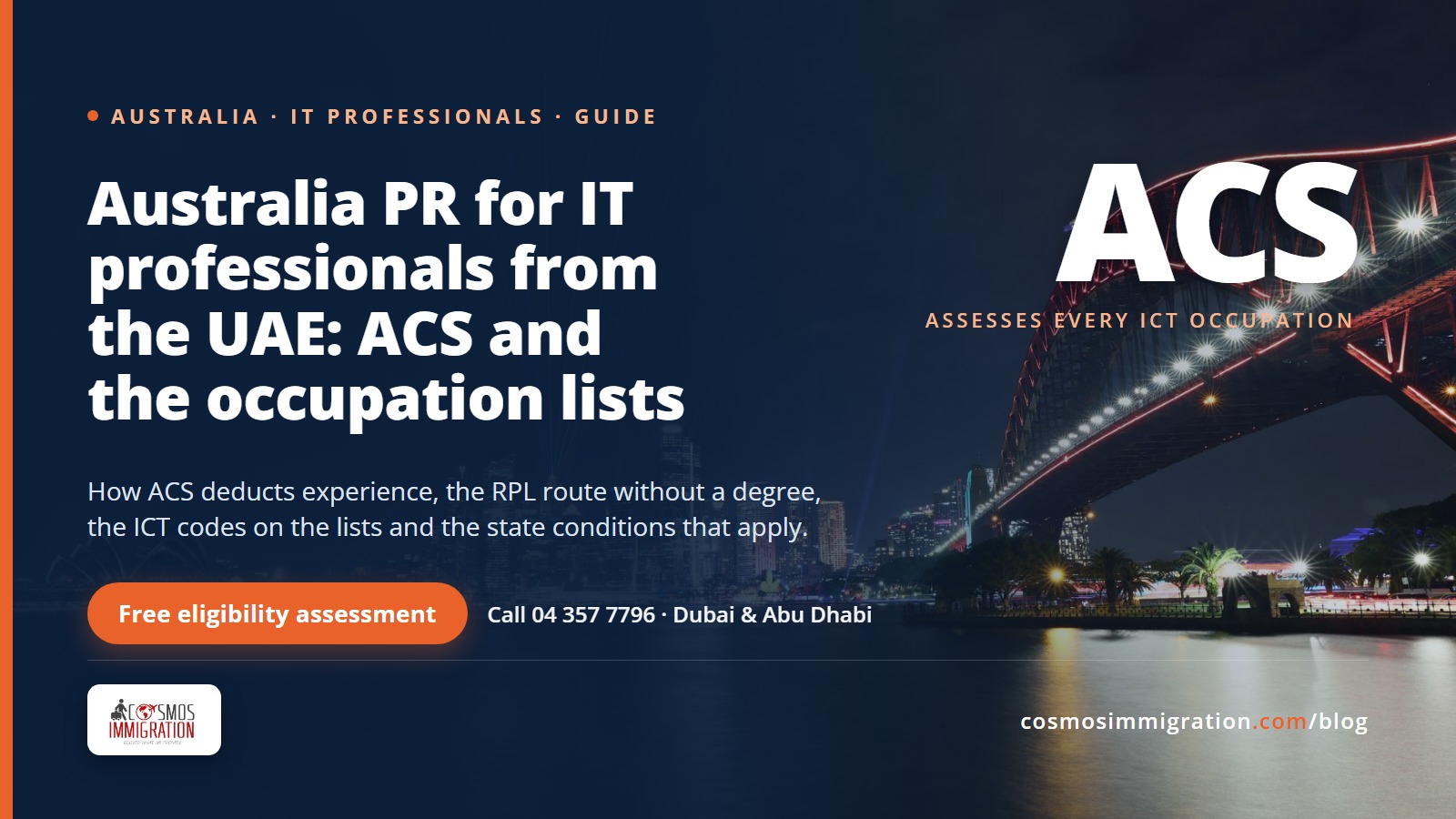
If you work in software, data, networks or cyber security in the UAE and want Australian permanent residence, the Australian Computer Society (ACS) assessment comes first. Its outcome sets how many of your years count for the 189, 190 and 491 points test. The timing matters because the June 2026 subclass 189 round listed no software, programming, analyst, database or network occupation, and the states that nominate ICT workers are between program years. The workable plan for late 2026 is a clean ACS outcome paired with a state or employer strategy.
At a glance
- ACS assesses IT, data science and cyber security occupations. General Skills fee $1,498, RPL fee $625 (ACS fee table, excluding GST, from 3 November 2025).
- ICT-major bachelor’s, closely related occupation: 2 years of work in the last 10 (or 4 any time) set your skill date; ICT minor: 5 in the last 10 (or 6 any time). Those years do not count as skilled employment.
- No ICT degree: the RPL pathway needs 6 years of relevant IT work and two project reports.
- A single 29-year-old developer with a bachelor’s and 6 years scores 60 points with competent English, 70 proficient, 80 superior, before nomination.
- Employer route: 28 ICT occupations sit on the Core Skills Occupation List for the 482 and 186 visas; the 2026-27 income floor is AUD 79,423.
What ACS decides, and what it deducts
ACS grades your qualification for AQF comparability and ICT content (major, minor or insufficient), then checks whether your employment is closely related to the nominated ANZSCO code. You can nominate up to three codes in one application.
Every suitable letter carries a Skill Level Requirement Met Date. Only work after that date counts as skilled employment for points; the work used to reach it is deducted. ACS’s own example: an IT-major bachelor’s completed 31 January 2014 plus 4 years of relevant work gives a skill date of 31 January 2016, leaving 2 countable years. The ACS General Skills table as at August 2026:
| Qualification (AQF comparable) | ICT content | Relevance to nominated code | Relevant work needed before the skill date |
|---|---|---|---|
| Bachelor’s or higher | ICT major | Closely related | 2 years in the last 10, or 4 years any time |
| Bachelor’s or higher | ICT major | Not closely related | 4 years any time |
| Bachelor’s or higher | ICT minor | Closely related | 5 years in the last 10, or 6 years any time |
| Bachelor’s or higher | ICT minor | Not closely related | 6 years any time |
| Diploma, advanced diploma or associate degree | ICT major | Closely related | 5 years in the last 10, or 6 years any time |
| Diploma, advanced diploma or associate degree | ICT major | Not closely related | 6 years any time |
Relevant work means professional ICT employment of at least 20 hours a week from age 18, and the 10-year window counts back from the date you submit online. ACS allows 4 to 6 weeks for a complete application, and a suitable outcome is valid for 2 years.
No ICT degree: the RPL pathway
RPL does not assess any tertiary qualification. You need 6 years of relevant IT work with the most recent role active or ended within the last 2 years, two project reports on the ACS RPL form (one from the last 2 years, one from the last 4) and at least two pieces of evidence of current professional skills. ACS screens the reports for plagiarism. Our skills assessment guide covers which body assesses which occupation.
Which ICT occupations are on which list
Home Affairs runs two occupation frameworks. The points-tested 189, 190 and 491 use the lists in legislative instrument LIN 19/051, benchmarked to ANZSCO 2013. The 482 Core Skills stream and 186 Direct Entry use the Core Skills Occupation List (CSOL), benchmarked to ANZSCO 2022. Check your six-digit code on the Home Affairs combined list before lodging with ACS.
The CSOL includes 28 ICT occupations, among them 135112 ICT Project Manager, 261111 ICT Business Analyst, 261312 Developer Programmer, 261313 Software Engineer, 261314 Software Tester, 261316 DevOps Engineer, 262111 Database Administrator, 262116 Cyber Security Analyst and 263111 Computer Network and Systems Engineer.
State lists are narrower. NSW’s lists for the 190 and 491 name unit groups 1351 (ICT Managers), 2611 (ICT Business and Systems Analysts), 2613 (Software and Applications Programmers), 2621 (Database and Systems Administrators, and ICT Security Specialists) and 2631 (Computer Network Professionals), and warn that not every occupation inside a unit group is eligible. Queensland’s offshore list for 2025-26 carried one ICT occupation, 262112 ICT Security Specialist.
189, 190 or 491: where an ICT applicant stands in 2026
All three visas require you to be under 45 at invitation, at least 65 points, at least competent English at invitation, and a skills assessment obtained within the 3 years before invitation (or the assessing body’s shorter validity, 2 years for ACS). Once invited you have 60 days to lodge. See our 189 vs 190 vs 491 comparison and Australia skilled migration page.
The 189 is invitation-only. The current round (4 June 2026) issued 10,000 invitations with a tie-break date of 24 April 2026. Its by-occupation results list 140 occupations with minimum invited scores; no software, programming, analyst, database or network occupation appears, and the only ICT-related entries are Multimedia Specialist, Telecommunications Engineer and Telecommunications Network Engineer, each at 95 points. Home Affairs notes a missing occupation can mean no EOIs were available or none met the round’s parameters.
The 190 adds 5 points and the 491 adds 15 through state nomination, and each state sets its own conditions:
- NSW: offshore applicants must have lived offshore continuously for at least 6 months (190) or 3 months (491). NSW ranks EOIs within each unit group on age, English, education, points and skilled experience, with no published round dates. As at August 2026, current-year 190 nominations are closed and next year’s settings are under review.
- Victoria: offshore applicants are eligible for the 190 with no minimum work experience. You must be under 45, hold competent English with at least 12 weeks’ validity left at nomination, and have 65 points including the nomination points. The 2026-27 program is not yet open.
- Queensland: offshore candidates need 65 points, competent English, at least 1 year of skilled employment in the nominated or a closely related occupation, and a commitment to regional Queensland for 3 years after a 491 grant or to Queensland for 2 years after a 190 grant. Registrations of interest for 2025-26 are closed.
In our Dubai and Abu Dhabi offices we treat state nomination as the main ICT route and lodge EOIs early so they are live the day a state reopens.
Points for a 29-year-old developer with a bachelor’s and 6 years
Take a 29-year-old with a bachelor’s degree (ICT major, closely related to 261312 Developer Programmer), 6 years of full-time work in the UAE and no partner claims. Using the Home Affairs points table last updated 11 June 2026:
| Item | Basis | Points |
|---|---|---|
| Age | 25 to under 33 | 30 |
| Education | Bachelor’s degree of a recognised standard | 15 |
| Overseas skilled employment | 6 years minus 2 deducted by ACS = 4 years (at least 3 but less than 5) | 5 |
| Partner | Single, or partner is an Australian citizen or permanent resident | 10 |
| English | Competent 0 / Proficient 10 / Superior 20 | 0 to 20 |
| Subtotal | Before any nomination | 60 / 70 / 80 |
| Nomination | 190 adds 5; 491 adds 15 | 65 to 95 |
English is the largest lever. Proficient means IELTS 7 in every component or PTE Academic 58 listening, 59 reading, 69 writing and 76 speaking; superior means IELTS 8 in every component or PTE 69, 70, 85 and 88. Time is the other: at 8 counted years the overseas employment points rise to 15. A partner with competent English gives 5 points; one who also meets the age requirement and holds a skills assessment gives 10. Model your case with the Australia points calculator and the points test explainer.
The employer route for tech workers
A sponsoring employer removes the wait for invitation rounds. The Skills in Demand visa (subclass 482) Core Skills stream needs a nomination in a CSOL occupation, at least 1 year of relevant experience in the last 5 years, the required English level, and pay at the Annual Market Salary Rate and no less than the Core Skills Income Threshold, AUD 79,423 for nominations lodged between 1 July 2026 and 30 June 2027. The visa runs up to 4 years.
The Employer Nomination Scheme (subclass 186) then gives permanent residence. Direct Entry requires a CSOL occupation, a positive skills assessment issued within the 3 years before lodgement, at least 3 years of relevant experience, competent English and age under 45 at lodgement unless exempt. The Temporary Residence Transition stream needs 2 years of eligible sponsored employment on a 482 or 457 visa in the 3 years before applying. Our subclass 186 guide covers both streams.
From the UAE: what this means for you
The ACS application is lodged online; the strict part is the employment file. Each reference must be on company letterhead, signed and dated by an authorised person, and state start and end dates in DD/MM/YYYY format, employment status, hours per week, annual salary, work location, position title, bullet-point duties and the signatory’s contact details. If you worked through a recruitment agency, the letter must come from the host company. If no reference can be obtained, ACS requires a statutory declaration.
Payment evidence is the usual gap. For each employer ACS wants two different types of evidence from the start of the role and two from the end, at least one from a source other than the employer: bank statements showing salary from the employer, payslips, or employment-linked insurance or provident fund documents. Cash salary cannot be evidenced, and Arabic-only documents need a translation. We see UAE files stall here more than on the degree, so collect bank statements first.
Home Affairs does not accept English tests taken fully online, so sit IELTS or PTE Academic at a test centre; tests from 7 August 2025 onward are scored under the current thresholds. An ACS outcome lasts 2 years and Victoria wants at least 12 weeks left on the English result at nomination, so time the test to be valid when a state reopens.
Frequently asked questions
My degree is in electronics or mechanical engineering. Can ACS still assess me?
Yes, but the outcome depends on how much ICT content ACS finds in your course units. ICT-minor content means 5 or 6 years of relevant work sit before the skill date; insufficient content means the RPL pathway. Nothing before the skill date counts for points.
Can I claim all 6 years in my EOI and let Home Affairs sort it out?
No. Employment points apply only to work in the nominated or a closely related occupation after the assessing authority’s skill date. A 190 invitation may state a higher score that must be met at assessment, and NSW requires evidence for every period of employment claimed.
I have 15 years’ experience and I’m 42. Is there still a path?
The points-tested visas require you to be under 45 at invitation, and 186 Direct Entry requires under 45 at lodgement unless exempt. At 40 to 44 you score 15 age points and up to 15 for 8 or more years of overseas employment, so superior English with a state or employer nomination is the realistic combination.
What to do next
Start with a free eligibility assessment so we can map your degree and job history against ACS’s rules and give you a points figure you can plan around. Call 04 357 7796, book a 20-minute review, or send your CV through our contact page. You can check our consultants’ MARA registrations on the verify credentials page and see the wider Australia options. We do not promise outcomes; Home Affairs and the states decide invitations and nominations.
Sources
- ACS General Skills Assessment Pathway — accessed 27 Aug 2026
- ACS Recognition of Prior Learning Assessment Pathway — accessed 27 Aug 2026
- ACS InfoHub: Skill Level Requirement Met Date — accessed 27 Aug 2026
- ACS Fees and payment — accessed 27 Aug 2026
- ACS Information for applicants — accessed 27 Aug 2026
- ACS InfoHub: Assessment process — accessed 27 Aug 2026
- ACS InfoHub: Employment references — accessed 27 Aug 2026
- ACS InfoHub: Payment evidence — accessed 27 Aug 2026
- ACS Occupations and ANZSCO codes — accessed 27 Aug 2026
- Home Affairs: Skilled occupation list — accessed 27 Aug 2026
- Home Affairs: The Core Skills Occupation List (PDF) — accessed 27 Aug 2026
- Home Affairs: Skilled Independent visa (subclass 189) Points-tested stream — accessed 27 Aug 2026
- Home Affairs: Points table for subclass 189 — accessed 27 Aug 2026
- Home Affairs: Skilled Nominated visa (subclass 190) — accessed 27 Aug 2026
- Home Affairs: Skilled Work Regional (Provisional) visa (subclass 491) — accessed 27 Aug 2026
- Home Affairs: SkillSelect invitation rounds — accessed 27 Aug 2026
- Home Affairs: Skills in Demand visa (subclass 482) Core Skills stream — accessed 27 Aug 2026
- Home Affairs: Employer Nomination Scheme (subclass 186) Direct Entry stream — accessed 27 Aug 2026
- Home Affairs: Employer Nomination Scheme (subclass 186) Temporary Residence Transition stream — accessed 27 Aug 2026
- Home Affairs: Salary requirements (CSIT) — accessed 27 Aug 2026
- Home Affairs: English language requirements — accessed 27 Aug 2026
- Home Affairs: Proficient English — accessed 27 Aug 2026
- Home Affairs: Superior English — accessed 27 Aug 2026
- NSW Government: NSW skills lists — accessed 27 Aug 2026
- NSW Government: Skilled Nominated visa (subclass 190) — accessed 27 Aug 2026
- NSW Government: Common questions about skilled visas — accessed 27 Aug 2026
- Live in Melbourne (Victorian Government): Skilled Nominated visa (subclass 190) — accessed 27 Aug 2026
- Migration Queensland: Skilled workers living offshore — accessed 27 Aug 2026
- Migration Queensland: Queensland offshore skilled occupation list — accessed 27 Aug 2026
Cover photo: Horace Young via Pexels
Not sure which route fits you? Book a free eligibility assessment with our Dubai or Abu Dhabi team. No obligation.
Call +971 4 357 7796WhatsApp us