If you are an engineer living in the UAE and want Australian permanent residence through the 189, 190 or 491 visa, two things sit at the centre of the process: a skills assessment from Engineers Australia, and a Department of Home Affairs points score of at least 65. Engineers Australia updated its fee page for 2026 to 2027 on 2 July 2026 and applies specific English minimums to applications submitted from 1 January 2026, so figures copied from earlier years will mislead you. This guide sets out the position as at August 2026 from the official pages only.
At a glance
- Engineers Australia assesses engineers for the 189, 190 and 491 visas. Accord-accredited degrees use a document pathway; everyone else writes a Competency Demonstration Report (CDR).
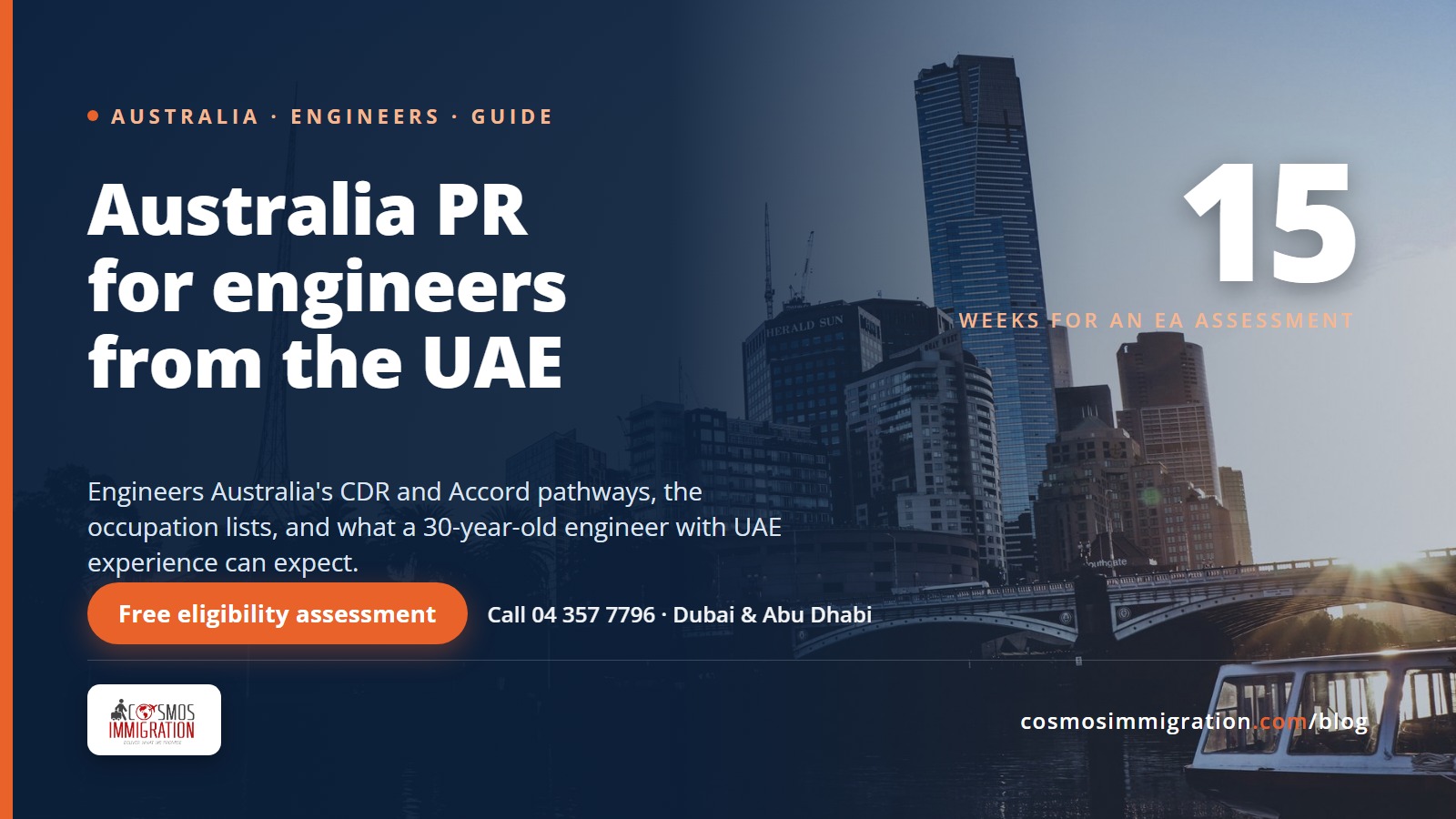
- 2026 to 2027 fees: AUD 555.50 (Accord) or AUD 1,034 (CDR) including GST. Standard applications generally take 15 weeks to be assigned to an assessor, which is not the time to an outcome.
- Civil, Structural, Mechanical, Electrical, Chemical, Mining, Petroleum and most other professional engineering codes are on the MLTSSL, open to all three visas.
- A 30-year-old engineer with a bachelor degree and 8 years of UAE experience scores 60 points with IELTS 6 in each band, 70 with IELTS 7, 80 with IELTS 8.
- Queensland and Victoria register engineers under state law, a work requirement after arrival rather than a visa condition.
The skills assessment: which pathway applies to you
Engineers Australia is the assessing authority Home Affairs names for the professional engineering occupations. Your pathway depends on whether your degree was accredited under the Washington Accord (four-year professional engineering degrees), the Sydney Accord (three-year engineering technology degrees) or the Dublin Accord (two-year engineering associate qualifications).
Engineers Australia recognises an Accord qualification only if the programme is listed as fully accredited on your country’s register for your intake year, and only if you completed it after, or in the same year as, the country became a full signatory. Provisional accreditation does not count. We run the International Engineering Alliance qualification checker in the first meeting with every engineer who comes to our Dubai or Abu Dhabi office.
If your programme is not accredited, is only provisionally accredited, or the occupation you want to nominate differs from your accredited degree title, you apply through the CDR pathway. In our experience this is the route most engineers from the UAE take. Home Affairs treats the outcome letter as valid for three years from the date of issue unless the letter itself states a shorter period.
What the CDR contains, and what it costs
Engineers Australia’s application guide lists the CDR documents: passport scan, photograph, detailed CV, degree certificate and transcripts, English evidence unless you are exempt, a continuing professional development statement, three career episodes and a summary statement. The summary statement must map all 16 Stage 1 competency elements to numbered paragraphs in the episodes. Translations must come from an authorised translator whose registered ID appears on each copy.
A career episode or summary statement written by someone else is treated as plagiarism. The application is rejected, a ban of 12, 24 or 36 months follows, and the details may be reported to Home Affairs. We help engineers structure and check their own episodes; we do not write them.
Fees below are from the Engineers Australia page updated 2 July 2026.
| Assessment | Fee excl. GST (AUD) | Fee incl. GST (AUD) |
|---|---|---|
| Washington, Sydney or Dublin Accord qualification assessment | 505 | 555.50 |
| Standard Competency Demonstration Report | 940 | 1,034 |
| CDR plus relevant skilled employment assessment | 1,375 | 1,512.50 |
| Fast-track fee (added to any assessment) | 360 | 396 |
A standard application generally takes 15 weeks to be assigned to an assessor. That is the queue, not the outcome timeframe. The fast-track fee is non-refundable and moves assignment to within 20 business days. The relevant skilled employment assessment is optional for every category except engineering manager, where it is mandatory.
Which engineering occupations are on the lists
For the 189, 190 and 491 visas, Home Affairs uses the Medium and Long-term Strategic Skills List (MLTSSL), the Short-term Skilled Occupation List and the Regional Occupation List, all on ANZSCO 2013 codes. The Core Skills Occupation List, on ANZSCO 2022 codes, applies to the employer-sponsored 482 and 186 visas and not to the points-tested visas. As at 27 August 2026 these codes are on the MLTSSL and eligible for all three visas: Civil (233211), Geotechnical (233212), Structural (233214), Transport (233215), Electrical (233311), Electronics (233411), Chemical (233111), Materials (233112), Industrial (233511), Mechanical (233512), Production or Plant (233513), Mining (233611), Petroleum (233612), Telecommunications (263311), Environmental (233915), Aeronautical (233911), Biomedical (233913), Engineering Technologist (233914), Engineering Manager (133211) and Engineering Professionals nec (233999).
Not every engineering code sits on the MLTSSL. Mechanical Engineering Draftsperson (312511), for example, is on the ROL and open only to the 491.
The visas and the points picture
All three visas share the same core conditions: under 45 at invitation, a suitable skills assessment, at least competent English at invitation, and 65 points or more in SkillSelect. The 189 is permanent, needs no nomination and has a base charge of AUD 6,135. The 190 is permanent and adds 5 points for state nomination. The 491 is a five-year provisional visa for designated regional areas that adds 15 points, costs from AUD 6,140, and allows a permanent residence application three years after grant. Take a worked example: a 30-year-old engineer with a recognised bachelor degree and eight years of engineering work in the UAE.
| Points item (Home Affairs points table) | Points |
|---|---|
| Age 25 to 32 at invitation | 30 |
| Bachelor degree of a recognised standard | 15 |
| Overseas skilled employment, at least 8 years in the last 10 | 15 |
| Competent English (IELTS 6 in each band) | 0 |
| Subtotal with competent English | 60 |
| With proficient English instead (IELTS 7 in each band, +10) | 70 |
| With superior English instead (IELTS 8 in each band, +20) | 80 |
| State nomination: +5 for the 190, +15 for the 491 | up to 95 |
| Single, or partner with competent English, or skilled partner | 10, 5 or 10 |
Employment counts only if it was in your nominated or a closely related occupation, for at least 20 hours a week, within the 10 years before invitation, and employment points are capped at 20. On this profile the English test is worth more than anything else you can still change. Our guide to the Australian points test walks through each line, and our Australia points calculator lets you test your own numbers.
State nomination conditions for engineers
State programmes reset each July, and several are between years. New South Wales is reviewing its settings and describes 190 nomination as “exceptionally competitive”; offshore applicants must have lived offshore continuously for at least six months, and NSW ranks candidates within ANZSCO unit groups. Victoria’s 2026 to 2027 programme is not yet open; under its published settings, overseas applicants qualify for 190 and 491 nomination with no minimum work experience, and must lodge a Registration of Interest as well as the EOI.
Queensland’s 2025 to 2026 Registrations of Interest are closed. Its last offshore criteria were 65 points, competent English, one year of skilled employment, and a commitment to live in Queensland for two years after a 190 grant or in regional Queensland for three years after a 491 grant. Western Australia asks for one year of paid, post-qualification experience in the last 10 years and ranks overseas and interstate candidates equally. South Australia named engineering a priority sector for 2025 to 2026 and asks offshore applicants for three years of skilled experience in the last five; no Registration of Interest is needed from offshore, but South Australia must be your first preferred state in the EOI.
Registration after you arrive
In Queensland, the Professional Engineers Act requires anyone providing a professional engineering service in or for Queensland to be a Registered Professional Engineer of Queensland, unless working under the direct supervision of an RPEQ or to a prescriptive standard. The Board of Professional Engineers of Queensland lists the entry conditions as a Washington Accord recognised degree, or an equivalent assessed by an accredited authority, plus five years of relevant experience in the last ten with at least four years after graduation, assessed first by an approved assessment entity over two to six months.
Victoria’s Professional Engineers Registration Act 2019 requires registration to provide professional engineering services in five prescribed areas. Neither registration is a visa condition. It governs the work you may lawfully do once you arrive.
From the UAE: what this means for you
Documents. Engineers Australia’s guide is specific about employment references: on company letterhead, showing employment type, pay rate, start and end dates, job title and at least five engineering duties, signed by a manager, HR officer or supervisor with a work email and phone number. The experience letters UAE employers issue at the end of a contract rarely carry all of this, so ask current and former employers for a fresh letter to that template while you are still in contact.
Tests. Engineers Australia accepts IELTS (General or Academic), TOEFL iBT, PTE Academic and Cambridge C1 Advanced, and all four can be sat in the UAE. For applications submitted from 1 January 2026 the minimums are IELTS 6 in each band; PTE 47 listening, 48 reading, 51 writing and 54 speaking; TOEFL iBT 16 listening, 16 reading, 19 writing and 19 speaking; or Cambridge 169 in each component. Home Affairs applies its own bands for points, so the score that clears Engineers Australia is not the score to aim for.
Timelines. The 15-week figure is the time for a standard application to reach an assessor, not the time to an outcome letter. Writing and checking three career episodes and a summary statement alongside a full-time job comes before that, and the visa stage follows it. Map the whole sequence before you let a UAE residence visa lapse.
Frequently asked questions
My degree is from India or Pakistan. Do I need a CDR?
Only your country’s accreditation register can answer this. If your programme is absent or listed as provisional on the International Engineering Alliance checker for your intake year, you apply through the CDR pathway.
Does Engineers Australia award my points for work experience?
Engineers Australia states on its own site that it does not award migration points. Home Affairs assesses your employment claims at the visa stage; the optional relevant skilled employment assessment is an Engineers Australia opinion, not the points decision.
Can I lodge the EOI before the skills assessment is issued?
Home Affairs requires a suitable skills assessment at the time of invitation and, following the Thapa decision, accepts one obtained within the 60-day invitation period. You cannot control when a round falls, so we advise holding the outcome letter before lodging.
What to do next
To find out which pathway and visa fit your degree and your years in the UAE, start with our free eligibility assessment, call 04 357 7796, or book a 20-minute review through our contact page. Our Australia skilled migration page and our guide to skills assessments from the UAE cover the wider process. Our consultants are individually registered with MARA, and we do not promise visa outcomes.
Sources
- Engineers Australia: Migration skills assessment — accessed 27 Aug 2026
- Engineers Australia: Assessment fees and additional services (2026 to 2027) — accessed 27 Aug 2026
- Engineers Australia: Prepare your migration skills assessment application (v1.1, September 2025) — accessed 27 Aug 2026
- Engineers Australia: Occupational categories — accessed 27 Aug 2026
- Department of Home Affairs: Skilled Independent visa (subclass 189) Points-tested stream — accessed 27 Aug 2026
- Department of Home Affairs: Points table for Skilled Independent visa (subclass 189) — accessed 27 Aug 2026
- Department of Home Affairs: Skilled Nominated visa (subclass 190) — accessed 27 Aug 2026
- Department of Home Affairs: Skilled Work Regional (Provisional) visa (subclass 491) — accessed 27 Aug 2026
- Department of Home Affairs: Points table for subclass 491 — accessed 27 Aug 2026
- Department of Home Affairs: Skilled occupation list — accessed 27 Aug 2026
- Department of Home Affairs: Skills assessment — accessed 27 Aug 2026
- Department of Home Affairs: Competent English — accessed 27 Aug 2026
- Department of Home Affairs: Proficient English — accessed 27 Aug 2026
- Department of Home Affairs: Superior English — accessed 27 Aug 2026
- NSW Government: Skilled Nominated visa (subclass 190) — accessed 27 Aug 2026
- Live in Melbourne (Victorian Government): Skilled Nominated visa (subclass 190) — accessed 27 Aug 2026
- Live in Melbourne (Victorian Government): Skilled Work Regional (Provisional) visa (subclass 491) — accessed 27 Aug 2026
- Migration Queensland: Skilled workers living outside Australia (offshore) — accessed 27 Aug 2026
- WA Migration Services: State Nominated Migration Program — accessed 27 Aug 2026
- Move to South Australia: Moving to South Australia from overseas — accessed 27 Aug 2026
- Board of Professional Engineers of Queensland: Become a RPEQ — accessed 27 Aug 2026
- Consumer Affairs Victoria: Professional engineers, who needs to be registered — accessed 27 Aug 2026
Cover photo: Hugo Heimendinger via Pexels
Not sure which route fits you? Book a free eligibility assessment with our Dubai or Abu Dhabi team. No obligation.
Call +971 4 357 7796WhatsApp us