If you live in the UAE and want to work in New Zealand, one rule decides how you should search: only an employer accredited by Immigration New Zealand (INZ) can hire you on the Accredited Employer Work Visa (AEWV), and that employer must hold an approved job check for your role before it can send you the application link. Timing matters because the Skilled Migrant Category and Work to Residence changes took effect on 24 August 2026, and English evidence now applies to skill level 3 AEWV roles, so the job you accept this year decides which residence route stays open. We meet people in our Dubai and Abu Dhabi offices who have applied for months without a reply, so this guide sets out what INZ’s own pages say about where to look and what to prepare.
At a glance
- Only accredited employers can hire on the AEWV. The employer needs an approved job check for your role and sends you the application link.
- Check any employer on INZ’s Accredited employer list by company name or 13-digit NZBN.
- Nobody can sell you a job or a “quota”. Employers and agents cannot charge you fees or recruitment costs, and INZ declines an AEWV where money was offered for a job offer.
- Stay length: 5 years for ANZSCO or NOL level 1 to 3, Green List roles or pay of at least NZD $52.50 an hour; 3 years for level 4 to 5. English evidence is required for level 3 to 5 jobs.
- AEWV cost from NZD $1,540; 80% processed within 8 weeks. NZQA’s International Qualification Assessment currently averages a 10-week wait.
Why the accredited-employer rule changes how you search
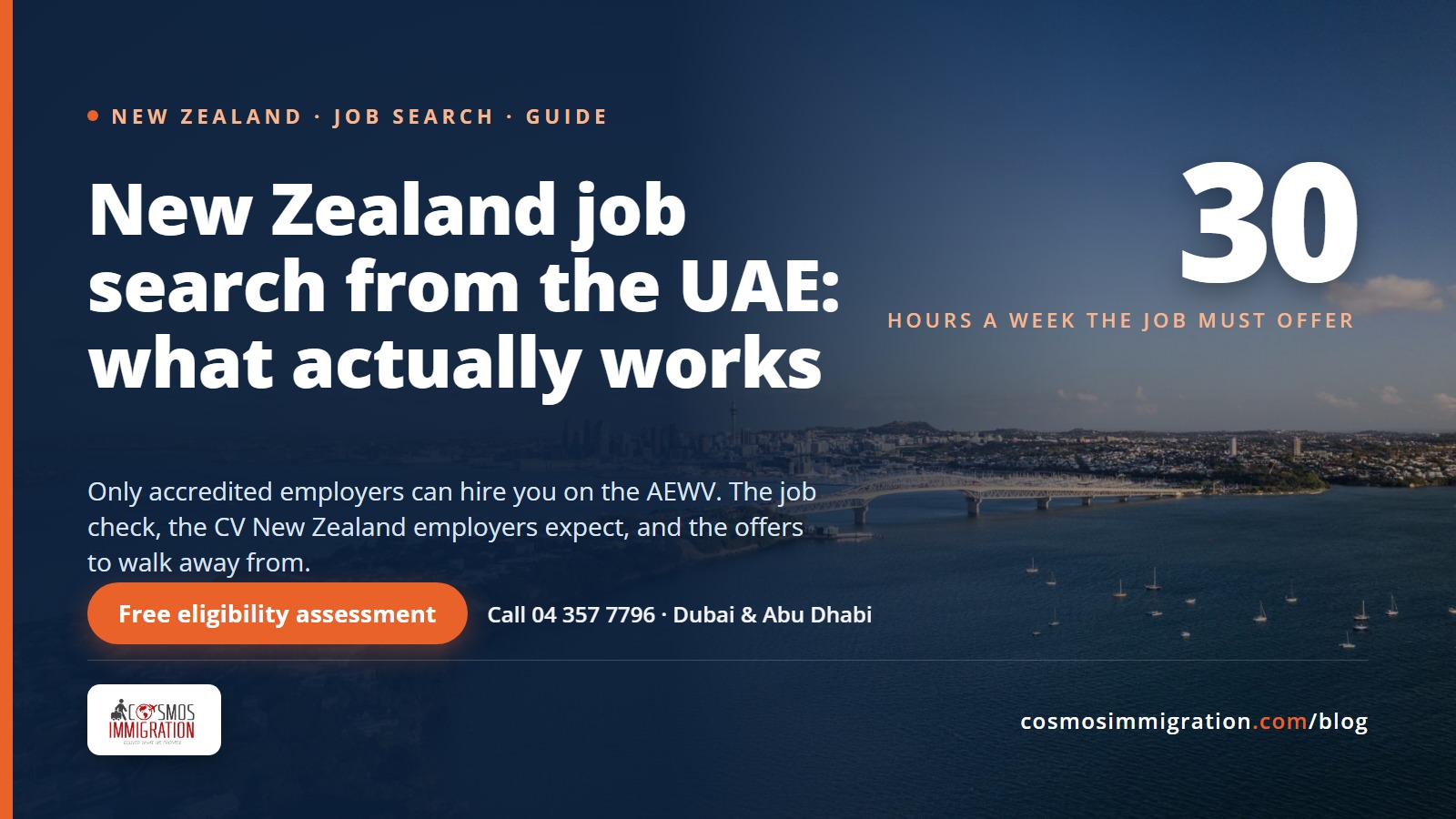
The AEWV is built around the employer. INZ requires an offer of full-time work (at least 30 hours a week) from an employer that is accredited to hire migrants and holds an approved job check for the specific job. The practical question is therefore not which jobs are open but which employers are able to hire you from overseas.
Before hiring on the AEWV, the employer must advertise the role to New Zealand workers for at least 14 days (ANZSCO skill level 1 to 3) or at least 21 days (level 4 to 5), and for level 4 and 5 roles must also engage with Work and Income before applying for the job check. Advertising is not required for Green List roles that meet the Green List requirements. An employer that has recruited from overseas before already understands this process, which makes it a more realistic target. Our guide to the Green List and Straight to Residence lists the roles that skip the advertising step.
How to check an employer
INZ publishes a searchable Accredited employer list, updated daily. You need the employer’s New Zealand Business Number (all 13 digits) or at least the first 3 characters of the company or trading name. INZ notes that some employers have chosen not to appear in search results; if you cannot find a company, ask it directly to confirm its accreditation.
Where INZ says to look
INZ’s guidance on finding a job from overseas says most people in New Zealand look for work on employment websites, through recruitment companies, or by contacting employers directly. It warns that many New Zealand job websites post roles expecting applicants already in the country, while some specialise in connecting with people overseas. For sector searches INZ names Kiwi Health Jobs (healthcare), the Education Gazette (teaching), Engineering New Zealand (engineering) and Careers at Science New Zealand (science).
On recruitment agencies, INZ states that employers often use them for specialist and high-level jobs, that you can register with more than one, and that you do not pay the agency because the employer pays it on placement. Approaching employers directly, starting with the organisation’s website, is described by INZ as an accepted and often successful approach.
Skill level, pay and English: which jobs are worth accepting
INZ grades jobs using ANZSCO and the newer National Occupation List (NOL), from level 1 (most skilled) to level 5. The level of the job you accept sets your maximum stay and whether you need English evidence.
| Job situation | Maximum continuous stay | English evidence | What it means for residence |
|---|---|---|---|
| ANZSCO or NOL skill level 1 or 2 | 5 years | Not required for the AEWV | Skilled Migrant Category or Green List routes may apply |
| ANZSCO or NOL skill level 3 | 5 years | Required (exemption only if your AEWV expires on or before 1 December 2026) | Skilled Migrant Category or Green List routes may apply, depending on the role |
| ANZSCO or NOL skill level 4 or 5 | 3 years, then normally 12 months outside New Zealand | Required | Very limited skilled residence options |
| Green List role (any level) | 5 years | Depends on the role’s skill level | Residence immediately or after 2 years of work, if the role’s requirements are met |
| Paid at least NZD $52.50 an hour | 5 years | Depends on skill level | 5-year stay at any skill level; residence depends on the role |
INZ notes that NOL occupations are not currently recognised for other visas; if you intend to apply for the Skilled Migrant Category, INZ says to use the ANZSCO classification for your job.
The minimum AEWV skill requirement is 2 years of relevant work experience (you must prove the hours) or a qualification at level 4 or higher on the New Zealand Qualifications and Credentials Framework, in the same field as the job unless you hold a bachelor’s degree or higher. If your qualification is below a bachelor’s degree and from outside New Zealand, INZ requires an International Qualification Assessment (IQA) from NZQA. Neither is needed if the job pays at least NZD $67.12 an hour or is a Green List role whose requirements you meet. Our guide to the Skilled Migrant Category 6-point system explains how pay and qualifications convert into residence points.
Scams and “quotas”: what INZ and Employment New Zealand say
INZ states on the AEWV page that job offer scams are common in India and South Asia, and that New Zealand employers or agents cannot charge you fees for a job or make you pay any of their recruitment costs. Its scam-protection page singles out “processing” or “placement” fees as a warning sign, and INZ will decline an AEWV application if it considers that you or your agent offered or promised money for a job offer. Employment New Zealand adds that a premium for giving or keeping a job is illegal, including money paid via a third party, and that a Labour Inspector can seek a penalty against the employer.
None of INZ’s pages describe any allocation or quota of New Zealand jobs that can be bought; the only gate INZ sets out is an accredited employer with an approved job check, and INZ declines an AEWV where money was offered for the job offer. In a February 2024 warning, INZ listed the hallmarks of a scam: paying a large sum for a visa and a job, paying to fast-track an application, an unrealistically high wage, and promises that the job is a pathway to residency. INZ also states that it never asks for visa fees to be deposited into a bank account and will not prioritise an application because an adviser is used. Its advice is to check directly with the employer that the offer is genuine.
The New Zealand-style CV and what to prepare before you apply
Tahatū Career Navigator (tahatu.govt.nz), the government careers service that replaced careers.govt.nz, says a CV must show an employer quickly and clearly how you match the job. Its advice is to update the CV for every application using keywords from the advertisement, reorder your skills so the matching ones sit first, and adjust the personal statement to fit. It describes a skills-focused CV for people with little experience and a work-focused CV for people with work experience; most UAE professionals will use the work-focused format. It recommends bullet points and simple formatting, and separately notes that applicant-tracking systems search for keywords from the advertisement such as the job title, the industry and the key skills listed.
A CV alone will not satisfy INZ at the visa stage. To prove 2 years of relevant experience, INZ asks for evidence of hours worked, so keep payslips and reference letters that state hours. If your occupation requires registration in New Zealand, INZ’s guidance is that you may need it to get both the job and the visa; use our credential verification page to see which documents apply. If your qualification is below a bachelor’s degree, apply for the NZQA IQA now: NZQA states the average wait is currently 10 weeks, and that once an application is confirmed complete, 90 per cent are finished within 3 weeks.
From the UAE: what this means for you
Two documents take longest from the UAE, and both must be ready before the job check is approved. INZ requires police certificates less than 6 months old when you apply if you are 17 or older and your total time in New Zealand will be 24 months or longer. A certificate not in English needs a certified English translation, and a valid and complete certificate must be uploaded with the AEWV application or INZ may decline it. Order it once the employer confirms a job check is under way, so it is still under 6 months old when you apply.
Medical examinations are done by INZ-approved panel physicians, and a chest X-ray may be required for stays of more than 6 months depending on the countries you have lived in. English test results must be no more than 2 years old.
A realistic sequence from Dubai or Abu Dhabi is: IQA and registration checks first (an average wait of 10 weeks for the IQA), the job search and the employer’s job check running in parallel, then the AEWV, which INZ processes at 80% within 8 weeks. Our AEWV from Dubai guide covers the visa stage, and our New Zealand working visa page covers the other work-visa options.
Frequently asked questions
Can I apply for the AEWV before I have a job offer?
The application is opened by the accredited employer, who must hold an approved job check for your role and then sends you the form link. Without that link there is no application to lodge.
Is the job check my responsibility or the employer’s?
The job check is the employer’s application to INZ. Ask whether a job check has been approved for the role and confirm their accreditation on INZ’s list before you resign or pay for documents.
Does a job on the AEWV lead to residence?
It can, but the route depends on skill level, pay and the Green List. A level 4 or 5 role gives a 3-year stay with very limited residence options; a Green List Tier 1 role or a role meeting Skilled Migrant Category rules can lead to residence. Our New Zealand skilled migration page sets out the pathways.
What to do next
To find out which New Zealand route your occupation, qualification and pay level fit, start with a free eligibility assessment, call our Dubai office on 04 357 7796, or book a 20-minute review through our contact page. We do not promise outcomes; the decision sits with Immigration New Zealand and the employer. More guides: our guide library.
Sources
- Accredited Employer Work Visa — Immigration New Zealand — accessed 27 Aug 2026
- Accredited employer list — Immigration New Zealand — accessed 27 Aug 2026
- Applying for a job check: process steps — Immigration New Zealand — accessed 27 Aug 2026
- How long you can stay on an AEWV — Immigration New Zealand — accessed 27 Aug 2026
- How to find a job in New Zealand — Immigration New Zealand — accessed 27 Aug 2026
- Protecting yourself from immigration scams — Immigration New Zealand — accessed 27 Aug 2026
- Immigration warns of ‘too good to be true’ job offers — Immigration New Zealand (14 February 2024) — accessed 27 Aug 2026
- Final details about changes to the Skilled Migrant Category Resident Visa and Work to Residence Visa — Immigration New Zealand — accessed 27 Aug 2026
- Deductions and premiums — Employment New Zealand — accessed 27 Aug 2026
- How to write a CV — Tahatū Career Navigator (formerly careers.govt.nz) — accessed 27 Aug 2026
- Apply for an International Qualification Assessment (IQA) — NZQA — accessed 27 Aug 2026
Cover photo: Ollie Craig via Pexels
Not sure which route fits you? Book a free eligibility assessment with our Dubai or Abu Dhabi team. No obligation.
Call +971 4 357 7796WhatsApp us