
Australia has three skilled visas that do not require an employer: the Skilled Independent (subclass 189), the Skilled Nominated (subclass 190) and the Skilled Work Regional (subclass 491). Two of them are permanent from day one and the third leads to permanent residence. None of them involves a job offer, a sponsor or a “work permit”. What they do require is a positive skills assessment, a recognised occupation, a language test and at least 65 points, and you must be under 45 when you are invited. If you have been quoted an “Australia work permit” by someone in Dubai, this article explains what that phrase actually means and which visa you might genuinely qualify for.
The three points-tested visas
| Visa | Who nominates you | Status on grant | Extra points |
|---|---|---|---|
| Subclass 189 Skilled Independent | Nobody. You are invited on your own score. | Permanent | None |
| Subclass 190 Skilled Nominated | A state or territory government | Permanent | 5 points for nomination |
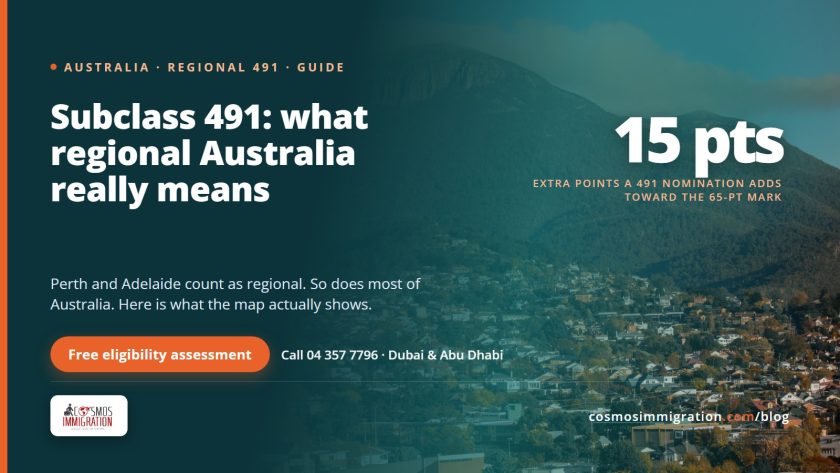
| Subclass 491 Skilled Work Regional | A state or territory government, or an eligible relative in a regional area | Provisional, with a pathway to permanent residence after living and working in a regional area | 15 points for nomination |
All three run through SkillSelect. You lodge an Expression of Interest, states and the Department of Home Affairs see your claimed points, and invitations go to the highest-ranked candidates in each occupation. The 189 is the hardest because it has no nomination bonus and invitation scores have been well above the 65-point floor for most occupations. The 190 and 491 are where most UAE applicants with mid-range scores actually succeed, provided a state wants their occupation.
How the employer-sponsored visas differ
The Skills in Demand visa (subclass 482) and the Employer Nomination Scheme (subclass 186) are the Australian equivalents of a work permit. An approved Australian business sponsors you for a specific role, must pay at least the Core Skills Income Threshold (indexed every July; check the current figure on immi.homeaffairs.gov.au), and lodges the nomination in its own account. You then apply for the visa against that nomination.
The important part for someone in Dubai: the business does this because it wants you, and it pays its own sponsorship costs. An agent cannot sponsor you. A “sponsor” who asks you for money is not a sponsor. If you do not already have an Australian employer who has offered you a role and agreed to sponsor, the 482 and 186 are not open to you today, and you should look at the points-tested visas instead.
Skills assessment comes before everything
This is the step most people skip in their planning, and it is the step that decides whether Australia is realistic. Before you can lodge an Expression of Interest for a 189, 190 or 491 you need a positive skills assessment from the assessing authority for your nominated occupation. Each occupation has one authority. Engineers Australia assesses engineers, the Australian Computer Society assesses IT professionals, VETASSESS covers many professional and trade occupations, Trades Recognition Australia covers most trades, and the nursing and teaching bodies handle their own professions.
The assessing authority checks your qualification, and in most cases your work experience, against the Australian standard for that occupation. Some authorities require a minimum number of years post-qualification. Some deduct years before they count experience towards points. Trades often need a practical or technical interview. If your job title in the UAE does not map cleanly to an ANZSCO occupation, or your duties do not match the one you nominate, the assessment fails and nothing else matters.
A registered agent’s most useful work happens here, before any application: choosing the occupation code, matching your reference letters to its task list, and telling you honestly if the match is not there.
The points test in plain terms
You need 65 points to be eligible. The main sources are age, English, work experience, qualifications and nomination. A few examples of how the grid works (the full table is on the Home Affairs site and in our Australia points calculator):
- Age carries the most weight, with the maximum for applicants aged 25 to 32 and nothing at all from age 45.
- English is tiered. Competent English (roughly IELTS 6 in each band) is the minimum to apply, but it scores zero. Proficient (IELTS 7 in each band) and Superior (IELTS 8 in each band) add substantial points.
- Overseas skilled experience counts only after the assessing authority’s deeming date and only in the nominated or a closely related occupation.
- A bachelor’s degree, a doctorate, an Australian qualification and a partner’s skills each add points.
Run the calculator honestly. If you land at 65 with no nomination, you are eligible but unlikely to be invited for a 189. If you land at 70 or above with a state nomination for the 190 or 491, you are in the range where invitations happen, depending on your occupation and the state’s current list.
Common UAE profiles and where they land
- Civil, mechanical or electrical engineer, degree, five or more years, IELTS 7. Strong 190 or 491 candidate after an Engineers Australia assessment. A Superior English result may put a 189 in reach.
- Accountant, ACCA or CPA plus degree. Assessment is possible but the occupation has been heavily subscribed for years, so a state nomination is usually essential.
- Chef, electrician, motor mechanic with trade certificates and several years of documented work. Realistic through TRA or VETASSESS, often with a 491 regional nomination. Your reference letters and payslips matter more than your certificate.
- Sales, administration or customer service roles with a degree. Most of these occupations are not on the current lists. Check the list before spending on a test.
- Driver, warehouse, cleaner, security, kitchen hand. Not skilled occupations for these visas. There is no points route; only a genuine sponsored offer, which is rare for these roles.
What to do next
- Score yourself on the Australia points calculator and note the number.
- Read the Australia skilled migration page for the assessment, English test and Expression of Interest sequence.
- If you are at or above 65, book a document review with a MARA-registered agent, and confirm their registration on the register first using our verification guide.
Not sure which route fits you? Book a free eligibility assessment with our Dubai or Abu Dhabi team. No obligation.
Call +971 4 357 7796WhatsApp us