A common situation for software engineers in Dubai: three European offers on the desk and no idea which one leads somewhere. One in Munich, one in Amsterdam, one in Milan. The salaries look similar once converted to dirhams. The rules behind them are not similar at all. This guide sets five countries side by side, using only what the official pages say as at September 2026.
At a glance
- The EU Blue Card applies in 25 of the 27 EU member states. It does not apply in Denmark or Ireland.
- Every applicant needs a work contract or binding job offer for highly qualified employment lasting at least 6 months.
- Each state sets its own salary threshold inside an EU band of 1.0 to 1.6 times its average gross annual salary.
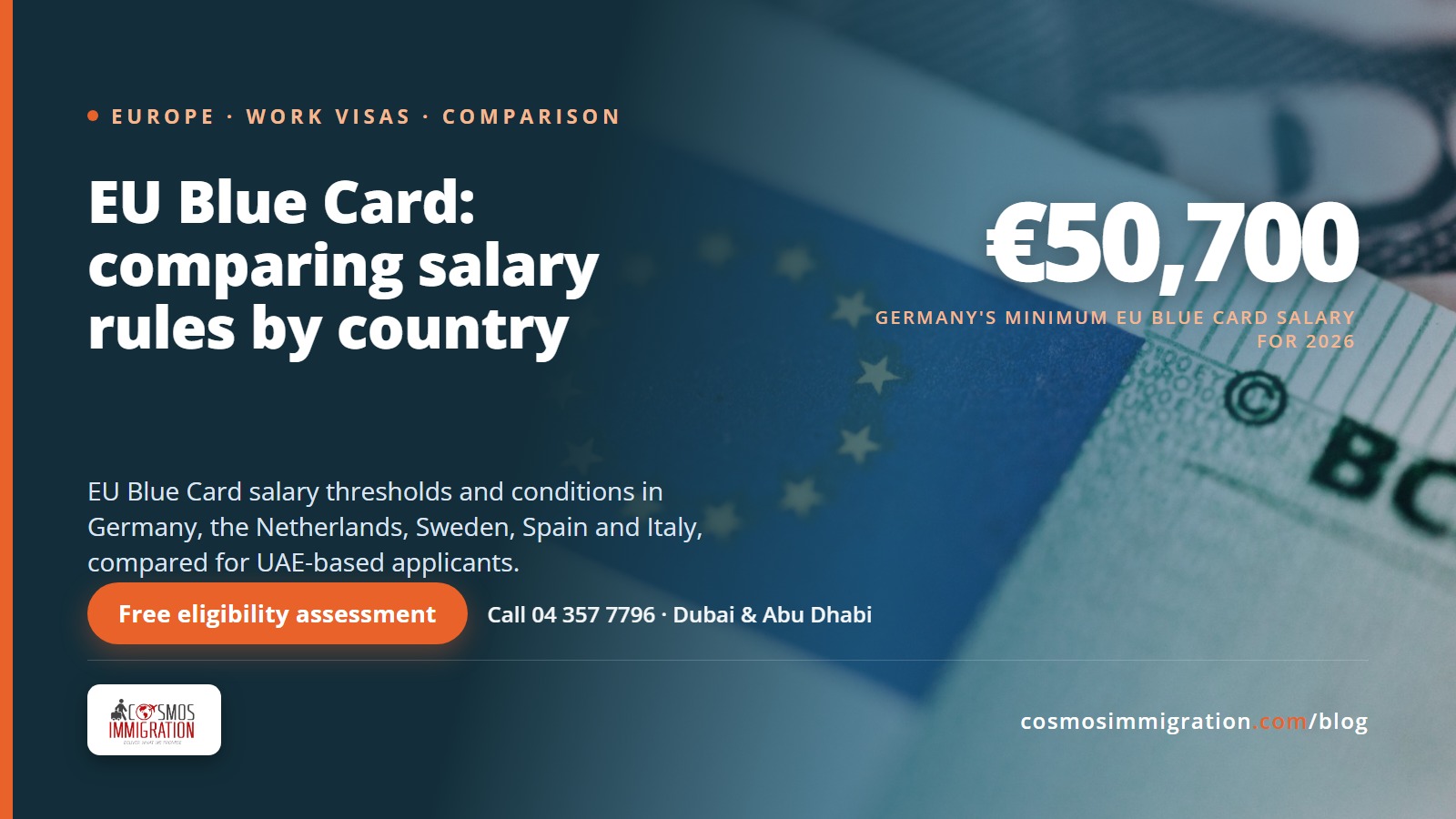
- Germany’s 2026 standard threshold is €50,700 gross per year. The Netherlands’ 2026 figure is €5,942 gross per month, excluding holiday allowance.
- After 12 months of legal residence in the first state, a holder may move to a second member state and apply for a new Blue Card there.
One card, 25 rulebooks
The EU Blue Card is a residence permit for highly qualified non-EU workers. The framework comes from the recast Directive (EU) 2021/1883. Member states had to write it into national law by November 2023, and the revised rules are now in force across the 25 participating states.
You need a valid work contract or a binding job offer for highly qualified employment lasting at least 6 months in the state concerned. You need proof of your qualifications, a valid travel document and sickness insurance. And the gross annual salary in that contract must sit between 1.0 and 1.6 times the average gross annual salary of the member state, with each state choosing its own figure inside that band.
The recast rules also allow relevant professional experience to count as an alternative to a degree for ICT roles. Brussels built the frame, but each capital fits its own engine, and the engine is the salary number.
The comparison table
The table states each threshold exactly as the official source gives it, with its year. Two countries publish 2026 figures, Sweden’s carries a July 2025 date, and Spain and Italy still show 2024 figures on the European Commission’s portal, with Spain’s marked as under review.
| Country | Salary threshold as stated | Key condition |
|---|---|---|
| Germany | €50,700 gross per year (as of 2026). Reduced threshold of €45,934.20 (as of 2026) for shortage occupations and for young professionals who graduated within the last 3 years. | The shortage-occupation reduction needs Federal Employment Agency (BA) approval of the employment. |
| Netherlands | €5,942 gross per month, excluding holiday allowance (2026). Reduced salary criterion of €4,754 per month (2026). | The standard figure is the same as the Highly Skilled Migrant threshold for those aged 30 and over. |
| Sweden | SEK 53,625 per month as of 15 July 2025, set at 1.25 times the average gross salary published by the Swedish National Mediation Office. | Tied to the national average-salary index; check the current figure before you sign. |
| Spain | €38,844 per year for 2024, set at 1.5 times the average gross annual salary under the pre-recast rules. Under review following transposition of Directive (EU) 2021/1883. | No labour market test. Reduced threshold of 0.8 times the regular figure for shortage occupations and for graduates within 3 years. |
| Italy | €33,500 per year for 2024. | Italy applies a labour market test, and no exceptions to the minimum salary apply. |
Germany and the Netherlands: the two 2026 figures
Germany is the largest issuer of EU Blue Cards in the EU. For 2026, your job must pay a gross annual salary of at least €50,700. If you work in a shortage occupation and the Federal Employment Agency has approved your employment, the figure drops to €45,934.20. The same reduced figure applies to young professionals whose last degree is less than 3 years old, for entry-level jobs in any profession.
In our Abu Dhabi office, the reduced figure decides many Germany cases. Our Germany page covers the routes we assess.
The Netherlands works in monthly amounts. The Immigration and Naturalisation Service (IND) sets the 2026 Blue Card requirement at €5,942 gross per month without holiday pay, the same as its Highly Skilled Migrant threshold for people aged 30 and over. A reduced criterion of €4,754 per month also exists for 2026, and in IND practice it typically applies to recent graduates. Read a Dutch offer carefully: holiday allowance sits outside the figure the IND checks.
Sweden, Spain and Italy: read the year on the number
Sweden does not publish a flat euro figure. The Swedish Migration Agency sets the threshold at 1.25 times the average gross salary published by the Swedish National Mediation Office. As of 15 July 2025 that meant SEK 53,625 per month, and the same figure was still the one shown on the Migration Agency’s page as at 13 September 2026, unaffected by Sweden’s separate 1 June 2026 work-permit reform, which changed the salary rule for other permit types.
The Commission’s portal gives Spain’s threshold as €38,844 for 2024, set at 1.5 times the average gross annual salary before the new Directive took effect, and says the threshold is under review after transposition. No updated figure appeared on that page as at 13 September 2026. Two things stand out: Spain applies no labour market test, and a reduced threshold of 0.8 times the regular figure applies to shortage occupations and to applicants who completed a higher-education qualification no more than 3 years before applying.
Italy’s portal page gives a 2024 minimum of €33,500. Unlike Spain, Italy applies a labour market test, and the page states that no exceptions to the minimum salary requirement apply. Standard card validity in Italy is 2 years, or the contract length plus 3 months for fixed-term contracts.
For Spain and Italy, verify the current-year figure with the national authority before you rely on it. A 2024 number is a signpost, not a contract.
Rights that come with the card
Decision time
You are entitled to a decision on a complete application as soon as possible and no later than 90 days after submission. Italy’s country page states up to 90 days, while Spain’s states up to 20.
How long the card lasts
The card must allow you to stay and work for at least 24 months. If your contract is shorter, the card runs for the contract period plus a further 3 months.
Changing employer
During the first 12 months of legal employment, you may have to inform national authorities of any change of employer or circumstances, so they can re-check the admission criteria and the labour market situation. After those 12 months you can change jobs more freely, though a notification may still be required.
Moving to a second EU country
After 12 months of legal residence in the first state, you may move to another participating member state for highly skilled employment. You apply for a new EU Blue Card in the state you move to, rather than restarting from outside the EU. States may still apply their own procedural rules, so check the destination on its own terms.
From the UAE: what this means for you
Every Blue Card application begins with the same three items: a contract or binding offer of at least 6 months, proof of your qualifications, and a salary that clears the national line.
Start with your degree. Dig out the original certificate and transcripts now, because most people discover a missing document only when the appointment is booked. If your degree was issued outside the UAE, expect time in attestation queues.
Then gather reference letters from former employers. If you are relying on professional experience for an ICT role rather than a degree, those letters are your evidence. Ask for dates, titles, duties and a signatory who can be contacted.
Read your offer against the table above, not against your Dubai package. A tax-free UAE salary does not map neatly onto a German gross annual figure or a Dutch monthly one. If an offer sits just below the line, the reduced thresholds in Germany, the Netherlands and Spain may help, but only if you fit the conditions each state attaches.
Keep sickness insurance and a valid travel document on your checklist from day one. Both are core conditions and can be sorted from Dubai or Abu Dhabi before an embassy appointment. If your shortlist runs beyond these five countries, our Austria page and our countries we serve page show where else we assess, and our skilled talent visas page sets the Blue Card alongside other work routes.
Frequently asked questions
Can I apply for an EU Blue Card without a job offer?
No. A valid work contract or a binding job offer for highly qualified employment of at least 6 months is a core condition in every participating state.
Which country has the lowest salary threshold?
The figures are stated in different years and different units, so a fair ranking is not possible from the official pages alone. Italy’s published 2024 figure of €33,500 is the lowest number in the table, but Italy applies a labour market test and allows no exceptions.
Does the Blue Card let me move between EU countries straight away?
Not straight away. After 12 months of legal residence in the first state, you may move to another participating state for highly skilled employment, and you must apply for a new EU Blue Card there. Denmark and Ireland are outside the scheme.
What to do next
If you have a European offer in hand, or you are deciding which country to target, start with a free eligibility assessment. Our consultants are individually registered with CICC and MARA. Call us on 04 357 7796, or book a 20-minute review through our contact page. We never promise an outcome, because the decision belongs to the national authority and not to us.
Sources
- European Commission — EU Immigration Portal, EU Blue Card — accessed 13 Sep 2026
- European Commission — EU Immigration Portal, EU Blue Card in Italy — accessed 13 Sep 2026
- European Commission — EU Immigration Portal, EU Blue Card in Spain — accessed 13 Sep 2026
- Make it in Germany (Federal Government of Germany) — EU Blue Card — accessed 13 Sep 2026
- Immigration and Naturalisation Service (IND), Netherlands — Fees and required amounts for 2026 known — accessed 13 Sep 2026
- Swedish Migration Agency (Migrationsverket) — Extend an EU Blue Card: what the employer must do — accessed 13 Sep 2026
Not sure which route fits you? Book a free eligibility assessment with our Dubai or Abu Dhabi team. No obligation.
Call +971 4 357 7796WhatsApp us