Every week someone sits across from us in our Dubai office with one of two questions. Their daughter received Canadian permanent residence last year, so when can she bring them over? Or they landed in Toronto this spring and want to know how quickly a spouse still working in Abu Dhabi can follow. As at September 2026, those two routes are in very different shape.
At a glance
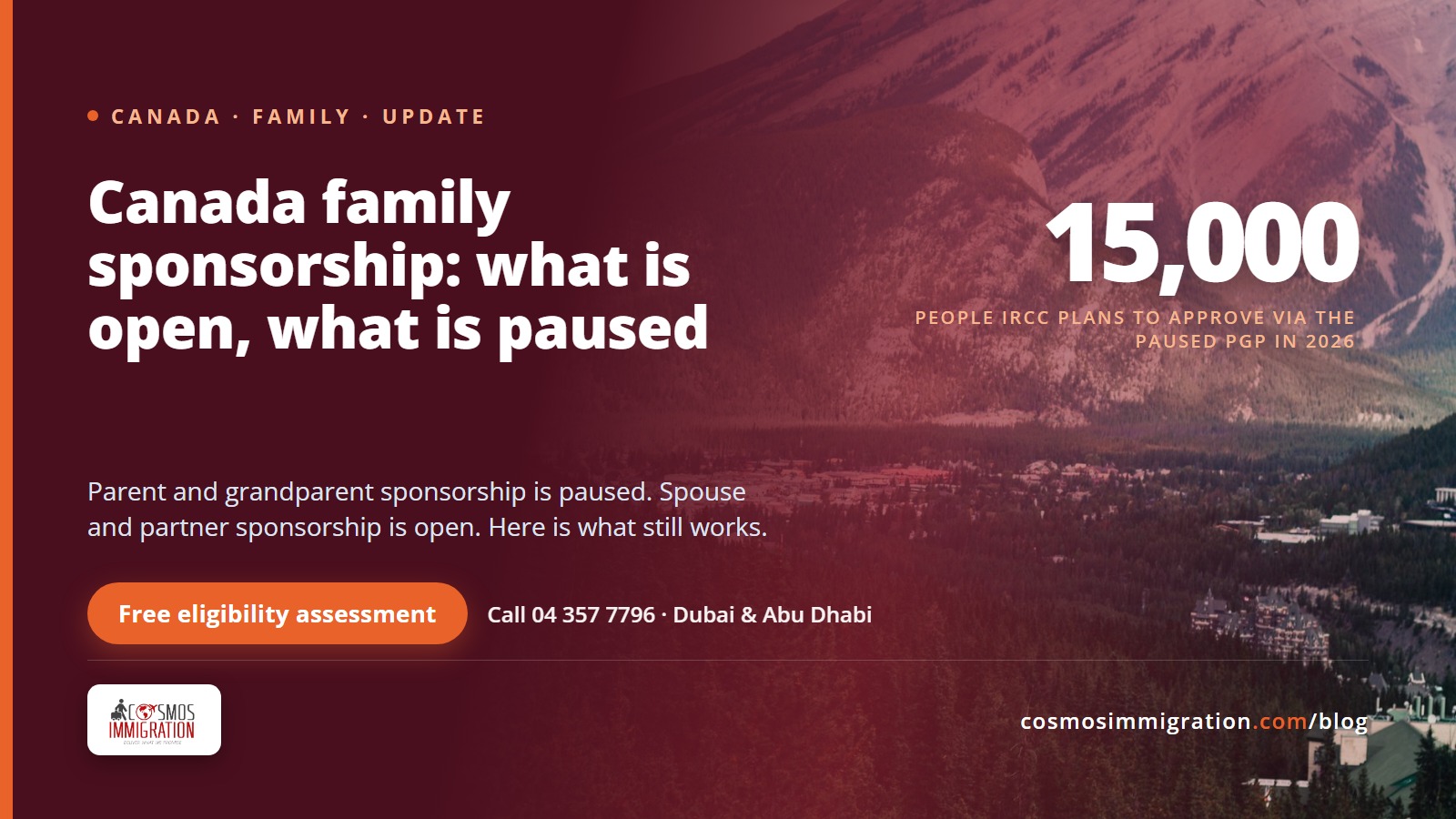
- The Parents and Grandparents Program (PGP) is paused: IRCC is not accepting new interest-to-sponsor forms or inviting sponsors until further notice, though existing applications are still processed.
- IRCC plans to approve up to 15,000 people for permanent residence through the PGP in 2026, in line with the 2026–2028 Immigration Levels Plan.
- Sponsoring a spouse, partner or child is listed as Open; IRCC publishes the current fees on its fee list.
- The super visa lets parents and grandparents visit for 5 years at a time, with multiple entries for up to 10 years; IRCC publishes the current fee.
- The undertaking is 3 years for a spouse or partner and 20 years for a parent or grandparent (10 years if the sponsor lives in Quebec).
Two programs, two very different doors
Canadian family sponsorship is really three doors for a UAE family: sponsoring a spouse or partner, sponsoring parents or grandparents for permanent residence, and the super visa, a long-stay visitor route rather than a path to PR. Here is how each stands as at September 2026.
| Route | Status as at Sept 2026 | Who it covers | Government fee from | Undertaking |
|---|---|---|---|---|
| Sponsor your spouse, partner or child | Open | Spouse, common-law partner, conjugal partner, dependent child | Published on the IRCC fee list | 3 years (spouse or partner) |
| Parents and Grandparents Program | Paused: no new interest-to-sponsor forms or invitations until further notice | Biological or adopted parents and grandparents | Published on the IRCC fee list | 20 years (10 years in Quebec) |
| Super visa | Available (visitor route, not PR) | Parents and grandparents of a Canadian citizen, PR or registered Indian | Published on the IRCC fee list | None; host shows financial support |
What “paused” means for parents and grandparents
On 15 July 2026, IRCC announced it was pausing intake of new applications under the PGP. The notice is direct about why: interest in the program continues to exceed the spaces available under the levels plan. IRCC will keep processing existing applications and plans to approve up to 15,000 people for permanent residence through the PGP in 2026.
The program page now shows a status of Paused, with no new interest-to-sponsor forms and no new invitations until further notice. No end date has been announced.
Who can sponsor parents when intake reopens
A sponsor must be invited to apply, be at least 18, live in Canada, and be a Canadian citizen, permanent resident or person registered under the Indian Act. They must have enough money to support the people they sponsor, and proof of income is required. A spouse or common-law partner can co-sign so that both incomes count.
IRCC’s last published income table was for the 2025 intake. It set the minimum necessary income a sponsor had to prove for each of the 3 tax years before applying:
| Family size | 2024 | 2023 | 2022 |
|---|---|---|---|
| 2 people | $47,549 | $44,530 | $43,082 |
| 3 people | $58,456 | $54,743 | $52,965 |
The figures rise with family size. Because intake is paused, these are the last published requirements, not a live 2026 threshold. We share them so a newly landed PR can see the scale of income involved and start building a Canadian tax history.
The undertaking is the promise you are really signing
For parents and grandparents the undertaking period is 20 years, or 10 years if the sponsor lives in Quebec. It starts the day the sponsored people become permanent residents, and from that day it cannot be cancelled or shortened. The sponsor remains responsible even if the relationship changes, the sponsor has financial problems, or the sponsored person becomes a Canadian citizen. A 20-year commitment is closer to a mortgage than to a visa form, and the child in Canada should sign it knowing that.
The super visa: the open door for parents
While PGP intake is paused, the super visa is the practical route most UAE-based families use for parents. It is a temporary resident visa, not permanent residence.
Parents and grandparents of a Canadian citizen, permanent resident or registered Indian can visit for 5 years at a time. The visa provides multiple entries for up to 10 years. Dependants cannot be included, so a younger sibling still at school in Sharjah needs their own route. IRCC publishes the current fee on its fee list.
Income calculation changed on 31 March 2026. IRCC announced on 20 March 2026 that it would change how it calculates the host’s family income, giving hosts two alternative ways to meet the income requirement. The stated aim is to make the program accessible to more families while ensuring hosted parents are financially supported. This is already in force.
The family size IRCC counts includes the visiting applicants, the host, the host’s spouse or common-law partner, the host’s dependent children, any previously approved super visa applicants still covered by an active letter of invitation, and anyone previously sponsored who is still within their undertaking period.
Foreign health insurance has been allowed since 28 January 2025. Applicants can prove the required minimum private health insurance with a policy from an insurer outside Canada, provided that insurer is authorized by the Office of the Superintendent of Financial Institutions (OSFI) to provide accident and sickness insurance and appears on OSFI’s list of federally regulated financial institutions. Coverage must remain valid for each entry to Canada.
Sponsoring a spouse or partner from the UAE
This is where we see the most movement. IRCC lists the Sponsor your spouse, partner or child program as Open, unaffected by the PGP pause. The current fees are published on the IRCC fee list.
- Spouse: legally married to the sponsor, at least 18 years old, and in a genuine relationship not entered into only for immigration purposes.
- Common-law partner: not legally married to the sponsor, at least 18, any gender, in a genuine relationship, and living with the sponsor for at least 12 consecutive months in a conjugal relationship. Short, temporary absences are permitted; long periods apart are not.
- Conjugal partner: for couples who cannot live together or marry because of legal, immigration, social, cultural or religious barriers, where the sponsored partner lives outside Canada.
The undertaking for a spouse, common-law partner or conjugal partner is 3 years.
On timing, IRCC publishes a service standard, not a promise. For the Family Class Priority category, covering overseas spouses, partners and dependent children, the standard is 12 months. On the most recently published Service Standards page, IRCC reported meeting it 75% of the time against a target of 80%. Check IRCC’s live processing-times tool for current estimates.
If you are the one still in the UAE and your partner is the Canadian, our spouse and partner visa page explains how we structure relationship evidence. If neither of you holds status yet, Canada PR from Dubai through the skilled route is usually the first conversation.
From the UAE: what this means for you
Relationship evidence for a spouse or partner. IRCC’s test is a genuine relationship not entered into only for immigration purposes, and for common-law partners the 12 consecutive months of living together is the hinge. In practice, the couple’s history in the UAE becomes the case file: the tenancy contract in both names, joint account statements, photographs across years, and the travel record that shows short absences rather than long separations. Start assembling it before the sponsor lands in Canada.
Income evidence for the host or sponsor. The person in Canada carries the financial side. For a super visa host, the family-size count decides the income to show, with two alternative ways to meet it since 31 March 2026. For a future PGP sponsor, income is proven across the 3 tax years before applying, so every Canadian tax year is part of the application.
Health insurance for super visa parents. Since 28 January 2025 a policy from a foreign insurer is acceptable if that insurer is OSFI-authorized for accident and sickness insurance and on OSFI’s list.
Sequencing. For parents, the realistic plan as at September 2026 is a super visa now and a PGP application if and when IRCC reopens intake, even while another family member pursues a Canada skilled migration pathway. In our experience, the family cases that go smoothly are the ones where evidence was collected while everyone was still in the same country.
Frequently asked questions
Can my child in Canada sponsor me for PR right now?
Not as a new applicant. As at September 2026, IRCC is not accepting new interest-to-sponsor forms or inviting sponsors under the PGP, until further notice. Applications already submitted are still being processed, with up to 15,000 approvals planned for 2026.
Is spousal sponsorship affected by the PGP pause?
No. The Sponsor your spouse, partner or child program is listed as Open, with a 3-year undertaking, and a 12-month service standard for overseas family class priority applications.
Can my parents buy their super visa health insurance outside Canada?
Yes, if the insurer is authorized by OSFI to provide accident and sickness insurance and appears on OSFI’s list. This has applied since 28 January 2025, and coverage must be valid for each entry to Canada.
What to do next
If your relative holds Canadian PR or citizenship, or you have just landed and want to plan for family in the UAE, start with a free eligibility assessment. Call us on 04 357 7796, or book a 20-minute review through our contact page. Our consultants are individually registered with CICC, and our Canada immigration page covers the wider routes. We never promise outcomes; every decision rests with IRCC.
Sources
- IRCC – Sponsor your parents and grandparents — accessed 13 Sep 2026
- IRCC news notice – Canada takes steps to responsibly manage the Parents and Grandparents Program — accessed 13 Sep 2026
- IRCC – Sponsor your parents and grandparents: Check if you’re eligible — accessed 13 Sep 2026
- IRCC – Sponsor your parents and grandparents: What it means to be a sponsor — accessed 13 Sep 2026
- IRCC Help Centre – How long am I financially responsible for the family member or relative I sponsor? — accessed 13 Sep 2026
- IRCC – Sponsor your parents and grandparents: Income requirements for the sponsor — accessed 13 Sep 2026
- IRCC – Super visa for parents and grandparents — accessed 13 Sep 2026
- IRCC news notice – Changes to how the parents and grandparents super visa income requirement is calculated — accessed 13 Sep 2026
- IRCC news notice – Change to health insurance requirement makes the super visa more accessible — accessed 13 Sep 2026
- IRCC – Super visa for parents and grandparents: Proof of financial support — accessed 13 Sep 2026
- IRCC – Sponsor your spouse, partner or child — accessed 13 Sep 2026
- IRCC – Sponsor your spouse, partner or children: Who you can sponsor — accessed 13 Sep 2026
- IRCC – Immigration, Refugees and Citizenship Canada service standards — accessed 13 Sep 2026
Not sure which route fits you? Book a free eligibility assessment with our Dubai or Abu Dhabi team. No obligation.
Call +971 4 357 7796WhatsApp us