New Zealand or Australia? It is a common question for skilled professionals in the UAE with a strong CV and years of Gulf experience, and the answer starts with a surprise: the two countries ask for very different things before they’ll let you move. New Zealand wants to know if you’re in demand right now. Australia scores you first, then finds out who wants you.
At a glance
- New Zealand’s Skilled Migrant Category (SMC) needs 6 skilled resident points, which some applicants can get entirely from one strong factor — a PhD, an eligible New Zealand master’s degree, a high-skill occupational registration, or a very high income.
- New Zealand’s Green List splits into Tier 1 (Straight to Residence) and Tier 2 (Work to Residence, which requires 24 months of qualifying work before you can apply).
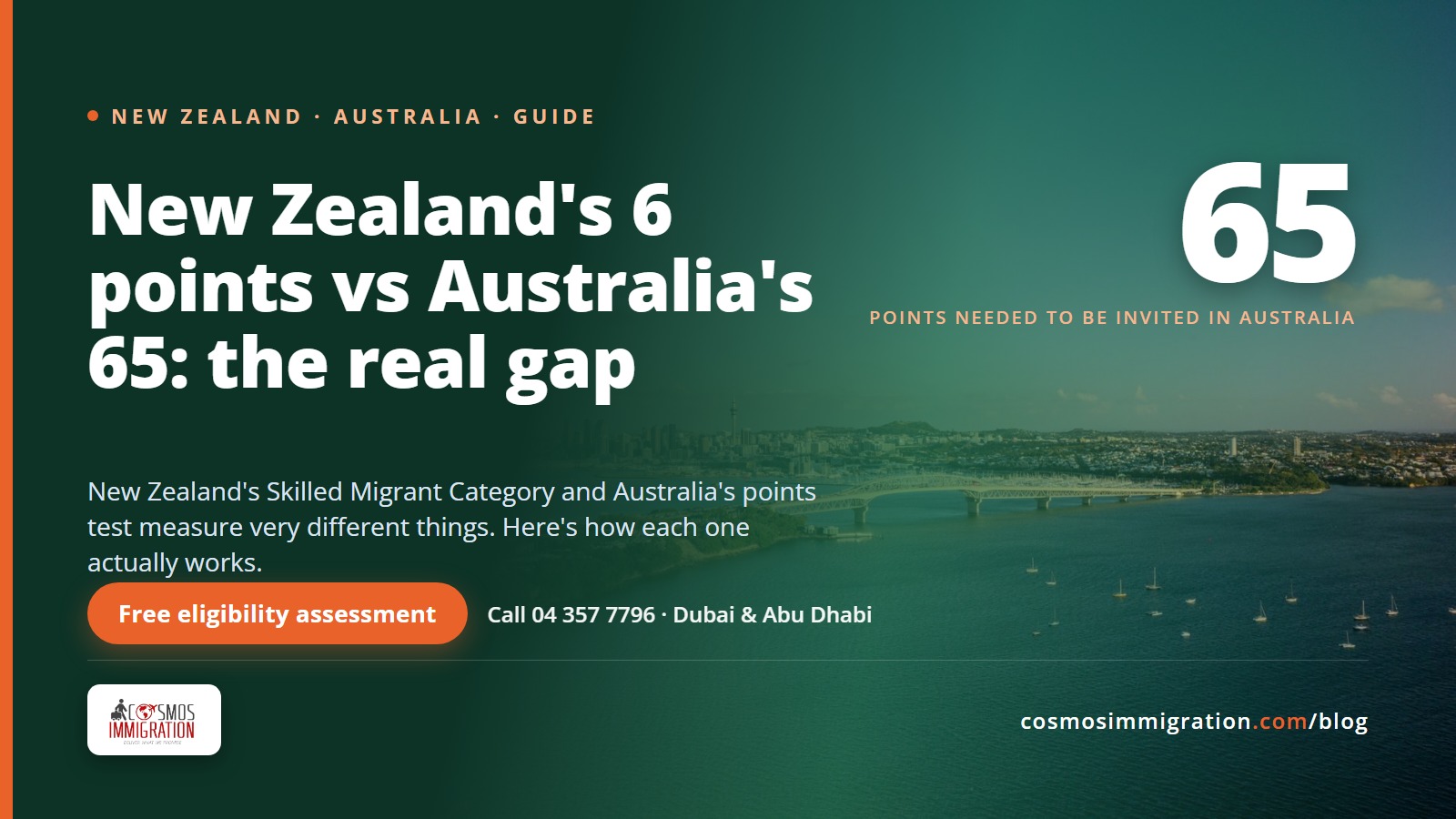
- Australia’s subclass 189, 190 and 491 visas are all points-tested — an Expression of Interest needs at least 65 points just to be considered for an invitation, and meeting that threshold does not mean an invitation follows.
- Australia’s subclass 186 employer-sponsored visa can grant permanent residence directly, with no geographical restriction on where the employer is based.
- Citizenship timelines are shaped differently: New Zealand asks for 1,350 days of residence across 5 years, including 240 days in each year; Australia asks for 4 years of residence, including the most recent 12 months as a permanent resident.
New Zealand’s skilled pathways: SMC and the Green List
New Zealand’s main skilled residence route is the Skilled Migrant Category (SMC). Since the system changed on 9 October 2023, it asks for 6 skilled resident points, drawn from your qualifications and pay or from your job or job offer. Some applicants can get all 6 from one strong factor: a PhD, an eligible New Zealand master’s degree, an occupational registration that required significant training, or a very high income. Wage thresholds also apply on some pathways and vary depending on when your skilled work experience started. The first formal step is an Expression of Interest (EOI).
Running alongside the SMC is the Green List — roles New Zealand says it needs filled, split into two tiers. Tier 1 roles lead to a Straight to Residence Visa: be 55 or younger, hold a Tier 1 job offer (or be working in one) with an accredited employer, and meet standard health, character and English requirements — there’s no minimum period of prior New Zealand work built into the visa itself. Tier 2 roles lead to a Work to Residence Visa, which asks for more runway: be 55 or younger, have already held a work visa for at least 24 months, have worked in a Tier 2 job in New Zealand for 24 months within the 30 months before applying, and hold a Tier 2 job offer with an accredited employer. That visa costs NZD $6,450.
Many skilled professionals arrive first on an Accredited Employer Work Visa (AEWV), a temporary, employer- and role-specific visa requiring an accredited employer, a job that passes a job check, and pay at or above market rate and the New Zealand minimum wage — it becomes a route to residence only once a Green List role or enough SMC points are in place.
Australia’s skilled pathways: points test and employer sponsorship
Australia’s core skilled routes — the Skilled Independent visa (subclass 189), Skilled Nominated visa (subclass 190) and Skilled Work Regional Provisional visa (subclass 491) — are all points-tested. An Expression of Interest lodged through SkillSelect needs to meet or exceed 65 points just to be considered for an invitation; reaching that threshold makes you eligible to be picked, not certain of it. Subclass 189 needs no state or territory sponsorship. Subclass 190 requires a state or territory to nominate you, on top of the points test. Subclass 491 requires state, territory or family sponsorship and is provisional, not immediate permanent residence. Outside the points system, the Employer Nomination Scheme visa (subclass 186) is Australia’s direct employer-sponsored route: no geographical restriction, and permanent residence granted immediately once you’re nominated, through a Direct Entry stream (generally a skills assessment plus any relevant registration) or a Temporary Residence Transition stream for eligible visa holders who then stay employed with that sponsor for at least 2 years. Eligibility for the points-tested visas also depends on your occupation sitting on one of several skilled occupation lists (MLTSSL, STSOL, ROL or the newer CSOL), depending on the visa subclass — New Zealand, by contrast, runs a single Green List that does the same job in one place.
Side by side: how the two systems are shaped
| Feature | New Zealand | Australia |
|---|---|---|
| Core skilled route | SMC (6 skilled resident points) or Green List Tier 1/Tier 2 | Points-tested EOI (subclass 189, 190, 491), 65-point threshold |
| Fastest structural route | Green List Tier 1 — Straight to Residence, no minimum prior work period | Subclass 186 (ENS) — immediate PR on nomination, no state/regional tie |
| Route that requires banked work time | Green List Tier 2 — 24 months of qualifying NZ work within a 30-month window | Subclass 186 Temporary Residence Transition — 2+ years of employment after visa grant for the transition stream |
| State/regional layer | Not applicable — Green List and SMC are national | Subclass 190 and 491 require state or territory nomination on top of the points test |
| Occupation gatekeeping | One list — the Green List | Several lists (MLTSSL, STSOL, ROL, CSOL), depending on visa subclass |
Citizenship: the residence clock in each country
The two countries measure the road to citizenship differently once residence is granted. In New Zealand, you generally need to hold a residence-class visa and have been present in the country for at least 1,350 days during the 5 years before applying, including at least 240 days in each of those 5 years, alongside good character and other requirements — in practice, roughly 5 years of residence with some tolerance for time spent overseas. In Australia, the general residence requirement asks for 4 years of living in the country on a valid visa immediately before applying, including the last 12 months as a permanent resident, with no more than 12 months’ total absence across those 4 years (and no more than 90 days in the final 12 months). The shorter total window is offset by that final year specifically needing to be spent as a permanent resident, not just as a visa holder.
From the UAE: what this means for you
The groundwork from Dubai or Abu Dhabi looks familiar whichever country you choose: educational documents and, where required, employment reference letters need to be verified or attested before they carry weight with either immigration authority, and English test results need to be booked well ahead of any deadline, since UAE test centres can book out weeks in advance. If your qualifications were earned outside New Zealand or Australia, expect a skills assessment or registration step before points or Green List eligibility can be confirmed — this is often the step that takes longest, so it’s worth starting early. Employer letters matter too: pay, job title, duties and dates need to line up with your visa application, since gaps between a CV and reference letters are one of the most common reasons a strong case takes longer than it should.
If you’re weighing these two countries against a third option, our New Zealand, New Zealand skilled migration visa, Australia skilled migration visa and Australia points calculator pages are a reasonable next stop.
Frequently asked questions
Can I qualify for New Zealand residence without a job offer?
It depends on the pathway. The SMC’s 6 skilled resident points can come from qualifications and pay, or from a job or job offer — so a job offer isn’t the only route in. The Green List pathways, though, are built around holding a specific listed role with an accredited employer.
Does reaching 65 points mean I’ll get an invitation for an Australian points-tested visa?
No. 65 points is the threshold your Expression of Interest needs to meet or exceed just to be considered for an invitation to apply for subclass 189, 190 or 491 — meeting it makes you eligible to be picked, not certain of an invitation.
Which country gets me to citizenship faster?
Neither is simply faster — the two are structured differently. New Zealand asks for 1,350 days of residence across 5 years, with at least 240 days each year. Australia asks for 4 years of residence, with the final 12 months specifically as a permanent resident. Which suits you depends on how much time overseas you expect during that window.
What to do next
If you’d like to see where your qualifications, occupation and work history fit against these two systems, a free eligibility assessment is the right starting point. You can call us on 04 357 7796, book a 20-minute review, or start with our contact page. We don’t promise outcomes on any visa application — every case is assessed on its own facts against the current rules.
Sources
- Immigration New Zealand — Getting New Zealand residence through the Skilled Migrant Category (SMC) — accessed 1 September 2026
- Immigration New Zealand — Green List roles — accessed 1 September 2026
- Immigration New Zealand — Straight to Residence Visa — accessed 1 September 2026
- Immigration New Zealand — Work to Residence Visa — accessed 1 September 2026
- Immigration New Zealand — How changes to the Accredited Employer Work Visa (AEWV) may affect you — accessed 1 September 2026
- Department of Home Affairs — SkillSelect Expression of Interest — accessed 1 September 2026
- Department of Home Affairs — State and territory nomination allocations — accessed 1 September 2026
- Department of Home Affairs — Visa options for skilled sponsored workers — accessed 1 September 2026
- Department of Home Affairs — Skilled occupation list — accessed 1 September 2026
- Department of Internal Affairs (govt.nz) — Application for New Zealand citizenship by grant (guide notes) — accessed 1 September 2026
- Department of Home Affairs — Form 1300t, Application for Australian citizenship (General eligibility) — accessed 1 September 2026
Not sure which route fits you? Book a free eligibility assessment with our Dubai or Abu Dhabi team. No obligation.
Call +971 4 357 7796WhatsApp us