A software engineer who left Dubai for Munich on an EU Blue Card messaged our office last month with a screenshot from a forum: “settlement permit after 33 months with B1 German, or 21 months with C1.” He wanted to know which target to plan around. Neither number is right. The current rule, in force since November 2023, is simpler and faster than the old figures still floating around online — and getting the details straight matters, because it changes when you can stop renewing a temporary permit and start building a life on permanent footing.
At a glance
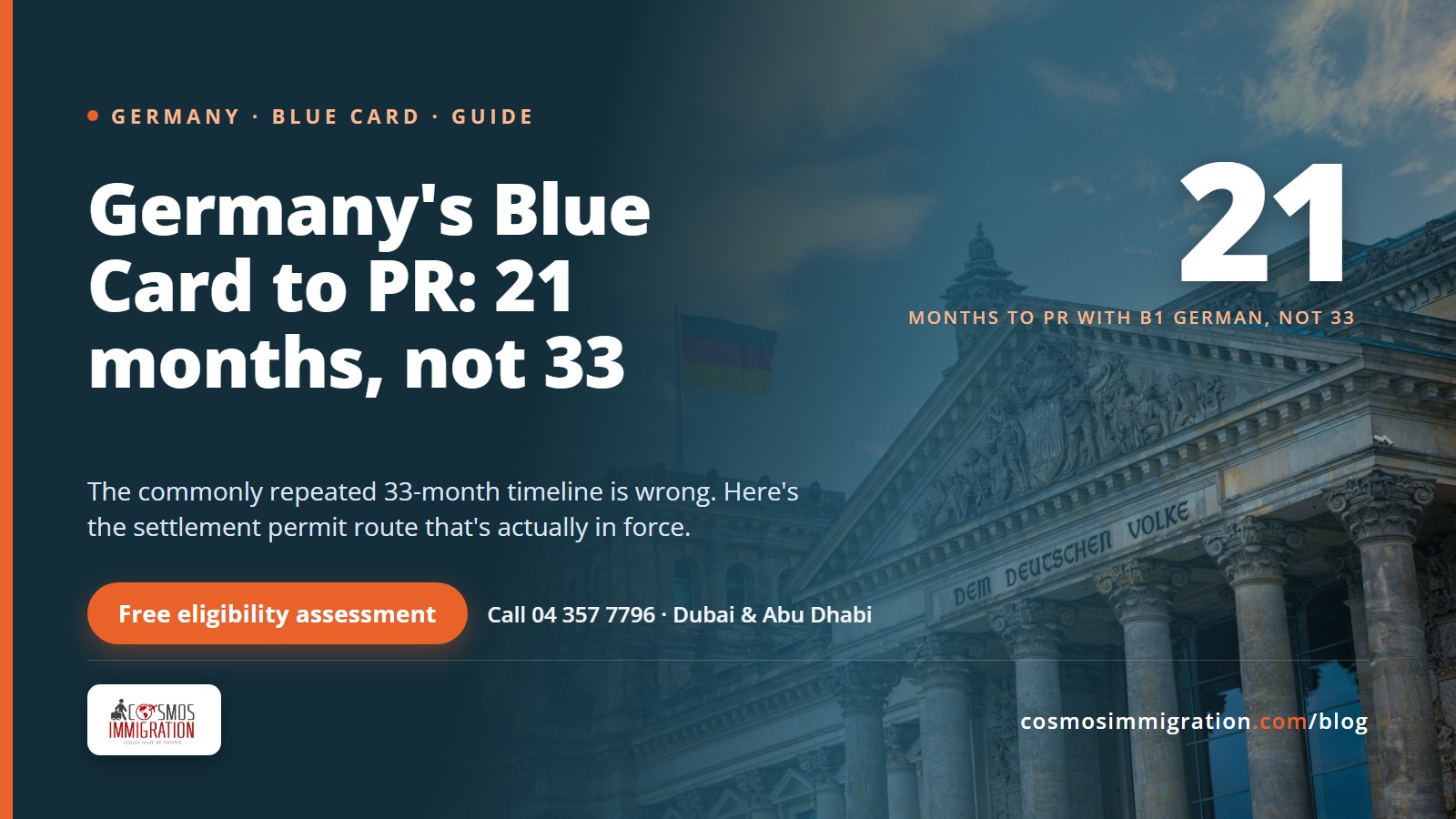
- EU Blue Card holders can apply for Germany’s settlement permit (Niederlassungserlaubnis) after 27 months of qualified employment with German at level A1, or after 21 months with German at level B1 — not the “33 months / C1” figure still repeated on some sites.
- The legal basis is Section 18c(2) of the Residence Act (AufenthG), which absorbed the EU Blue Card Directive (EU) 2021/1883 into German law on 18 November 2023.
- The general (non-Blue-Card) settlement permit route requires five years of legal residence and 60 months of pension contributions — useful as a comparison, not the route most Blue Card holders should aim for.
- A slower fallback route exists for skilled workers under Sections 18a, 18b, 18d or 18g AufenthG: three years of residence, 36 months of pension contributions, and B1 German plus a “Living in Germany” knowledge test.
- Spouses of Blue Card holders are exempt from the pre-entry German-language test that normally applies to family reunification, and can build their own path to a settlement permit later.
The figure people repeat is wrong — here is the one that matters
A figure that keeps circulating says Germany’s fast-track settlement permit needs 33 months of work and B1 German, or 21 months and C1 German. That combination does not appear on any current German government page we can find. It reads like a leftover from an older version of the rule that has since been simplified.
The current text, published by the German federal government’s own Germany immigration information service, is direct: an EU Blue Card holder can apply for the settlement permit after at least 27 months of qualified employment with pension contributions paid throughout, if they can show German at level A1. If they can show German at level B1 instead, the required period drops to 21 months. There is no C1 requirement anywhere in the current text. Berlin’s own municipal government service page repeats the identical 27/A1 and 21/B1 figures, cross-checking cleanly against the federal source.
This sits in Section 18c(2) of the Residence Act, which took its current form when the EU transposed Directive (EU) 2021/1883 into German law on 18 November 2023. If your source is older than that date, or simply doesn’t cite a section number, treat the numbers on it with caution.
What “qualified employment” and pension contributions actually mean
The 27 or 21 months is not just time spent living in Germany — it has to be qualified employment, and the same period has to be backed by contributions into the statutory pension insurance scheme (the state pension system most salaried employees are automatically enrolled in through payroll). If you took unpaid leave, moved between contracts with a gap, or worked in a role that didn’t require the qualification your Blue Card was granted on, it’s worth checking with the Ausländerbehörde (the local foreigners’ authority) how that period is counted before you assume your clock has been running the whole time.
The Blue Card itself is a temporary residence title — issued for the length of your employment contract plus six months, up to a maximum of four years, and renewable if the conditions are still met. The settlement permit is a different, permanent status: once granted, it carries no expiry date and confirms your right to work without further permission tied to a specific employer or role.
How the Blue Card route compares to the other paths to a settlement permit
Germany runs several roads to the same destination, and it helps to see them side by side rather than assume the Blue Card figures apply to everyone.
| Route | Time required | German level | Pension contributions | Who it applies to |
|---|---|---|---|---|
| Blue Card fast track | 27 months (or 21 with B1) | A1, or B1 for the shorter period | Same 27 or 21 months | EU Blue Card holders (Section 18g AufenthG) |
| Skilled-worker fallback | 3 years on the residence title | B1, plus “Living in Germany” knowledge test | 36 months | Holders of titles under Sections 18a, 18b, 18d or 18g, including Blue Card holders who prefer this route |
| Germany-trained route | 2 years on the residence permit | B1, plus knowledge test | 24 months | Skilled workers who completed vocational training or academic study in Germany before moving to a work-based residence permit |
| General (non-skilled-worker) route | 5 years of legal residence | Sufficient command of German, plus basic knowledge of the legal and social system | 60 months | Anyone resident in Germany, regardless of visa category |
The pattern is consistent: the more directly your residence status is tied to a skilled role — and the better your German — the shorter the wait. A Blue Card holder who reaches B1 within their first 21 months of qualified work is, on paper, on the fastest published route to permanence that Germany currently publishes.
Family: what changes for a spouse
One detail that surprises people planning a move as a couple: spouses and registered civil partners of EU Blue Card holders are exempt from the pre-entry German-language requirement that otherwise applies to family reunification under Section 30 of the Residence Act. Most family-reunification categories require the joining spouse to prove basic German before they even apply for a visa. Blue Card families are one of the listed exceptions — the spouse can join in Germany and start learning German there instead of before departure.
Once the Blue Card holder has been granted their own settlement permit, the spouse has a separate route to apply for a settlement permit of their own, though the conditions for that step depend on their individual residence history and are worth confirming with the Ausländerbehörde directly.
From the UAE: what this means for you
If you’re weighing a Blue Card offer from Munich, Frankfurt or Berlin while based in Dubai or Abu Dhabi, the practical planning point is this: the clock that matters starts on your first day of qualified employment in Germany, not on the day you decide to learn German. Booking a recognised German test (A1 or B1, depending on which track you’re aiming for) early — many test centres in the UAE offer Goethe-Institut or telc exams — means your language proof is ready well before the 21 or 27-month mark, rather than becoming a last-minute scramble.
Document preparation from the UAE follows the pattern you’ll already recognise from other visa applications: degree and employment certificates may need attestation before they’re accepted by German authorities, and it’s worth starting that process in parallel with your Blue Card application rather than after you land. If your qualifications need independent verification for the job offer itself, our credential verification guidance covers what documents German employers and authorities typically expect to see. And because Germany isn’t the only country in Europe offering a fast-track skilled-worker route, it’s worth a quick side-by-side look at options like the Opportunity Card if you’re still job-searching rather than holding an offer, before committing to a specific pathway.
Frequently asked questions
Is the 33-months / C1 figure ever correct?
Not under the current rule. The figures published on official German government pages today are 27 months with A1 German, or 21 months with B1 German. If you see 33 months or a C1 requirement quoted for the Blue Card settlement permit, it does not match the current text of Section 18c(2) AufenthG.
Do I need to stay with the same employer for the full 21 or 27 months?
The requirement is qualified employment with pension contributions paid throughout that period, not necessarily one unbroken contract with a single employer. If you change roles or employers, it’s worth confirming with your local Ausländerbehörde how the change affects your qualifying period before you assume continuity.
What if my German is below A1 when I arrive?
The Blue Card itself does not require German at the point of entry — the language requirement applies to the later settlement-permit application. That gives you the 21-to-27-month window to study, though reaching B1 sooner is what unlocks the faster 21-month track rather than the 27-month one.
What to do next
If you’re holding a Blue Card offer, already in Germany on one, or comparing Germany against other European or Gulf-adjacent options, a free eligibility assessment is a practical starting point — it maps your current documents and language level against the route that actually fits your situation. Call us on 04 357 7796, or book a 20-minute review to talk it through. Our tools page also has calculators worth checking before you commit to a plan — see our tools. We don’t promise outcomes on any application; what we can do is help you plan around the rules as they currently stand.
Sources
- Settlement permit — Make it in Germany (Federal Government of Germany) — accessed 1 Sept 2026
- Niederlassungserlaubnis für Inhaber einer Blauen Karte EU beantragen — Service Berlin (Land Berlin) — accessed 1 Sept 2026
- Die Blaue Karte EU — BAMF (Bundesamt für Migration und Flüchtlinge) — accessed 1 Sept 2026
- EU Blue Card — Make it in Germany (Federal Government of Germany) — accessed 1 Sept 2026
- Aufenthaltsgesetz (AufenthG) Section 30 — Bundesministerium der Justiz — accessed 1 Sept 2026
Not sure which route fits you? Book a free eligibility assessment with our Dubai or Abu Dhabi team. No obligation.
Call +971 4 357 7796WhatsApp us