Picture a refusal letter that leaves you thinking, “I don’t even understand what I did wrong.” Often nothing in the file is mysterious. A medical exam booked too late. A bank letter missing the institution’s letterhead. An Educational Credential Assessment that quietly expired while the applicant waited to feel “ready” to apply. None of it is a hidden trap. It is paperwork that could have been fixed months earlier, with the right checklist.
It is a common pattern: skilled, qualified candidates who lose an otherwise strong Canada PR application not to some unbeatable rule, but to a missed step. This guide walks through why Canadian immigration officers actually refuse permanent residence applications, and which reasons are fixable if you catch them early.
At a glance
- Canada PR refusals generally fall into two groups: inadmissibility (security, criminal, or medical grounds) and misrepresentation, or a set of fixable procedural gaps.
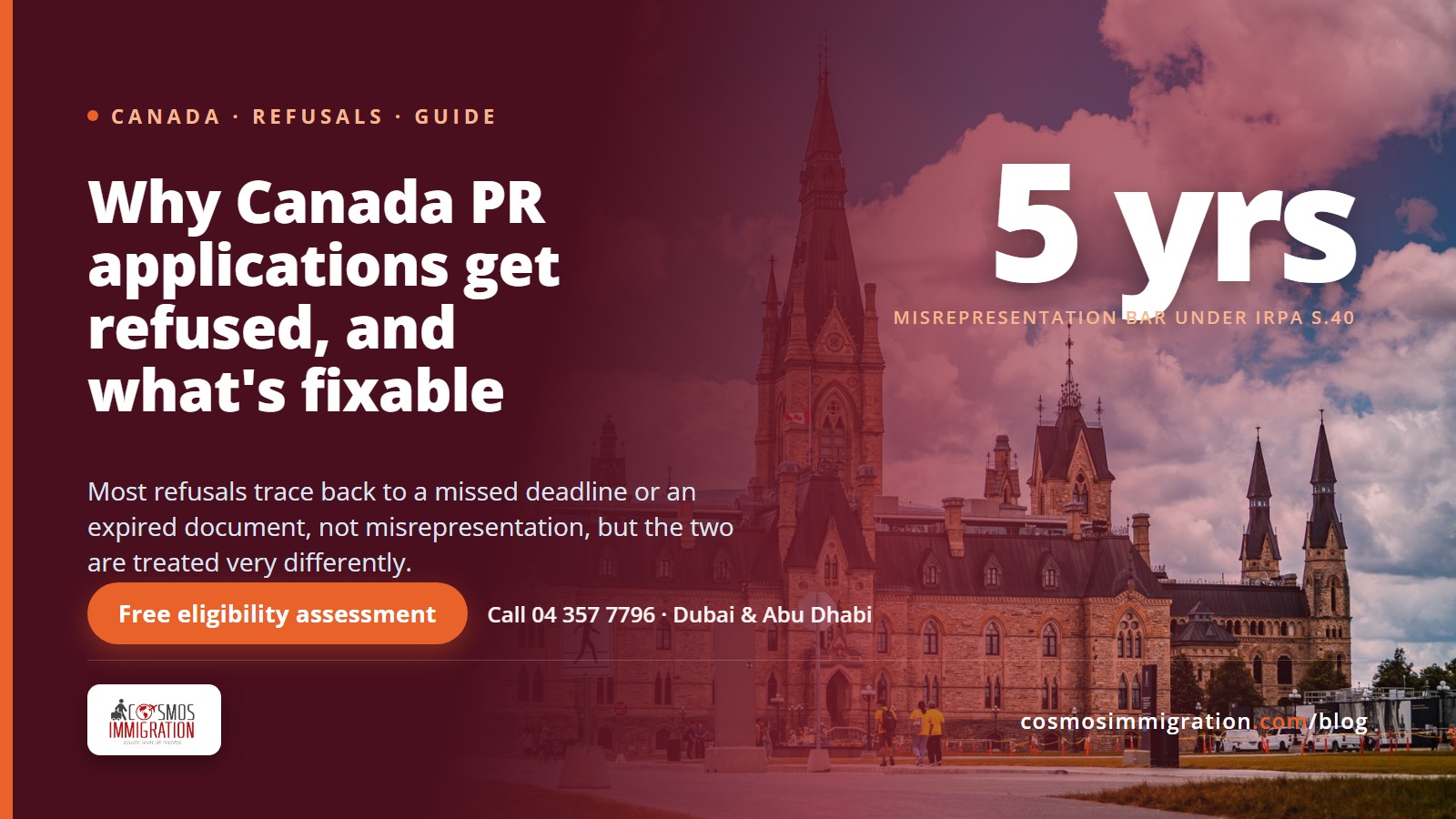
- Misrepresentation under IRPA section 40 carries a 5-year bar on applying for permanent residence — and you’re responsible for your application even if a representative completed it for you.
- Medical inadmissibility is assessed on three grounds only: danger to public health, danger to public safety, or excessive demand on health or social services.
- Common fixable mistakes include missing the 60-day Express Entry deadline to apply after an invitation, incomplete proof of funds, a lapsed medical exam window, missing biometrics, or an Educational Credential Assessment older than 5 years.
- IRCC’s own procedural fairness guidance describes giving applicants a chance to respond to concerns before a decision is made — though it is not described as something that happens in every single case.
What actually gets a Canada PR application refused?
Every application is reviewed by an immigration officer, who decides whether the person can enter or stay in Canada. If the officer finds the applicant inadmissible, the result is a denied visa or eTA, a refusal of entry, or removal from Canada. IRCC groups the reasons under categories that include security, criminal, and medical reasons. A temporary resident permit can sometimes be issued for a justified reason to travel, but otherwise an inadmissible person will normally not be allowed to enter the country.
Most people who come to us after a refusal fall into one of two very different situations: a serious admissibility or honesty problem, or a procedural detail that went unnoticed. The two need very different responses, so it’s worth understanding both before you assume the worst.
Misrepresentation: the refusal that follows you for five years
Of everything in this article, misrepresentation is the one worth taking most seriously. Under section 40(1) of the Immigration and Refugee Protection Act, a person is inadmissible for misrepresentation if they directly or indirectly misrepresent or withhold material facts relating to a relevant matter that induces, or could induce, an error in the administration of the Act. It also covers being sponsored by someone found inadmissible for misrepresentation, and certain refugee- and citizenship-related situations.
The consequence is significant. Under section 40(2)(a), a person found inadmissible for misrepresentation remains inadmissible for five years — from the date of a final determination if it happened outside Canada, or from the date a removal order is enforced if it happened inside Canada. Section 40(3) is explicit that during that five-year period, the person cannot apply for permanent resident status at all.
IRCC is direct about responsibility here: “There are serious consequences for lying on an application or in an interview, or for sending fake or altered documents.” The applicant is responsible for all information in their application, even if a representative completed it. Providing false medical documents or misrepresenting information to a panel physician is treated as fraud, and so is lying about physical presence in Canada when applying for a PR card renewal or citizenship. If a representative is helping you, check your own file carefully before it’s submitted.
Medical inadmissibility: not just about being unwell
Every applicant for permanent residence, along with their family members — even non-accompanying ones — must complete an immigration medical exam. IRCC assesses medical inadmissibility on three grounds only: danger to public health, danger to public safety, or excessive demand on health or social services.
The exam has to be done by an IRCC-listed panel physician; no other doctor’s report is accepted. Under Express Entry, applicants complete an “upfront medical exam” after receiving the invitation but before submitting, by contacting a panel physician directly. Outside Express Entry, IRCC sends instructions once a complete application is submitted, and the applicant has 30 days to complete the exam.
The procedural mistakes that sink strong applications
This is the category we see most often — and the one that’s genuinely fixable. None of these involve dishonesty or inadmissibility; they’re about missing a deadline, a document, or a step.
| Fixable issue | What IRCC requires |
|---|---|
| Missed Express Entry deadline | Once invited to apply (including under a Provincial Nominee Program invitation), you have 60 calendar days to submit online. Miss it and you’re removed from the pool, needing to re-enter for a future round. |
| Insufficient or undocumented proof of funds | Written proof of settlement funds is required once invited to apply, evidenced by an official bank letter on the institution’s letterhead, showing funds that are available and accessible. |
| Late or missed medical exam | Non-Express-Entry applicants must complete their medical exam within 30 days of receiving IRCC’s instructions; Express Entry applicants need an upfront exam with a panel physician before submitting. |
| Missing biometrics | Fingerprints and a photo are required unless exempt. IRCC bases exemptions on age at the time of application — for example, applicants who were 79 or younger at submission but have since turned 80 still must give biometrics. |
| Expired Educational Credential Assessment | An ECA must be less than 5 years old both when you create your Express Entry profile and when it’s used in an application. IRCC states plainly: “If you apply with an expired ECA, we’ll refuse your application.” |
As at September 2026, the minimum settlement funds IRCC requires (updated effective 7 July 2025) are: CAD $15,263 for 1 person, $19,001 for 2, $23,360 for 3, $28,362 for 4, $32,168 for 5, $36,280 for 6, and $40,392 for 7, plus $4,112 for each additional family member. IRCC can update this table, so always check the current figures rather than relying on a past screenshot — our Canada PR points calculator is a useful starting point.
Does IRCC give you a chance to fix a problem first?
IRCC decision-makers are required to follow the rules of procedural fairness across all types of immigration and citizenship applications. This includes the applicant’s “right to be heard”: being advised of significant facts likely to affect the outcome, and given a fair opportunity to respond. IRCC’s guidance says decision-makers should tell applicants which documents may be needed to address a concern, and where concerns arise from an interview, the applicant should be given an opportunity to address them — including, where appropriate, through a procedural fairness letter.
Read that carefully rather than assuming it means you’ll always get a warning. This is IRCC describing a required part of its decision-making process — not something every applicant is assured of before every refusal. The safer approach is a complete, accurate application the first time.
From the UAE: what this means for you
If you’re building your profile from Dubai or Abu Dhabi, most fixable issues come down to timing. An Educational Credential Assessment done early — while your degree documents are freshly attested — can expire before you’re ready to apply; the 5-year clock runs from both when you create your profile and when you use it. If your qualifications need reassessment, check what’s involved through credential verification before you commit to a timeline.
Proof of funds is another area where UAE-based applicants stumble — not because the money isn’t there, but because the bank letter isn’t formatted the way IRCC expects. It needs to be an official letter on the bank’s letterhead, confirming funds that are available and legally accessible, not a screenshot. Get this ready before an invitation arrives, since the 60-day clock starts the moment you’re invited.
The medical exam has its own timing trap for Express Entry candidates: the upfront exam has to happen with a panel physician after your invitation but before you submit — not before, not after. If you’re not sure your profile is ready for that 60-day window, a full review against IRCC’s current requirements is worth doing first. Explore our immigration tools, or start with our Canada skilled migration overview.
Frequently asked questions
If my immigration consultant filled out my form and made a mistake, am I still responsible?
Yes. IRCC states that the applicant is responsible for all information in their application, even if a representative completed it. Always review your full application yourself before it’s submitted.
Will IRCC always warn me before refusing my application?
IRCC’s guidance describes giving applicants a chance to respond to concerns, including through a procedural fairness letter where appropriate — but this is a described practice, not something every case is assured of. The safest approach is a complete, accurate application the first time.
What happens if I miss the 60-day deadline after getting an invitation to apply?
If you don’t submit your complete application within 60 calendar days of an Express Entry or Provincial Nominee Program invitation, and you haven’t declined it, you’re removed from the pool. You would need to meet the eligibility criteria again and re-enter the pool to be considered in a future round.
What to do next
If you’re planning a Canada PR application from the UAE, it’s worth having your documents and timeline checked before you submit, not after. We offer a free eligibility assessment. Call us on 04 357 7796, or book a 20-minute review. We don’t promise outcomes — every case depends on IRCC’s own decision — but we can help you avoid the mistakes covered here. Browse more guides on our blog.
Sources
- Reasons you may be inadmissible to Canada — Canada.ca (IRCC) — accessed 1 September 2026
- Find out if you’re inadmissible — Canada.ca (IRCC) — accessed 1 September 2026
- Immigration and Refugee Protection Act (S.C. 2001, c. 27), Section 40 — Justice Laws Website, Department of Justice Canada — accessed 1 September 2026
- Consequences of immigration and citizenship fraud — Canada.ca (IRCC) — accessed 1 September 2026
- Procedural fairness — Canada.ca (IRCC operational bulletins and manuals) — accessed 1 September 2026
- Provincial Nominee Program: Express Entry process — Apply for permanent residence — Canada.ca (IRCC) — accessed 1 September 2026
- Express Entry: Proof of funds — Canada.ca (IRCC) — accessed 1 September 2026
- Medical examination for permanent residence applicants — Canada.ca (IRCC) — accessed 1 September 2026
- Medical refusals and inadmissibility — Canada.ca (IRCC operational bulletins and manuals) — accessed 1 September 2026
- Biometrics: Who needs to give their fingerprints and photo — Canada.ca (IRCC) — accessed 1 September 2026
- Express Entry: Educational credential assessment — Canada.ca (IRCC) — accessed 1 September 2026
Not sure which route fits you? Book a free eligibility assessment with our Dubai or Abu Dhabi team. No obligation.
Call +971 4 357 7796WhatsApp us