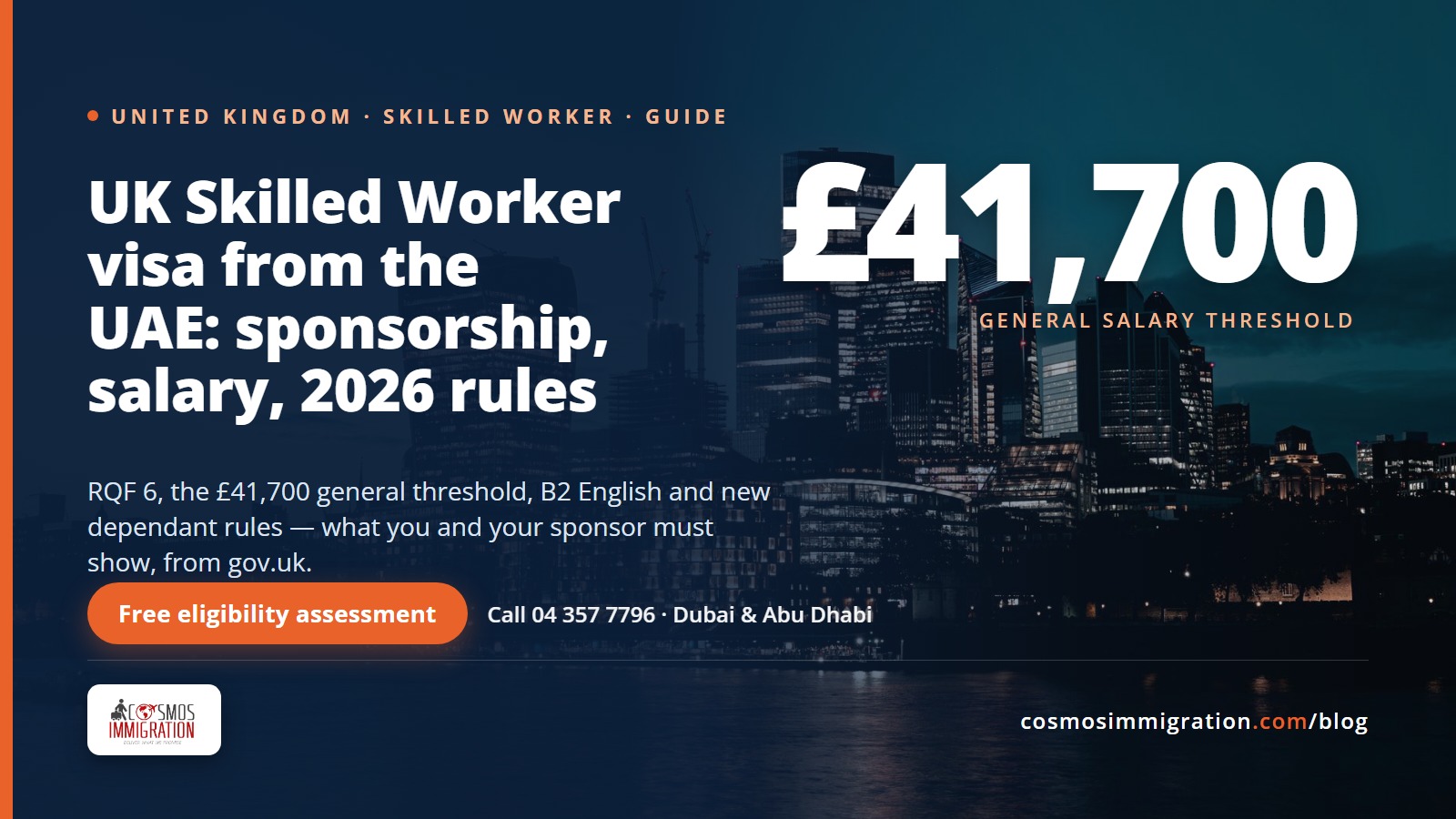
If you are in the UAE with a UK job offer, or working towards one, the Skilled Worker rules you need to check are the ones in force since 22 July 2025 and 8 January 2026, not the ones most people still quote. The job now has to be at RQF level 6, the pay floor is £41,700 or the going rate for your occupation code, whichever is higher, and new applicants must prove English at B2. The figure that catches out most applicants is the going rate: for a software developer it is £54,700, not £41,700, and an offer below it does not qualify. This guide sets out the rules as at August 2026, with every number taken from gov.uk.
At a glance
- You need a job offer from a Home Office-approved sponsor and a Certificate of Sponsorship (CoS), and you must apply within 3 months of receiving the CoS.
- Since 22 July 2025 the job must be at RQF level 6 unless it is on the Immigration Salary List or the Temporary Shortage List.
- Minimum pay is the higher of £41,700 a year or the going rate for your occupation code.
- Since 8 January 2026 new applicants must prove English at CEFR B2; approved test centres operate in Dubai, Abu Dhabi, Sharjah and Al Ain.
- Settlement (ILR) is still 5 years on gov.uk as at August 2026; a 10-year baseline is only a consultation, and B2 English applies at settlement from 26 March 2027.
What changed in July 2025 and January 2026
Two rule changes reshaped this route. On 22 July 2025 the skill threshold rose from RQF 3 to RQF 6, removing around 180 occupations. Anyone already on the route can keep extending in a medium-skilled role if their first Certificate of Sponsorship was issued before that date. A new applicant from the UAE cannot use those roles unless the job is on the Immigration Salary List or the Temporary Shortage List. Entries on both lists carry removal dates at the end of 2026, so eligibility through either list should be checked against those dates rather than assumed to continue.
The same statement of changes lifted the general salary threshold to £41,700 and raised the going rates. It also ruled that workers sponsored in RQF 3 to 5 roles through either list cannot bring dependants.
The second change took effect on 8 January 2026, when the English requirement for new Skilled Worker applicants rose from B1 to B2. If you held the visa before that date and are extending, B1 still applies.
Sponsorship: the employer comes first
There is no self-sponsored version of this visa. Your employer must hold a sponsor licence. Gov.uk says a licence application usually takes around 8 weeks to process and costs £611 for a small or charitable sponsor or £1,682 for a medium or large one. Where a UK company has not sponsored before, those 8 weeks sit in front of everything else in your timeline. Once the licence is granted, the employer assigns you a Certificate of Sponsorship stating your job title, occupation code, salary and sponsor licence number.
The employer also pays the Immigration Skills Charge. Gov.uk states that a licence can be revoked if the sponsor passes this cost to the worker, so an employer asking you to contribute to it is acting outside the rules. The charge is not made for dependants, and it is refunded if the visa is refused or withdrawn or if you do not start the job.
| Immigration Skills Charge | Small or charitable sponsor | Medium or large sponsor |
|---|---|---|
| First 12 months | £480 | £1,320 |
| Each additional 6 months | £240 | £660 |
| Maximum for a 5-year CoS | £2,400 | £6,600 |
These figures are worth having to hand when a first-time sponsor asks what sponsoring you will cost them, since the charge is in addition to the licence fee above.
Salary thresholds and going rates
You must be paid the higher of £41,700 or the going rate for your occupation code. Going rates are annual, based on a 37.5-hour week, and pro-rated for other working patterns. In practice the going rate is usually the figure that applies: of the eight occupations below, seven have going rates above £41,700. These are the codes we deal with most often from Dubai and Abu Dhabi, taken from the official table last updated 22 July 2025.
| Occupation code | Job type | Standard going rate | What you must actually be paid |
|---|---|---|---|
| 2134 | Programmers and software development professionals | £54,700 | £54,700 |
| 2123 | Electrical engineers | £58,700 | £58,700 |
| 2121 | Civil engineers | £50,400 | £50,400 |
| 2431 | Management consultants and business analysts | £50,200 | £50,200 |
| 2421 | Chartered and certified accountants | £49,200 | £49,200 |
| 2135 | Cyber security professionals | £48,500 | £48,500 |
| 2122 | Mechanical engineers | £46,800 | £46,800 |
| 2136 | IT quality and testing professionals | £41,200 | £41,700 (general threshold applies) |
When you can be paid less
Reduced rates exist, and each has its own floor. If you are under 26, a recent graduate or in professional training, you can be paid 70% of the going rate, subject to a minimum of £33,400 and a 4-year cap on total stay under that concession. A relevant STEM PhD allows 80% of the going rate with a minimum of £33,400. A non-STEM PhD allows 90% with a minimum of £37,500. Immigration Salary List jobs have a £33,400 floor but must still meet the going rate. Healthcare and education roles are assessed against national pay scales instead.
English, fees and the money you must show
You can meet the English requirement with a degree taught in English (a non-UK degree needs an Ecctis assessment to confirm this) or with a Secure English Language Test at B2. Outside the UK the approved providers are the IELTS SELT Consortium, LanguageCert, Pearson and PSI Services, and the test must have been awarded within the 2 years before you apply. Nationals of the countries listed on gov.uk are exempt from the requirement.
The application fee from outside the UK is £819 for a visa of up to 3 years or £1,618 for more than 3 years. For Immigration Salary List jobs the fees are £628 and £1,235. The Immigration Health Surcharge is £1,035 per year for most applicants and £776 per year for anyone under 18. Unless you are exempt, you must also show £1,270 held for 28 days, plus £285 for a partner, £315 for your first child and £200 for each further child, held for the same 28 days. This 28-day window is the point at which UAE bank statements usually need attention, because the balance has to be in place for the full period before the application is made.
Dependants and settlement in 2026
If your role is RQF 6 or above, your husband, wife, civil partner or unmarried partner (where you have lived together for at least 2 years) and children under 18 can apply as dependants. Partners can work and study. Dependants of workers sponsored in medium-skilled roles through the two lists can only join if the worker has been continually employed since before 22 July 2025 or another listed exception applies.
On settlement, it helps to keep what is in force separate from what has only been proposed. As at August 2026, gov.uk still says you can apply for indefinite leave to remain from 28 days before you complete 5 years. You must have spent no more than 180 days outside the UK in any 12-month period, be paid at least the higher of £41,700 or the going rate at the point of settlement, have your sponsor confirm you are still needed, and pass the Life in the UK test if you are aged 18 to 64. The fee is £3,226 per person and a decision usually comes within 6 months. Time spent in the UK as a dependant does not count toward your own 5 years.
Two changes sit behind the 2026 headlines, and only one of them is law. From 26 March 2027 the English requirement at settlement rises from B1 to B2 for Skilled Worker applicants, including people already on a pathway to settlement. Separately, the “earned settlement” consultation, published 20 November 2025 and now closed, proposes raising the baseline qualifying period from 5 to 10 years, adjustable for contribution and integration, with the Skilled Worker route defaulting to 10 years unless an earned reduction applies. The gov.uk page says the Home Office is still analysing feedback, and no rule change has been published. We advise clients to budget for the possibility of a longer path and to check the consultation outcome before relying on the 5-year figure.
From the UAE: what this means for you
The United Arab Emirates is not on the gov.uk list of countries whose residents need a tuberculosis test, so applicants from Dubai or Abu Dhabi do not need that appointment. The gov.uk visa application centre finder directs UAE applicants to VFS Global. The Abu Dhabi centre is at Level B2, The Mall, World Trade Centre, on Airport Road.
The documents gov.uk asks for are the CoS reference number, your passport, proof of English, your job title, salary, occupation code and sponsor licence number, and bank statements if you are not exempt from the maintenance requirement. Degree attestation is not on the list. What the list does require is an Ecctis reference for overseas qualifications and a certified translation of any document not in English.
Jobs in education, healthcare, therapy or social services also need a criminal record certificate from every country where you have lived for 12 months or more if you are under 28, or during the last 10 years if you are 28 or over. For a long-term UAE resident that generally means a UAE police clearance plus one from your home country, and the home-country certificate is usually the slower of the two to obtain.
The Home Office list of approved test centres dated 11 August 2026 shows IELTS for UKVI at British Council and IDP sites in Dubai, Abu Dhabi, Sharjah and Al Ain, PTE Academic UKVI in Business Bay and Dubai Silicon Oasis, LanguageCert in Al Quoz, Abu Dhabi and Sharjah, and several PSI centres across Dubai and Abu Dhabi.
On timing, you can apply up to 3 months before your CoS start date and must apply within 3 months of the CoS being issued. Gov.uk says a decision usually comes within 3 weeks of applying online, proving your identity and providing your documents. In the cases we handle from our Dubai office, the longer wait is usually on the employer’s side: the licence application at around 8 weeks, followed by the CoS being assigned. The visa decision itself is the shorter step, which is why we ask clients to confirm the employer’s licence position before resigning from a UAE role.
Frequently asked questions
Can I apply without a job offer and find work after arriving?
No. This route requires a confirmed offer from a Home Office-approved employer and a Certificate of Sponsorship before you apply.
My UAE degree was taught in English. Do I still need IELTS?
Not necessarily. A degree taught in English at a non-UK institution can meet the requirement, but you need an Ecctis assessment to confirm it. Without that reference, a B2 Secure English Language Test is the fallback.
Is ILR really moving to 10 years?
Proposed and consulted on, not enacted. As at August 2026 gov.uk still states 5 years. What is enacted is B2 English at settlement from 26 March 2027. We will update this guide when the outcome is published.
What to do next
If you have an offer, or a UK employer interested in sponsoring you, start with our UK Skilled Worker visa page and the wider UK immigration overview. Request a free eligibility assessment, call 04 357 7796, or book a 20-minute review at our Dubai or Abu Dhabi office. You can check who you are dealing with on our verify credentials page, or browse all our guides. We assess your case against the published rules and say plainly where an offer falls short; we do not promise outcomes.
Sources
- Skilled Worker visa: Overview (GOV.UK) — accessed 27 Aug 2026
- Skilled Worker visa: Your job (GOV.UK) — accessed 27 Aug 2026
- Skilled Worker visa: When you can be paid less (GOV.UK) — accessed 27 Aug 2026
- Skilled Worker visa: going rates for eligible occupation codes (GOV.UK) — accessed 27 Aug 2026
- Explanatory memorandum to the statement of changes to the Immigration Rules: HC 997, 1 July 2025 (GOV.UK) — accessed 27 Aug 2026
- Skilled Worker visa: temporary shortage list (GOV.UK) — accessed 27 Aug 2026
- Skilled Worker visa: Knowledge of English (GOV.UK) — accessed 27 Aug 2026
- Prove your English language abilities with a secure English language test (SELT) (GOV.UK) — accessed 27 Aug 2026
- Skilled Worker visa: How much it costs (GOV.UK) — accessed 27 Aug 2026
- Pay for UK healthcare as part of your immigration application: How much you have to pay (GOV.UK) — accessed 27 Aug 2026
- UK visa sponsorship for employers: Immigration skills charge (GOV.UK) — accessed 27 Aug 2026
- Skilled Worker visa: Your partner and children (GOV.UK) — accessed 27 Aug 2026
- Skilled Worker visa: Documents you’ll need to apply (GOV.UK) — accessed 27 Aug 2026
- Skilled Worker visa: Apply from outside the UK (GOV.UK) — accessed 27 Aug 2026
- Indefinite leave to remain if you have a Skilled Worker, Health and Care Worker, T2 or Tier 2 visa (GOV.UK) — accessed 27 Aug 2026
- Indefinite leave to remain (Skilled Worker): Time in the UK (GOV.UK) — accessed 27 Aug 2026
- Indefinite leave to remain (Skilled Worker): Salary requirements (GOV.UK) — accessed 27 Aug 2026
- Explanatory memorandum to the statement of changes in the Immigration Rules: HC 1691, 5 March 2026 (GOV.UK) — accessed 27 Aug 2026
- Earned settlement consultation (GOV.UK) — accessed 27 Aug 2026
- Countries where you need a TB test for your UK visa application (GOV.UK) — accessed 27 Aug 2026
- Find a visa application centre (GOV.UK) — accessed 27 Aug 2026
- British Embassy Abu Dhabi: UK VFS Visa Application Centre (GOV.UK) — accessed 27 Aug 2026
Cover photo: Mario Spencer via Pexels
Not sure which route fits you? Book a free eligibility assessment with our Dubai or Abu Dhabi team. No obligation.
Call +971 4 357 7796WhatsApp us