The next decreto flussi click days are already fixed: 12 January, 9 February, 16 February and 18 February 2027, each at 09:00 Italian time. The same four dates apply again in 2028. What has not been announced yet is the 2027 pre-compilation window, the period in which Italian employers prepare their applications on the Ministry of Interior’s ALI portal. Only an employer in Italy can file, so a worker in the UAE cannot apply directly.
We are asked regularly in Dubai and Abu Dhabi about offers to sell a nulla osta or a click-day place. No such thing can be bought. This guide sets out the official process as it stands on 26 September 2026, so you can check any offer against it.
Updated 26 September 2026.
At a glance
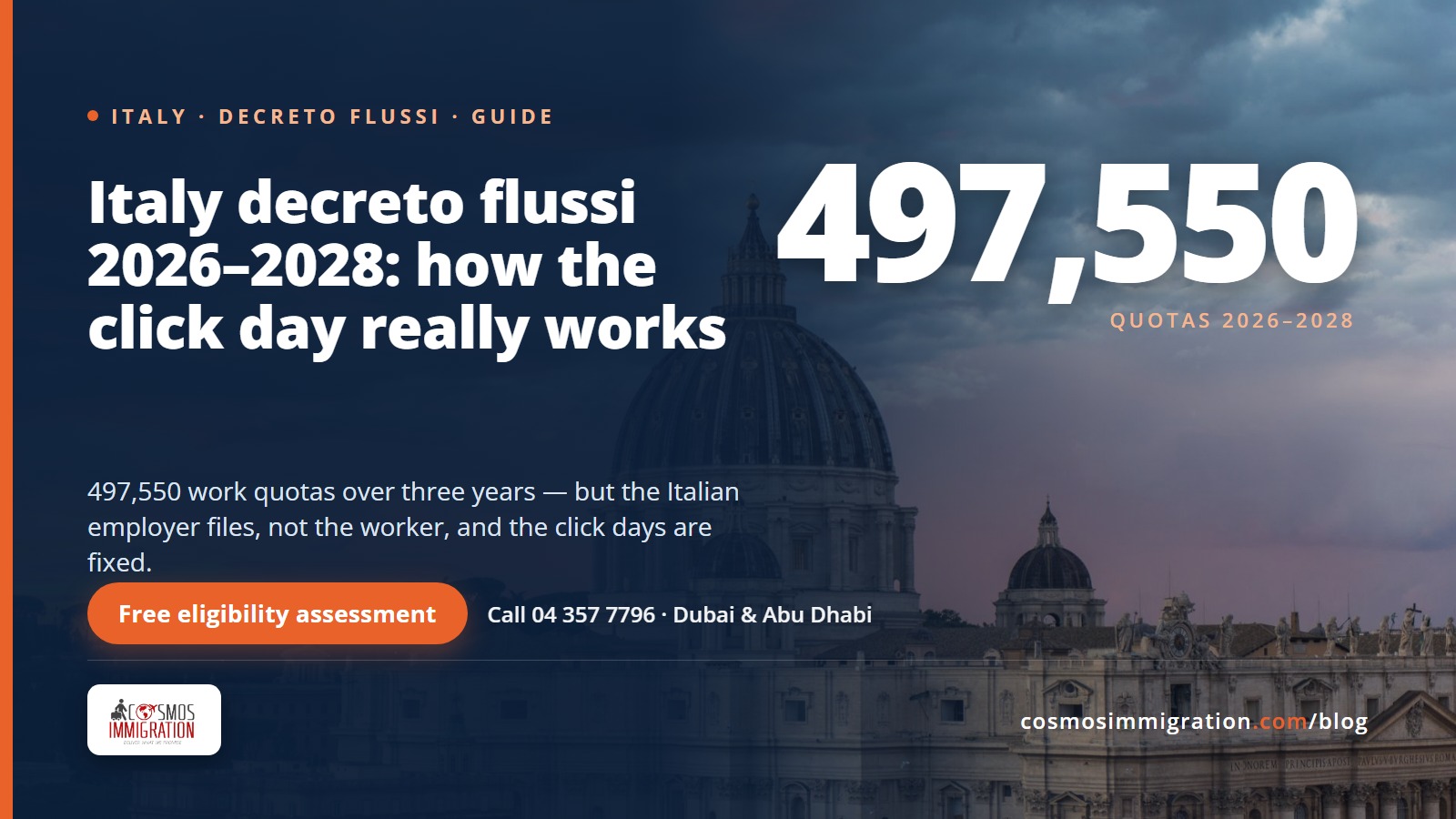
- The decree (DPCM 2 October 2025, published 15 October 2025) sets 497,550 entries over three years: 164,850 in 2026, 165,850 in 2027 and 166,850 in 2028.
- 2027 click days: 12 Jan (seasonal agriculture), 9 Feb (seasonal tourism), 16 Feb (non-seasonal employment) and 18 Feb (family and care assistance), all at 09:00 Italian time, which is 12:00 in the UAE. 2028 uses the same dates.
- The 2027 pre-compilation window is set by a joint ministerial circular. As of 26 September 2026 that circular has not been published.
- Only an employer in Italy can file, on the ALI portal with SPID or CIE digital identity and a PEC email. A worker abroad cannot self-apply.
- After the nulla osta, the worker applies for a type D visa at the Italian mission for their emirate. For the Blue Card and intra-company transfer routes, see our Italy work visa routes from the UAE.
- Nobody can sell you a quota place, a “priority” click or a faster consular appointment. The Italian Embassy in Colombo reported the arrest of intermediaries doing exactly that.
Click day dates for 2026, 2027 and 2028
Earlier decrees set their dates one year at a time. This one fixes the calendar for all three years in article 8 of the DPCM. Applications open at 09:00 on each date and stay open until the quota for that category runs out, or until 31 December of the same year at the latest.
| Category | Employer form | 2026 | 2027 | 2028 |
|---|---|---|---|---|
| Seasonal work, agriculture | C-Stag agricolo | 12 Jan 2026 | 12 Jan 2027 | 12 Jan 2028 |
| Seasonal work, tourism | C-Stag turistico | 9 Feb 2026 | 9 Feb 2027 | 9 Feb 2028 |
| Non-seasonal employment in the listed sectors | B2020 | 16 Feb 2026 | 16 Feb 2027 | 16 Feb 2028 |
| Non-seasonal family and care assistance | A-bis | 18 Feb 2026 | 18 Feb 2027 | 18 Feb 2028 |
The categories and forms shown are the ones the 2026 circular used; the circular for each later year confirms them. All times are 09:00 Italian time. In January and February Italy is three hours behind the UAE, so the portal opens at 12:00 noon UAE time. That matters only to the employer or its professional, since they are the ones who press send.
When does pre-compilation open for 2027?
This is the “open date” most people are really asking about. The decree says pre-compilation takes place in a period, and for a duration, set by a joint circular of the ministries involved. That circular for the 2027 cycle had not been published when we checked on 26 September 2026.
The only precedent is 2026. The DPCM was published on 15 October 2025, the joint circular followed on 16 October, and pre-compilation ran from 09:00 on 23 October to 20:00 on 7 December 2025, with a short editing window from 9 to 13 December. Since the first 2027 click day is 12 January 2027, the 2027 window has to fall before that date. If the 2026 pattern is repeated, it would sit somewhere in the last quarter of 2026. That is our reading of the pattern, not an announcement. The Ministry of Interior and the ALI portal will publish the real dates.
Can an employer still apply for 2026?
Yes, until 31 December 2026, but only against quotas that remain available in that category and province. The decree also has a lapse rule. Requests that have not been assigned a quota within six months after 31 December of their year, and nulla osta that have not led to a visa within the same period, lapse and are archived automatically.
What the 2026–2028 decree actually sets
The decree covers three years rather than one, and several lines change from year to year. The figures below come from the DPCM itself (articles 6 and 7).
| Entry type | 2026 | 2027 | 2028 |
|---|---|---|---|
| Non-seasonal employment (lavoro subordinato) | 76,200 | 76,200 | 76,200 |
| of which: listed cooperating countries | 25,000 | 25,000 | 25,000 |
| of which: countries with new agreements in force during the period | 18,000 | 26,000 | 34,000 |
| of which: family and care assistance | 13,600 | 14,000 | 14,200 |
| of which: refugees and stateless persons | 300 | 300 | 300 |
| of which: unreserved | 19,300 | 10,900 | 2,700 |
| Self-employment (lavoro autonomo) | 650 | 650 | 650 |
| Seasonal work, agriculture and tourism | 88,000 | 89,000 | 90,000 |
| of which: reserved for tourism | 13,000 | 14,000 | 15,000 |
| of which: multi-year seasonal nulla osta | 5,000 | 6,000 | 7,000 |
| Total | 164,850 | 165,850 | 166,850 |
The pattern is easy to miss. The non-seasonal total stays flat at 76,200, but the share reserved for countries that sign new agreements with Italy grows from 18,000 to 34,000, and the unreserved pool shrinks to match. In practice, nationality matters more each year. The listed cooperating countries include India, Pakistan, Bangladesh, Sri Lanka, the Philippines, Egypt, Jordan, Morocco, Tunisia, Nigeria and Ghana. Family and care assistance is the exception: the Prefettura di Macerata’s official summary of the decree notes that no nationality restriction applies to that quota.
The sectors are fixed by the decree: agriculture, forestry and fishing; food, beverage and tobacco; textiles, clothing and footwear; metallurgy and metal products; other industry; construction; wholesale and retail; accommodation and food service; tourism; transport, logistics and warehousing; business and personal support services; private healthcare and social care; and other services.
Who applies: the Italian employer, never you
The request for a nulla osta al lavoro is filed by an employer in Italy, which may be a company or a private household, at the Sportello Unico per l’Immigrazione (SUI) of the province where the work will take place. The request names the worker. The Ministry of Interior’s own visa page states that the work visa “is obtained only after” that nulla osta. There is no form for the worker to complete and no portal account for the worker to open.
Which form for which job
Each click day has its own form, and the employer picks the one that matches the job. C-Stag agricolo is for seasonal farm work and C-Stag turistico for seasonal hotel and tourism work. B2020 covers non-seasonal jobs in the listed sectors, such as construction, logistics or food production. A-bis is for family and care assistance, meaning domestic workers and carers hired by a household. If someone offers you a “work permit” but cannot tell you which form the employer is using, treat that as a warning sign.
Before the click day the employer has to satisfy several conditions:
- Ask the local Centro per l’Impiego whether a worker already in Italy is available; no reply within eight calendar days counts as a negative.
- Obtain an asseverazione from a professional authorised under Law 12/1979 or from an employer organisation, in every sector including family assistance.
- Show economic capacity: outside the domestic sector, taxable income or turnover of at least EUR 30,000 a year; a household hiring a carer needs EUR 20,000 (single) or EUR 27,000 (with cohabiting family).
- File no more than three requests a year as a private employer (Decree-Law 146/2025); employer organisations, authorised professionals and staffing agencies are exempt from the cap.
Decree-Law 146/2025 also made truthfulness checks systematic. Every application is cross-matched against Interior, Chamber of Commerce, tax, social security and customs databases, and the Labour Inspectorate checks that the number of requests is proportionate to the employer’s economic capacity, in order to identify mass filings.
How the click day works
The click day is the moment at which applications already prepared and saved during pre-compilation are transmitted. Nothing is drafted on the day itself. Here is how the 2026 cycle ran.
2026 timeline
| Date (Italian time) | What happened | Who acts |
|---|---|---|
| 23 Oct 2025, 09:00 to 7 Dec 2025, 20:00 | Pre-compilation on the ALI portal (SPID or CIE, PEC required); documents uploaded and signed digitally | Employer or its professional |
| 9 to 13 Dec 2025 | Portal reopened only to edit and save pre-filled forms | Employer |
| 12 Jan 2026, 09:00 | Click day: seasonal agriculture (model C-Stag agricolo) | Employer |
| 9 Feb 2026, 09:00 | Click day: seasonal tourism (model C-Stag turistico) | Employer |
| 16 Feb 2026, 09:00 | Click day: non-seasonal employment in the listed sectors (model B2020) | Employer |
| 18 Feb 2026, 09:00 | Click day: non-seasonal family and care assistance (model A-bis) | Employer |
| Within 10 days of each click day | Ministry of Labour distributes quotas by province and sector; requests are assigned in order of arrival, or wait | Ministry of Labour |
| 20 days (seasonal) or 60 days (non-seasonal) from quota assignment | SUI decides; silence counts as approval unless the Questura objects (not automatic for Bangladeshi, Pakistani, Sri Lankan and Moroccan nationals) | SUI, Questura, Labour Inspectorate |
| Until 31 Dec 2026 | Applications may still be lodged, only against quotas that remain available | Employer |
You, as the worker, take no part in any of these steps. The first document that reaches you is the nulla osta itself, once the SUI has issued it.
What changes for 2027
The click-day dates stay the same, and the new circular will confirm which form is used on each date. Three things differ. The pre-compilation dates will come from a new circular, so the 2026 window above is a guide, not a promise. The quota lines move as shown in the table: more places for family and care assistance and for new-agreement countries, fewer unreserved places. And if the Ministry of Labour finds significant unused quotas 50 days after they were assigned, the decree allows it to redistribute them, so availability can shift during the year.
After the nulla osta: visa, entry, contract, permit
A nulla osta is an authorisation to hire, not a visa. The remaining steps are these:
- The nulla osta is addressed to a specific Italian mission. For most UAE residents that is Abu Dhabi or Dubai, but the rules also allow the mission in your country of origin, so check which one your employer named.
- You book a type D visa appointment. The SUI then asks the employer by PEC to confirm the hire within 15 days; without confirmation the nulla osta is revoked, and only after it does the mission issue the visa.
- The nulla osta must be used within 6 months of issue; fingerprints are taken for national visas.
- Within 15 days of entering Italy, you and the employer sign the contratto di soggiorno digitally (you may sign by hand) and the employer uploads it to the ALI portal.
- You apply for the permesso di soggiorno within 8 working days of entry and may work from the day the receipt is issued. A permit for open-ended employment lasts up to two years, seasonal up to nine months; renew at least 60 days before expiry.
“Buy a nulla osta”: checks before you pay anyone
Offers of this kind usually price a “quota place” together with the click-day filing, and sometimes add a “priority” consular appointment. None of these can be sold. The quota is assigned by the Ministry of Labour to the employer’s request in order of arrival; the filing is made by the employer under its own digital identity; consular appointments in Abu Dhabi are booked through Prenot@mi after the embassy has been emailed. The Italian Embassy in Colombo reported the arrest of a group charging roughly EUR 6,000 for a promised visa and EUR 600 for a “priority appointment”, and reminded applicants that no intermediary can give preferential access to consular services.
Warning signs to look for:
- You cannot name the Italian employer, its Chamber of Commerce registration or the SUI province.
- You are told to pay for the nulla osta itself. The employer files it, in its own name.
- Nobody can show you the request on the ALI portal, or the asseverazione behind it.
- You are promised a 2027 place before the 2027 pre-compilation window has even been announced.
- You are told to fly on a visit visa and “sort it out in Italy”. The route runs through a type D visa issued where you live.
If any of these apply, hold on to your money until you get straight answers. Our credential verification page sets out how to check who you are dealing with.
From the UAE: what this means for you
Which mission. Only holders of a UAE residence visa issued in the Emirate of Abu Dhabi (Abu Dhabi, Al Ain and Al Dhafra) apply at the Embassy in Abu Dhabi; residence visas issued in Dubai or another emirate go to the Consulate General of Italy in Dubai.
Timing. Abu Dhabi accepts applications between six months and 15 calendar days before travel, keeps your passport and may take up to 90 calendar days; once the nulla osta arrives you email visa.abudhabi@esteri.it and book on Prenot@mi. Dubai requires filing at least 15 days before travel and a UAE residence visa with at least six months left. Notice periods and flight bookings should allow for the full 90-day processing window.
Documents from the UAE side. The D form, a passport issued within the last 10 years with two blank pages, a no-objection letter from your UAE sponsor or a resignation acceptance or termination letter, medical insurance of at least EUR 30,000 (Abu Dhabi requires a UAE-based insurer), proof of accommodation in Italy and a flight booking.
Degrees and attestation. Neither mission’s subordinate work checklist asks for degree certificates, so there is no attestation step for this route. Only Blue Card applicants need apostilled or legalised degrees with a Declaration of Value and Italian translation.
Realistic outlook. The 2026 click days have passed. Applications for 2026 can still be lodged until 31 December 2026, but only against quotas that remain available. The next realistic starting point for most people is the 2027 cycle, which begins with employer pre-compilation on the ALI portal once the circular is out. If you have an Italian employer willing to hire you, the useful thing to do now is make sure they know the 2027 dates and have their SPID or CIE, PEC and asseverazione ready. If you are only planning a short trip first, our Schengen visa from Dubai guide covers that separately. A visit visa is not a work route.
Frequently asked questions
What is the decreto flussi 2026 open date, and when does 2027 open?
For 2026, pre-compilation opened on 23 October 2025 at 09:00 and closed on 7 December 2025 at 20:00, and the click days ran from 12 January to 18 February 2026. For 2027 the click days are already fixed (12 January, 9 February, 16 February and 18 February 2027), but the pre-compilation window depends on a joint circular that had not been published as of 26 September 2026.
How do I apply for decreto flussi 2026?
You do not apply yourself. An employer in Italy prepares the nulla osta request on the ALI portal, sends it on the click day for its category, and the SUI decides. Your part starts once the nulla osta is issued, when you apply for a type D visa at the Italian mission for your emirate.
When is click day in Italy in 2026 and 2027?
The dates are the same in both years: 12 January for seasonal agriculture, 9 February for seasonal tourism, 16 February for non-seasonal employment and 18 February for family and care assistance, each at 09:00 Italian time (12:00 UAE time). The decree repeats them for 2028.
Can I apply for the decreto flussi myself from Dubai?
No. The employer in Italy files the nulla osta request on the ALI portal. Your part starts after it is issued, with the type D visa application.
Are Indian, Pakistani and Filipino nationals eligible?
Yes. All three are on the decree’s list of countries with reserved non-seasonal quotas. Bangladeshi, Pakistani, Sri Lankan and Moroccan files do not get the automatic silence-approval; the Questura and Labour Inspectorate must clear them.
Is there a route outside the quota?
Yes. The EU Blue Card and intra-company transfers sit outside the click day, but each still needs an Italian employer to file the nulla osta. Our Italy page covers both.
Can I still apply after the click day?
The employer can. Requests for 2026 can be sent until 31 December 2026, as long as quota remains for that category and province. Requests that have not been assigned a quota within six months after 31 December lapse automatically.
What to do next
If you hold a real Italian job offer, or a document that claims to be a nulla osta, we can check it against the decree before you spend anything on flights. Italian work authorisations are always filed by the Italian employer; our role is to help you understand the process and your documents. Book a free eligibility assessment, call 04 357 7796, or arrange a review through our contact page. We do not promise outcomes.
If Italy’s quotas do not fit your situation, two other European work routes we cover are Germany’s Ausbildung vocational training route and Ireland’s Critical Skills Employment Permit. More guides: all-guides library.
Sources
- Gazzetta Ufficiale: DPCM 2 ottobre 2025, Programmazione dei flussi di ingresso legale in Italia dei lavoratori stranieri per il triennio 2026-2028 (GU Serie Generale n. 240 del 15-10-2025), articles 6, 7, 8 and 9 — accessed 26 Sep 2026
- Prefettura di Macerata: DPCM 2 ottobre 2025, programmazione dei flussi d’ingresso 2026-2028 (yearly totals, family-assistance quota by year, pre-compilation window) — accessed 26 Sep 2026
- Ministero dell’Interno: Decreto flussi 2026-2028, previste 497.550 quote in tre anni. Precompilazione delle domande dal 23 ottobre — accessed 26 Sep 2026
- Ministero del Lavoro: Flussi 2026-2028, pubblicato il decreto da oltre 497mila ingressi — accessed 27 Aug 2026
- Circolare interministeriale prot. n. 8047 del 16 ottobre 2025 (quota tables, sectors, country list, employer requirements) — accessed 27 Aug 2026
- integrazionemigranti.gov.it: Flussi 2026, entro il 7 dicembre la precompilazione delle domande — accessed 27 Aug 2026
- integrazionemigranti.gov.it: Ingressi e soggiorno per lavoro, le ultime novità normative (DL 146/2025) — accessed 27 Aug 2026
- integrazionemigranti.gov.it: Decreto flussi, quanto tempo ci vuole per ottenere il nulla osta al lavoro? — accessed 27 Aug 2026
- integrazionemigranti.gov.it: DL 145/2024, modifiche alla disciplina dell’ingresso in Italia per motivi di lavoro — accessed 27 Aug 2026
- Prefettura di Catania: Decreto Flussi 2026, disposizioni operative (Legge 179/2025) — accessed 27 Aug 2026
- Prefettura di Chieti: Decreto Flussi 2026-2028 — accessed 27 Aug 2026
- Prefettura di Roma: Prima assunzione dei lavoratori stranieri — accessed 27 Aug 2026
- Ministero dell’Interno: Visto e permesso di soggiorno — accessed 27 Aug 2026
- Ministero del Lavoro: Decreto legge sull’ingresso di lavoratori stranieri e gestione dell’immigrazione (DL 146/2025) — accessed 27 Aug 2026
- Embassy of Italy in Abu Dhabi: Checklist of the documents required to issue the dependent work visa — accessed 26 Sep 2026
- Consulate General of Italy in Dubai: Subordinate work visa checklist — accessed 27 Aug 2026
- Embassy of Italy in Colombo: Notizia sull’arresto di truffatori ai danni di richiedenti visto per l’Italia — accessed 27 Aug 2026
Cover photo: Duc Tinh Ngo via Pexels
Not sure which route fits you? Book a free eligibility assessment with our Dubai or Abu Dhabi team. No obligation.
Call +971 4 357 7796WhatsApp us