If you are applying for Express Entry from the UAE under the Federal Skilled Worker Program or the Federal Skilled Trades Program, IRCC will ask for proof of settlement funds, and the only document it accepts is a bank letter with a fixed list of contents. Most balance-confirmation letters issued by UAE branches leave out at least one item on that list, usually the six-month average balance or the liabilities. This guide sets out the figures on the canada.ca page as at August 2026, who is exempt, and what your letter must contain before you upload it.
At a glance
- IRCC’s settlement-funds table was last updated on 7 July 2025: CAD 15,263 for one person, CAD 28,362 for a family of four. IRCC updates it every year.
- Proof of funds applies to the Federal Skilled Worker Program and the Federal Skilled Trades Program. Canadian Experience Class applicants are exempt, as is anyone authorized to work in Canada with a valid job offer.
- The funds must be available when you apply and again when IRCC issues your permanent resident visa. You also show them to the border officer when you land.
- Only official letters from banks or financial institutions count. Property equity and borrowed money do not.
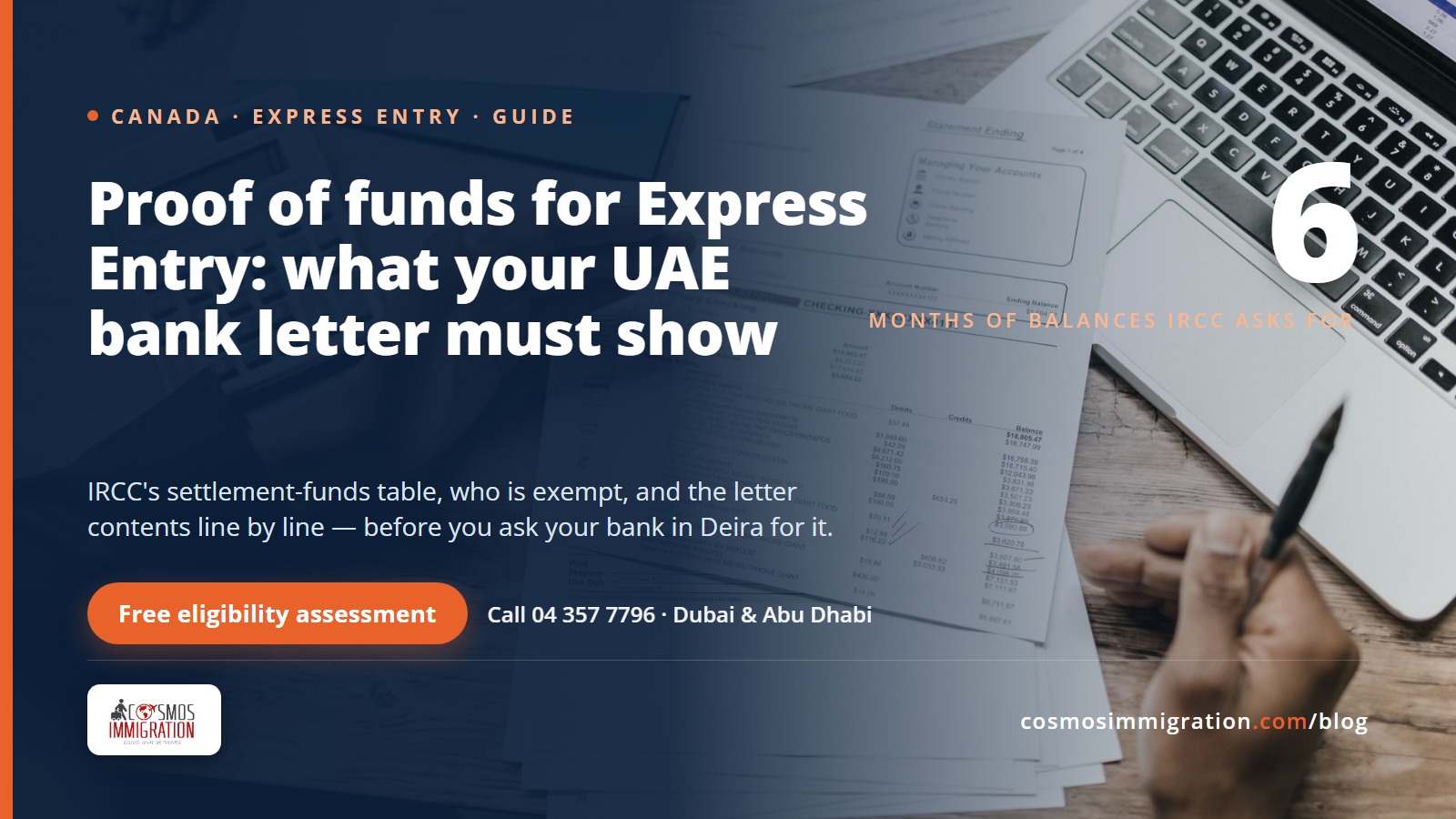
- The letter must list your debts and, for each account, the account number, opening date, current balance and average balance for the past six months.
How much you need, by family size
The figures below are taken from the canada.ca proof-of-funds page as at August 2026. The table carries the note “Updated July 7, 2025”. IRCC updates the numbers every year, based on 50 per cent of the low income cut-off totals, so check the page again before you upload anything.
| Number of family members | Funds you need (CAD), updated 7 July 2025 |
|---|---|
| 1 | $15,263 |
| 2 | $19,001 |
| 3 | $23,360 |
| 4 | $28,362 |
| 5 | $32,168 |
| 6 | $36,280 |
| 7 | $40,392 |
| Each additional family member beyond 7 | $4,112 |
Family size is where UAE applicants most often go wrong. IRCC’s count includes you, your spouse or common-law partner, your dependent children and your partner’s dependent children. It includes them even if they are Canadian citizens or permanent residents, and even if they are not coming to Canada with you. An applicant who plans to land alone before a spouse and two children still has to show the family-of-four figure.
When the table last changed, IRCC gave candidates already in the pool until 28 July 2025 to update their profiles and stay eligible. Updating the profile did not change the date and time it was received.
Who is exempt
Proof of funds is a minimum requirement of the Federal Skilled Worker Program and the Federal Skilled Trades Program. IRCC states that you do not need it if you are applying under the Canadian Experience Class, or if you are authorised to work in Canada and have a valid job offer. The job-offer exemption applies even if you were invited under one of the other two programs.
The online system currently asks every applicant for a proof-of-funds document. If you are exempt, you still have to upload something: a letter explaining that you were invited under the Canadian Experience Class, or that you have a valid job offer and authorisation to work in Canada. IRCC also advises keeping the funds in your profile up to date, because the system may find you eligible for more than one program and you will not always know which one you are invited under.
Most applicants from the UAE have no Canadian work history, so in practice the exemption rarely applies to the people we assess. The programs you may fit are summarised on our Canada immigration page.
What IRCC accepts, and what it does not
IRCC accepts one form of proof: official letters from banks or financial institutions where you hold an account.
Legal access
You must be able to prove that you can legally access the money when you arrive in Canada. IRCC gives two examples of what fails this test. Equity in real property cannot be used as settlement funds, and money borrowed from another person cannot be used either. In UAE terms, a paid-down apartment does not help, and a transfer from a relative shortly before you apply is the kind of deposit the rule is written to exclude.
Joint and spouse accounts
If your spouse is coming with you, money held together in a joint account can be counted. Money in an account in your spouse’s name only may be counted, but you must prove that you have access to it. IRCC adds that you must be able to use the money to pay for your family’s costs of living, even if they are not coming with you.
The bank letter, line by line
The letter must be printed on the financial institution’s letterhead and include:
- the bank’s contact information: address, telephone number and email address;
- your name;
- your outstanding debts, such as credit card debts and loans;
- for each current banking and investment account you hold with them: the account number, the date it was opened, the current balance and the average balance for the past six months.
You need one letter from every institution where you hold an account.
Collecting it from a UAE branch
An online-banking statement shows transactions and balances. It does not usually show the date the account was opened, the average balance over six months or your liabilities, so on its own it does not meet the list. The document to ask for is the balance confirmation letter issued at the branch, on letterhead, stamped and signed.
Even that letter is often incomplete as issued. Standard UAE templates confirm the name, the account number and the balance on the day, and frequently omit the six-month average and any mention of credit cards or loans. Take IRCC’s list to the branch and ask for each item by name. Request the letter in English, and check that every item is present before you leave the counter. If something is missing, ask for the letter to be reissued rather than adding a separate note.
Currency, gratuity, gold and crypto
Converting dirhams to Canadian dollars
IRCC’s table is in Canadian dollars and your letter will be in dirhams. The exchange rate moves between the date you create your profile, the date you apply and the date the visa is issued. Convert your balance to CAD, keep a note of the rate and date you used, and hold a margin above the CAD figure rather than sitting at the minimum. The page does not set a conversion method, so the safer position is a balance that clears the threshold at any plausible rate.
End-of-service gratuity
The canada.ca page does not mention gratuity. What it asks for is accessible money shown in a bank letter. An unpaid gratuity is an entitlement from your employer, not a balance, so it cannot be shown until it has been paid into your account. A gratuity paid shortly before you apply also does little for the six-month average the letter must state, and a single large deposit with no visible source can resemble the borrowed money IRCC excludes. Keep the final settlement letter and the payslip trail so the deposit has a documented, legal source. Where you have any control over timing, have it paid well before you expect an invitation.
Gold and cryptocurrency
IRCC’s page is silent on gold and cryptocurrency. It accepts only official letters from banks or financial institutions showing your account balances, and neither physical gold nor coins held on an exchange appear in such a letter. If you intend to rely on either, sell early and keep records of the sale and the transfer into your account. The six-month average reflects only money that has been sitting in the account over that period, so a late sale does not lift it by much.
Showing the funds twice, and then at the border
IRCC’s rule is that the money must be available both when you apply and when the permanent resident visa is issued. Spending the balance down in between, for example to settle a car loan before leaving the UAE, puts the application at risk.
IRCC’s page for approved applicants outside Canada lists what you must have when you arrive: a valid passport, your confirmation of permanent residence and permanent resident visa, and proof that you have the funds to support yourself and your family after arrival, unless you are exempt.
The same page states that if you arrive with CAN$10,000 or more, in cash or in instruments such as banker’s drafts, cheques and money orders, you must tell the CBSA officer. If you do not, you could be fined and the funds could be seized. The rest of the landing checklist is on our Canada skilled migration page.
From the UAE: what this means for you
Start with the figure. Count your family by IRCC’s definition, take the CAD amount from the table and add a margin for currency movement. If you are short, start building the balance now, because the six-month average only improves with time in the account. Use the Canada PR points calculator to check your score at the same time; a low balance and a low score need different fixes.
Request the branch letter in English a few weeks before you expect an invitation to apply. IRCC’s list does not ask for attestation; the requirement is that every item on the list is present. Obtain a fresh letter before you travel, because the border officer will want a current picture.
Review the account history. Large unexplained deposits in the six months before you apply invite questions about borrowed money. If you are moving funds into a joint account or waiting for a gratuity, do it early and keep the paperwork. List your liabilities accurately; IRCC asks the bank to state your debts, so a UAE credit card or personal loan will appear on the letter in any case.
Frequently asked questions
Can I show proof of funds from a UAE account, or must the money be in Canada?
IRCC asks for official letters from any bank or financial institution where you have an account and does not say the account must be in Canada. What matters is legal access to the money when you arrive.
My spouse holds our savings in an account in their name only. Does that count?
IRCC says you may be able to count it, but you must prove you have access to the money. A joint account is simpler: IRCC states directly that you can count funds you hold together, provided your spouse is coming with you.
Do I need to show funds again when I land in Canada?
Yes, unless you are exempt. IRCC lists proof of funds among the documents you must have when you arrive, and the CBSA officer asks questions similar to those on your application.
What to do next
For a second pair of eyes on your bank letter before you upload it, send us your details for a free eligibility assessment, call 04 357 7796, or book a 20-minute review through our contact page. We cannot promise an invitation or an approval, and we will not pretend otherwise.
Sources
- Documents for Express Entry: Proof of funds — accessed 27 Aug 2026
- Express Entry: If we approve your application: Outside Canada — accessed 27 Aug 2026
Cover photo: RDNE Stock project via Pexels
Not sure which route fits you? Book a free eligibility assessment with our Dubai or Abu Dhabi team. No obligation.
Call +971 4 357 7796WhatsApp us