
Last reviewed 28 October 2026 against GOV.UK, UCAS, QAA, U.S. Department of Homeland Security, USCIS, U.S. Department of State, EducationUSA and UAE Ministry of Higher Education and Scientific Research pages.
A bachelor’s degree with honours in England, Wales and Northern Ireland normally takes three years of full-time study, and most UK master’s degrees take at least one full-time calendar year. In Scotland, honours degrees take four years. In the United States, a bachelor’s degree typically takes four years and a master’s degree about two years. So a student from the UAE who wants a bachelor’s and a master’s can finish both in about four years in England, against about six in the US.
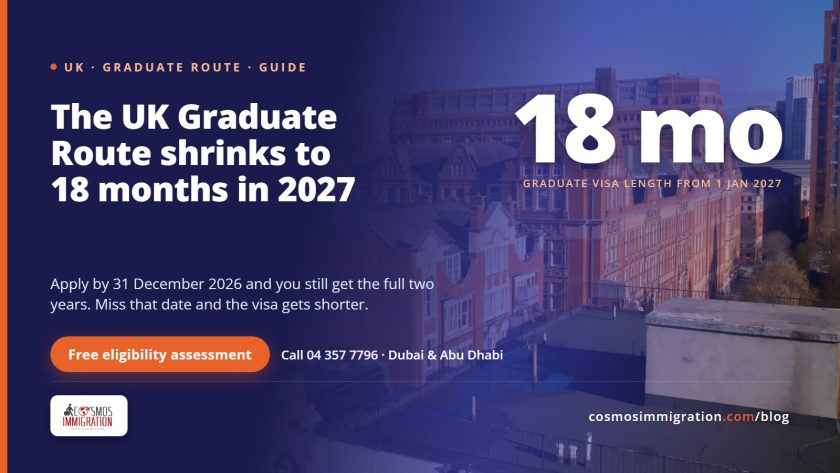
Length is only one difference. The two countries also use different application systems (UCAS in the UK, the Common App or a college’s own form in the US), different student visas, and different rules for working after graduation. Two of those rules have just changed: the UK Graduate visa drops from 2 years to 18 months for applications made on or after 1 January 2027, and the US replaced open-ended “duration of status” with a fixed period of admission for F-1 students from 15 September 2026.
This guide compares both systems side by side for families and students in the UAE, using official sources only. It does not rank universities or compare tuition, because those vary by institution and course.
At a glance
| Item | UK (England unless stated) | United States |
|---|---|---|
| Bachelor’s degree | Normally at least 3 years full-time; 4 years for honours in Scotland | Typically 4 years |
| Master’s degree | Most take at least 1 full-time calendar year | About 2 years |
| Choosing a subject | You apply for a named course from the start | You usually declare a major by the end of the second year |
| Undergraduate application | UCAS: up to 5 choices, GBP 34.50 for the 2027 cycle | Common App (for member colleges) or the college’s own form; each college sets its fee and deadline |
| Main deadline for 2027 entry | 13 January 2027, 18:00 UK time, for most courses | Set by each college |
| Student visa | Student visa: GBP 558, plus immigration health surcharge GBP 776 a year | F-1 visa: USD 185 application fee, plus I-901 SEVIS fee USD 350 |
| Work after graduating | Graduate visa: 2 years if you apply by 31 December 2026, 18 months from 1 January 2027 (3 years after a PhD) | OPT: up to 12 months; STEM graduates can apply for a further 24 months |
| Use of the degree back in the UAE | Recognition by the UAE Ministry of Higher Education and Scientific Research, case by case | Same process |
How long each degree takes, and why
The UK: depth from day one
The UK’s Quality Assurance Agency (QAA) explains that a bachelor’s degree with honours normally includes the equivalent of at least three years of full-time study, built from 360 credits with at least 90 at the final level. In Scotland, bachelor’s degrees with honours are four years. Degrees with a placement year or a year abroad can also run to four years in England, Wales and Northern Ireland.
At master’s level, QAA’s framework says most master’s degrees are achieved on the basis of study equivalent to at least one full-time calendar year, taken by students who already hold an honours degree. Integrated master’s degrees, common in science and engineering, combine bachelor’s and master’s study and typically take at least four years in England, Wales and Northern Ireland and five in Scotland.
UK honours degrees are awarded in classes: First Class, Upper Second (2:1), Lower Second (2:2) and Third. Master’s degrees are often awarded with merit or distinction.
In practice, a student applies for a specific course, such as BSc Economics or LLB, and studies mainly that subject from the first term. That suits a student who already knows what they want to study.
The US: breadth first, then a major
EducationUSA, the U.S. Department of State’s advising network, describes a bachelor’s degree as a four-year (sometimes five-year) programme in which students earn credits across a wide range of courses. Students do not normally declare a major until the end of their second year. A master’s degree is described as a two-year degree for further specialisation, and a doctorate as a five- to eight-year programme.
An associate degree takes two years, and community colleges often have agreements with four-year universities so that a student can complete the first two years at community college and the last two at university.
This structure suits a student who is not yet sure of their subject, or who wants to combine fields. The cost is time: a bachelor’s plus a master’s is usually about six years, against about four in England.
How applications work
UK undergraduate: UCAS
Undergraduate applications to UK universities go through UCAS. For 2027 entry:
- One application lets you add up to five choices (up to six for conservatoires).
- The application fee for the 2027 cycle is GBP 34.50.
- The equal consideration date for most undergraduate courses is 13 January 2027 at 18:00 UK time. Your reference must be completed before UCAS can receive the application.
- For Oxford, Cambridge and most courses in medicine, dentistry and veterinary medicine or science, the equal consideration date was 15 October 2026, which has now passed for 2027 entry.
A school in the UAE that follows a British curriculum will usually be familiar with UCAS references. If your school is not, ask early who will write the reference, because the application cannot be sent without it.
US undergraduate: the Common App or the college’s own form
Many US colleges accept the Common App, an online application used by students from over 200 countries. Key points from the Common App’s guidance for international students:
- Each college sets its own fee, and more than 500 colleges have no application fee for international students. A need-based fee waiver is available in the Profile section.
- Each college sets its own deadlines and admission plans: early action, early decision, regular decision or rolling admission. A deadline means 11:59 pm in your own time zone.
- Your school counsellor submits transcripts and school forms. Some colleges also want letters of recommendation.
- Questions such as whether you need an English test, or whether financial aid is offered to international students, vary by college, so check each college’s own page.
Because every US college works to its own calendar, a student applying to both countries needs two timelines: one built around 13 January for UCAS, and one built from each US college’s dates.
Student visas: what each country asks for
UK Student visa
According to GOV.UK, you can apply for a Student visa if you are 16 or over and you have an unconditional offer from a Home Office student sponsor, enough money for your course and living costs, and enough English. The key numbers:
- Visa fee: GBP 558 from outside the UK.
- Immigration health surcharge: GBP 776 for each year of the visa for students.
- Living costs: GBP 1,529 a month for courses in London or GBP 1,171 a month elsewhere, for up to 9 months, plus one year’s course fees (up to 9 months) as shown on your Confirmation of Acceptance for Studies (CAS). The money must be held for at least 28 days in a row, ending no more than 31 days before you apply.
- Timing: apply up to 6 months before the course starts and within 6 months of receiving your CAS. A decision usually takes about 3 weeks from outside the UK.
- Length of stay: for degree-level study, students aged 18 or over can usually stay up to 5 years in total.
- Family: partners and children can join only if you are government-sponsored on a course longer than 6 months, or on a postgraduate course of 9 months or more which, for courses starting on or after 1 January 2024, must be a PhD, other doctorate or research-based higher degree. A taught one-year master’s no longer qualifies.
Successful applicants receive an eVisa, a digital record of their immigration status, rather than a printed card. Our UK student visa page covers the application from the UAE in more detail.
US F-1 student visa
For the US, the school first issues a Form I-20, which carries the student’s SEVIS identification number. The student then pays two separate fees:
- I-901 SEVIS fee: USD 350 for F-1 students, paid before the U.S. Department of State issues the visa. F-2 dependants do not pay it.
- Visa application fee: USD 185 for an F student visa.
The big 2026 change. On 17 July 2026 the Department of Homeland Security published a final rule that ended “duration of status” for F students, effective 15 September 2026. F-1 students are now admitted for a fixed period: the length of the programme on their I-20, up to four years, plus 30 days to arrive and 30 days to leave (down from 60).
Students who need more time to finish, to start a new programme, or for OPT or STEM OPT must apply to USCIS for an extension of stay on Form I-539, or leave and be readmitted with a new period.
The same rule restricts changes. Below graduate level, students cannot change major, change level or transfer school during their first year, unless the Student and Exchange Visitor Program authorises an exception. At graduate level, students cannot change major or level at any point during the programme, and cannot transfer unless an exception is authorised.
For a US bachelor’s student, this matters more than it might seem. The breadth of the US system is a reason to choose it, but the new rule means the first year should be planned carefully with the school’s designated school official, and a five-year programme will need an extension.
Working after graduation
UK Graduate visa: 2 years now, 18 months from 2027
The Graduate visa lets students stay in the UK after successfully completing an eligible UK bachelor’s degree, postgraduate degree or other eligible course. GOV.UK states that it lasts:
- 2 years if you apply on or before 31 December 2026
- 18 months if you apply on or after 1 January 2027
- 3 years after a PhD or other doctoral qualification
You must apply from inside the UK, before your Student visa expires, and after your university has told the Home Office you have completed the course. The Graduate visa cannot be extended, although you may be able to switch to another visa, such as a Skilled Worker visa. The application fee is GBP 937, plus a health surcharge of GBP 1,035 a year (GBP 1,552.50 for 18 months).
What this means for UAE students starting in 2027. A student who starts a one-year master’s or a three-year bachelor’s in September 2027 will not apply for a Graduate visa until 2028 at the earliest, so the 18-month period will apply. Plans built on the old 2-year figure need to be updated.
US OPT and STEM OPT
Optional practical training (OPT) is temporary work directly related to an F-1 student’s major. USCIS says eligible students can receive up to 12 months of OPT, before and/or after completing their studies, but any pre-completion OPT is deducted from the time available afterwards. Students apply on Form I-765 after their designated school official recommends OPT in SEVIS. For post-completion OPT, the application can be filed up to 90 days before completing the degree and no later than 60 days after.
Students with an eligible science, technology, engineering or mathematics degree can apply for a 24-month STEM OPT extension. If the extension is filed on time and the OPT period runs out while it is pending, employment authorisation is automatically extended for 180 days.
Under the 2026 fixed-admission rule, a student who travels and is readmitted with a fixed period before filing for OPT or STEM OPT must file an extension of stay with the OPT application.
Will a UK or US degree be recognised in the UAE?
Neither country’s degree is automatically recognised. In the UAE, the Ministry of Higher Education and Scientific Research runs a service that issues an official recognition report for higher education qualifications obtained from institutions outside the UAE. Ministerial Decree No. (34) of 2025 sets the general conditions:
- The qualification must be valid, and all the information on it must be accurate.
- The awarding institution must have been properly established and accredited by the relevant accreditation authority in its own country, at the time the qualification was issued, to offer that programme.
The decree says recognition allows the qualification to be used in the UAE for employment, career progression, further studies and other purposes, and that the Ministry can revoke a recognition later if those conditions were not met.
For students, the practical step is the same for either country: before enrolling, confirm the university and programme are accredited in the UK or the US, since the Ministry’s conditions focus on the institution’s accreditation and the validity of the qualification. We cannot say in advance how the Ministry will assess a particular programme; check its service page for the current requirements.
From the UAE: what this means for you
- If you know your subject: England’s three-year bachelor’s and one-year master’s are the shorter route. Build your timeline around the 13 January UCAS date.
- If you want to explore before choosing: the US system gives more room, but plan the first year carefully under the new F-1 rules.
- If you plan to work abroad after graduating: compare 18 months on the UK Graduate visa (for applications from 2027) with up to 12 months of OPT, or up to 36 months in total for STEM graduates.
- If you plan to come back to the UAE: check accreditation before you enrol, so the Ministry recognition step is straightforward.
- Budget for fixed government costs early: GBP 558 plus GBP 776 a year for the UK; USD 185 plus USD 350 for the US, before tuition and living costs.
Our study abroad guide for UAE students compares more destinations, and our USA page covers US visa routes from the UAE.
Frequently asked questions
Is a three-year UK bachelor’s degree equal to a four-year US degree?
Both are bachelor’s degrees. The UK honours degree is shorter because students specialise from the start, while the US degree includes broader study before the major. How a particular degree is treated for further study or work depends on the institution or employer reviewing it, and in the UAE on the Ministry’s recognition process.
Is the UK Graduate visa still 2 years?
Only for applications made on or before 31 December 2026. From 1 January 2027 it is 18 months, or 3 years after a PhD.
Can I bring my spouse on a UK Student visa for a master’s?
Not on a taught master’s starting on or after 1 January 2024. Dependants are allowed for PhD, other doctoral and research-based higher degrees, or for government-sponsored students on courses longer than 6 months.
Can an F-1 student change major in the US?
Yes, but under the rule in force since 15 September 2026, not during the first year of a programme below graduate level unless the Student and Exchange Visitor Program authorises an exception, and not at all at graduate level.
What to do next
If you are weighing the UK against the US for yourself or your child, start with a free assessment or call 04 357 7796. We can help you set out the timelines, visa steps and costs side by side. Universities make admission decisions and governments make visa decisions, and we do not promise outcomes.
Sources
All accessed 28 October 2026.
- Student visa (GOV.UK)
- Student visa: money you need (GOV.UK)
- Student visa: your partner and children (GOV.UK)
- Graduate visa (GOV.UK)
- Pay for UK healthcare as part of your immigration application (GOV.UK)
- What is credit? A guide for students (QAA)
- The Frameworks for Higher Education Qualifications of UK Degree-Awarding Bodies, 2024 (QAA)
- 2027 cycle toolkit (UCAS)
- Key dates timeline (UCAS)
- What is the application fee for the 2027 cycle? (UCAS)
- Common App for international students (Common App)
- Frequently asked questions on the US educational system (EducationUSA, U.S. Department of State)
- I-901 SEVIS fee (U.S. Immigration and Customs Enforcement)
- Paying the I-901 SEVIS fee (Study in the States, DHS)
- Fees for visa services (U.S. Department of State)
- Final rule: fixed time period of admission, quick facts (Study in the States, DHS)
- Final rule, 17 July 2026 (Federal Register)
- Optional Practical Training for F-1 students (USCIS)
- STEM OPT extension (USCIS)
- Recognition of higher education qualifications from outside the UAE (Ministry of Higher Education and Scientific Research)
- Ministerial Decree No. (34) of 2025 on the recognition system for higher education qualifications from outside the country (MoHESR, unofficial English translation)
This article is general information, not advice on your individual case.
Not sure which route fits you? Book a free eligibility assessment with our Dubai or Abu Dhabi team. No obligation.
Call +971 4 357 7796WhatsApp us