
Last reviewed 29 October 2026 against IRCC, Canada Border Services Agency, Service Canada and Canada Revenue Agency pages.
If your permanent residence has been approved and you are moving from the UAE, the first jobs are fixed by Canadian government rules: carry your Confirmation of Permanent Residence and two copies of a goods list through the border, declare more than CAD 10,000 in funds, apply for a social insurance number (SIN), check whether your province has a health coverage waiting period, and make sure your PR card reaches you. IRCC also offers free settlement help before you leave, once your PR is approved.
This guide is for people who already have PR approval, or expect it soon, and are planning the move from Dubai, Abu Dhabi or elsewhere in the UAE. It covers the weeks before you fly, landing day, your first month, and the rules that matter for the next five years.
At a glance
| Task | What the official source says (checked 29 October 2026) |
|---|---|
| Free pre-arrival services | Available online once your PR is approved and you are still outside Canada |
| Documents at the border | Confirmation of Permanent Residence, passport, visa if you need one, two copies of your goods lists |
| Cash and funds | Declare more than CAD 10,000 when you arrive |
| SIN | Needed to work or get government benefits; for PRs it does not expire |
| Health coverage | Some provinces may not cover newcomers for the first three months |
| PR card | First card free if you send your photo and address within 180 days; otherwise CAD 50 |
| Keeping PR status | At least 730 days in Canada in every five-year period |
| First tax return | Due the year after you become a resident for tax purposes |
Before you leave the UAE
Use the free pre-arrival services. IRCC funds free online pre-arrival services. You can register if your PR application has been approved, you are outside Canada, and you hold one of the documents IRCC lists, such as your Confirmation of Permanent Residence. They are not open to visitors, students or temporary workers. The services help with planning the move and the job search, including recognition of foreign credentials, and connect you with local organizations once you arrive.
Check whether your job is regulated. Employment and Social Development Canada’s Foreign Credential Recognition Tool shows whether your occupation is regulated in the province you plan to live in, and roughly how long and how much recognition takes. Start this before you fly, because the tool also shows how long recognition can take.
Choose a city with your eyes open. IRCC notes that most newcomers settle in Toronto, Montréal or Vancouver, and lists medium-sized cities from St. John’s to Victoria. It suggests weighing work, schools, climate, cost of living and health services. Our guide on why smaller Canadian cities attract newcomers covers the programs that reward settling outside the big three.
Budget for a lower first income. IRCC is direct about this: you may have to take a lower-paid job while you upgrade your skills or gain Canadian experience, and the cost of living may be higher than you are used to. It says household expenses can take up to half of take-home pay, most Canadians spend 35% to 50% of income on housing and utilities, and pay cheque deductions can cut pay by 25% to 35%.
It also gives a floor for rent: at least CAD 350 a month for a room and at least CAD 2,000 for a larger apartment or house. For a side-by-side view of monthly costs, see our cost of living comparison of Dubai and Toronto.
Collect and translate your documents. IRCC suggests having important documents translated into English or French before you arrive. Its list of other documents to bring includes marriage and birth certificates, references from former employers, school and university records, professional certificates, vaccination records for the family, and your UAE driving permit together with an International Driving Permit. Make photocopies and keep them separate from the originals.
Landing day: the border
IRCC says that to enter Canada as a new permanent resident you need:
- your immigrant visa, if you need one
- a Confirmation of Permanent Residence for each family member travelling with you
- a valid passport or travel document for each family member
- two copies of a detailed list of the personal and household goods you are bringing
- two copies of a list of goods arriving later, with their value
Keep these with you, not in checked luggage. The goods list should show each item’s value, and make, model and serial number where it has one. IRCC says to give the list to the border officer on arrival even if you are not bringing goods that day, and suggests completing the CBSA’s BSF186 Personal Effects Accounting Document before you travel.
Funds over CAD 10,000. IRCC says you must tell a Canadian official on arrival if you are carrying more than CAD 10,000, whether in cash, cheques, bank drafts, money orders, or securities such as stocks and bonds. If you do not, you may be fined and the funds may be seized.
You then go through two short interviews: one on your documents, one on the goods you are bringing.
Your first weeks in Canada
1. Get your social insurance number. Service Canada says you need a SIN to work in Canada or to get government programs and benefits. For permanent residents it is permanent and does not expire. Service Canada no longer issues plastic cards; you receive a confirmation letter. Keep the number private.
2. Apply for provincial health coverage. IRCC says all permanent residents can apply for public health insurance, and each province runs its own plan. Those plans usually do not pay for eye care, dental care, prescription medicines or ambulance services. IRCC also warns that some provincial plans may not cover newcomers for the first three months, so contact the ministry of health in your province as soon as you arrive and buy private cover for any gap.
3. Make sure your PR card arrives. IRCC says your first PR card costs nothing if you send your photo and Canadian address within 180 days of becoming a permanent resident; after that the fee is CAD 50. IRCC currently shows about 28 days to process a new card. You need the card, with your passport, to return to Canada on a commercial flight after a trip abroad, which matters if you plan to fly back to Dubai soon after landing.
4. Find a settlement organization. IRCC’s health care page suggests contacting a local settlement organization on arrival. IRCC’s Find newcomer services tool lists the organizations near your new address.
5. Sort out driving. IRCC says you need a driving permit issued by your province or territory to drive in Canada, and that a foreign one can usually be used only for a short time after you arrive. The process may include a written test and one or two road tests, depending on your province and driving history. Car insurance is compulsory.
6. Know the sales tax where you live. IRCC explains that the federal GST is 5%, most provinces add provincial sales tax, and Ontario and the four Atlantic provinces combine the two as HST. Alberta and the three territories have no provincial or territorial sales tax.
Taxes and benefits in your first year
The Canada Revenue Agency says you become a resident for tax purposes once you have enough residential ties in Canada, and for most newcomers that starts on the first day they live there. You do not have to file your first return until the year after you become a resident: someone who arrived in 2025 did not have to file a 2025 return until 30 April 2026.
The CRA says new residents can apply for some payments before they ever file, including the Canada Groceries and Essentials Benefit, which replaced the GST/HST credit, and the Canada child benefit for families with children. Only one application per household is needed for the groceries benefit; families eligible for the child benefit use form RC66, which also covers the provincial programs.
The rules that matter for the next five years
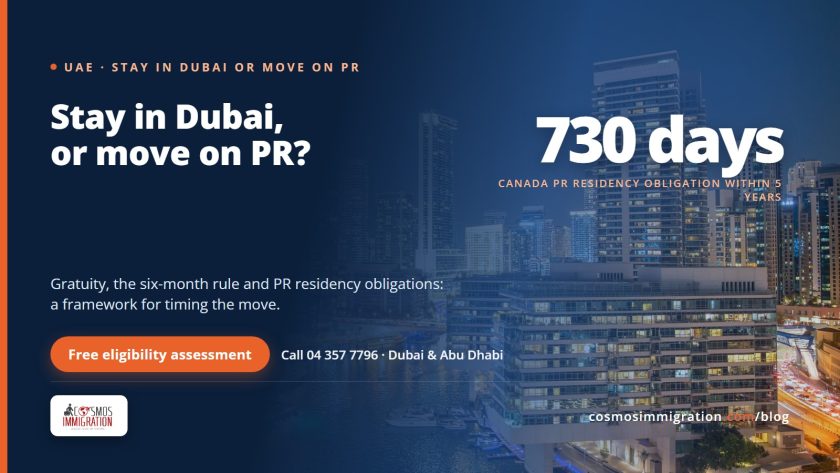
Keep your 730 days. IRCC says that to keep PR status you must have been in Canada for at least 730 days in the last five years. The days do not have to be continuous, and some time abroad can count in specific cases. Many families keep one parent working in the UAE for a while after landing; if that is your plan, track your days from the start with IRCC’s travel journal.
Your PR card expiring does not end your status. IRCC says you lose permanent residence only after an officer’s determination following an inquiry or travel document appeal, or if you give it up voluntarily.
Citizenship comes later. As a permanent resident you can live, work and study anywhere in Canada, receive most social benefits, and apply for citizenship once you meet its requirements. You cannot vote or hold some jobs that need high-level security clearance.
Frequently asked questions
Can I use the free settlement services before I move?
Yes, if your permanent residence has been approved and you are still outside Canada. IRCC’s pre-arrival services are online and free, and they are not open to visitors, students or temporary workers.
How much cash can I bring to Canada from Dubai?
IRCC’s guidance sets a declaration threshold rather than a cap: you must declare more than CAD 10,000 when you arrive. Not declaring can lead to a fine and seizure of the funds.
Will I have health cover from day one?
Not always. IRCC says some provincial plans may not cover newcomers for the first three months. Check with your province’s ministry of health on arrival and arrange private insurance for any gap.
Can I fly back to the UAE before my PR card arrives?
You can leave, but to return on a commercial flight IRCC says you need a valid PR card or a permanent resident travel document. Without the card, you would need to apply for the travel document before flying back.
When do I file my first Canadian tax return?
The year after you become a resident for tax purposes. For example, the CRA says someone who arrived in 2025 had until 30 April 2026 to file the 2025 return.
Next step
If you are still working out which route to Canada fits your family, start with a free assessment through our contact page or call 04 357 7796. We look at your profile against the permanent residence programs, working with CICC- and/or MARA-registered advisers. Our page on Canada PR from Dubai sets out the main routes.
Sources
- Pre-arrival services: who can get services (IRCC)
- Choose a city (IRCC)
- Prepare financially (IRCC)
- Prepare to cross the border to settle in Canada (IRCC)
- Health care in Canada (IRCC)
- Driving in Canada (IRCC)
- Social Insurance Number (Service Canada)
- Get a permanent resident card (IRCC)
- Understand permanent resident status (IRCC)
- Newcomers to Canada and the CRA (Canada Revenue Agency)
- Find newcomer services near you (IRCC)
- Foreign credential recognition (ESDC)
Not sure which route fits you? Book a free eligibility assessment with our Dubai or Abu Dhabi team. No obligation.
Call +971 4 357 7796WhatsApp us