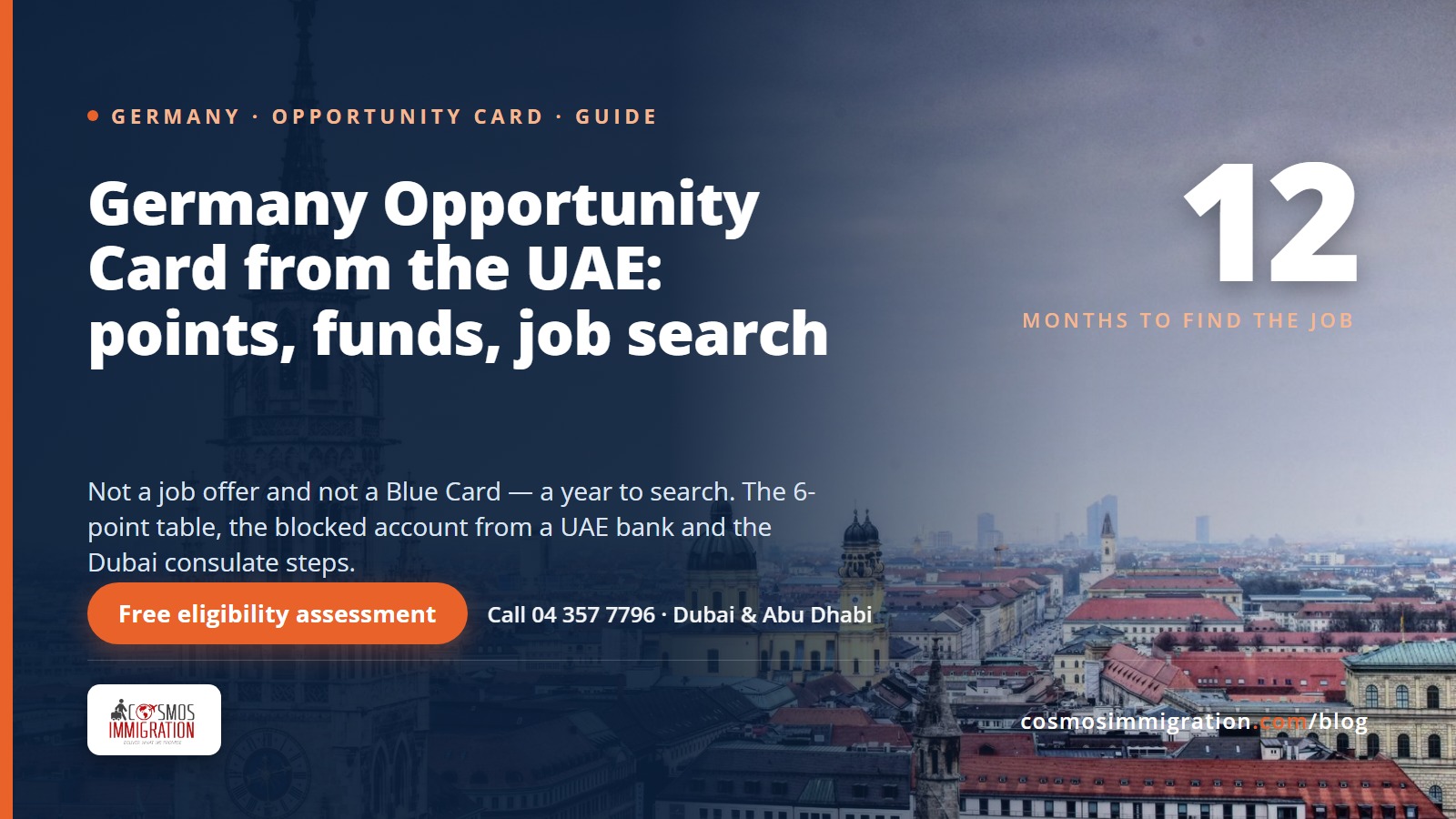
Germany’s Opportunity Card (Chancenkarte) lets a UAE resident move to Germany for up to a year to look for qualified work without holding a job offer first. UAE residents apply through the German Consulate General in Dubai, and the 2026 blocked-account figure on the federal portal is higher than the figure still printed on the consulate’s own leaflet. This guide sets out the two routes in, the points table, the proof of funds and the Dubai application steps, as at August 2026.
At a glance
- Two routes in: a qualification fully recognised in Germany, or at least 6 points under the points system.
- The points route also needs German at A1 or English at B2, plus a degree or a two-year vocational qualification recognised in the country where you earned it.
- Proof of funds: a blocked account of €1,091 net per month for 2026 (the Dubai consulate leaflet still shows €1,027) or a declaration of commitment from a sponsor in Germany.
- The card runs for up to 12 months. You may work part-time up to 20 hours a week and do job trials of up to two weeks per employer.
- UAE residents apply through the German Consulate General in Dubai: fee €75 paid in AED, processing up to 12 weeks.
What the Opportunity Card is, and what it is not
The Opportunity Card sits in Section 20a of Germany’s Residence Act. It is a job-search residence title rather than a work permit. It allows a legal stay in Germany while you look for qualified employment or set up as self-employed, and it converts into a residence permit once you have a job.
It is designed for candidates who cannot secure an offer from abroad and need to attend interviews in person. If you already hold an offer, the EU Blue Card is usually the relevant route, and our Germany page covers it.
Who qualifies: two doors in
Door 1: a qualification recognised in Germany
If your foreign qualification is fully recognised in Germany, or you obtained it in Germany, you count as a skilled worker and the points system does not apply to you. No language certificate is required, although the federal portal recommends German.
Door 2: the points route
If your qualification is not recognised in Germany, you need all three of the following:
- A university degree, or a vocational qualification of at least two years, recognised by the state where you obtained it, evidenced by a positive anabin result, a Statement of Comparability (Zeugnisbewertung) from ZAB or a Digital Statement on Professional Qualification.
- German at CEFR A1 or English at CEFR B2.
- At least 6 points in the table below.
The points table
Every point claimed must be supported by a document at the appointment. The Dubai consulate also asks for a printout of your self-check result from the federal portal.
| Criterion | Points | What the consulate will want to see |
|---|---|---|
| Qualification found partially equivalent (or compensatory measures required for a regulated profession) | 4 | Notification of partial recognition |
| Qualification in a shortage occupation | 1 | Match against the federal shortage list |
| At least 2 years’ relevant experience in the last 5 years | 2 | Experience certificates linked to the qualification |
| At least 5 years’ relevant experience in the last 7 years | 3 | Experience certificates linked to the qualification |
| German A2 | 1 | Goethe-Institut or ÖSD certificate |
| German B1 | 2 | Goethe-Institut or ÖSD certificate |
| German B2 or higher | 3 | Goethe-Institut or ÖSD certificate |
| English C1 or native speaker | +1 | Certificate carrying the ALTE Q-mark |
| Age under 35 at application | 2 | Passport |
| Age 35 to 40 | 1 | Passport |
| 6 continuous months of legal stay in Germany in the last 5 years (study, work, language course; not tourism) | 1 | Old passports, visas, entry stamps |
| Spouse or partner who also meets the card requirements | 1 | Partner’s own self-check and documents |
A worked example shows how the arithmetic runs. An applicant aged 34 with a home-country degree, six years of relevant work and an English C1 certificate scores 2 for age, 3 for experience and 1 for English, which is 6. The same applicant at 36 scores 5 and would need German A2 or a shortage-occupation match to reach the threshold.
Proof of funds: the blocked account, funded from a UAE bank
Both routes require proof of funds. The federal portal states €1,091 net per month for 2026 in a blocked account (Sperrkonto). The Dubai consulate’s leaflet, as at August 2026, still quotes €1,027 per month plus funds for a return flight. We advise clients to fund the account against the higher federal figure.
You choose the provider yourself. Most accounts are opened online, and the provider’s own fees are charged in addition. The deposit is sent from your UAE bank account, with the German mission named as beneficiary until the visa is issued and the foreigners authority after you arrive. Once in Germany, only a set amount can be withdrawn each month; the consulate’s sheet describes this as one-sixth or one-twelfth of the deposit, depending on whether it covers six or twelve months. If the visa is refused, the refusal notice is enough to unblock the money.
The alternative is a formal obligation letter (Verpflichtungserklärung) from a sponsor living in Germany. The consulate accepts either form of proof.
What you can do in Germany, and what comes next
The job-search card is issued for a maximum of one year, and the Dubai consulate issues the entry visa for between six and twelve months. During the search you may hold part-time jobs totalling 20 hours a week. You may also do job trials of up to two weeks per employer, provided they are aimed at qualified employment, an apprenticeship or a qualification programme. Becoming self-employed is an accepted goal as well.
Once you have a qualifying offer, you apply to the local foreigners authority for the matching residence title. For most graduates that is the EU Blue Card. In 2026 it requires a gross annual salary of at least €50,700. The lower threshold of €45,934.20 applies in shortage occupations, to graduates within three years of their degree, and to IT specialists without a degree who have three years of university-level IT experience in the last seven. The Blue Card runs for the contract length plus six months, up to four years. A settlement permit follows after 27 months with German A1 or 21 months with B1. If your job counts as qualified employment but fits no other residence title, the Opportunity Card itself is extended for up to two years.
From the UAE: what this means for you
Where you apply. The German Consulate General in Dubai, visa section at Street 8A, Jumeirah 1, handles Opportunity Card applications for everyone residing in the UAE, including Abu Dhabi residents. You count as habitually resident only if your Emirates ID was issued at least six months before the application date.
How you apply. File online through the Federal Foreign Office’s Consular Services Portal (digital.diplo.de/chancenkarte), then book an appointment on the consulate’s own system. Booking is free of charge. If no slots are showing, check again later, as new ones are released regularly.
The appointment itself. You attend the visa section in person with the complete file. The consulate takes the originals and your fingerprints, and the €75 fee is paid in cash in AED. An incomplete file is not accepted and you must book a new appointment, which is why we check each client’s folder against the consulate’s list before submission. Processing can take up to 12 weeks, and the consulate asks applicants not to enquire about status during the first eight.
The document set the Dubai consulate lists. VIDEX national visa form; passport (ideally valid at least a year, with two free pages) plus copies of your UAE residence permit and Emirates ID; three biometric photos, 3.5 x 4.5 cm, under six months old; anabin printouts or a ZAB statement; the self-check printout; a Goethe-Institut or ÖSD German certificate or an English certificate carrying the ALTE Q-mark; CV and work experience certificates; proof of recent job applications, a job-search plan and a motivation letter; accommodation for at least the first month; health insurance (not travel insurance) at the time of approval; and the blocked-account confirmation or obligation letter.
Start the search before you fly. The consulate expects proof of recent job applications, a job-search plan and a motivation letter. In practice this means applying for roles from the UAE before the appointment and keeping a record of each application, its date and any reply. That record supports the job-search plan and the motivation letter, and the replies indicate whether your profile attracts interest before you commit to the move.
Legalisation of UAE documents. Your degree is verified through anabin or ZAB rather than stamped in Dubai. Legalisation applies to documents issued by a UAE authority. The Consular Section of the UAE Ministry of Foreign Affairs certifies the document first, and the German Consulate General in Dubai, the only German mission in the UAE that legalises, then adds its own. Intake runs through VFS Global centres in Abu Dhabi and Dubai, so the Ministry step comes before the VFS step. Fees start at €31.20, paid in cash in AED. Our credential check identifies which document needs which step.
Language tests in the UAE. The Goethe-Institut Gulf Region runs exams from A1 to C1 in Abu Dhabi and Dubai, and the consulate names Goethe-Institut and ÖSD certificates specifically. English certificates must carry the ALTE Q-mark.
Order of work from Dubai. Run the federal self-check first. Then start the ZAB or anabin step, since the remaining steps depend on it. Book a language exam if you need one. Open the blocked account when the file is close to complete, and book the consulate appointment after that. Our Opportunity Card page and free assessment tools follow the same sequence.
Frequently asked questions
Do I need German to get the Opportunity Card?
Not for Door 1, where your qualification is recognised in Germany. The points route needs German A1 or English B2 as a minimum. German at A2 or above earns extra points and helps in interviews.
Can I work while I search?
Yes: up to 20 hours a week of part-time work, plus job trials of up to two weeks per employer aimed at qualified employment, an apprenticeship or a qualification programme.
What if I do not find a job within the year?
The federal portal provides an extension of up to two years only where you already hold qualified employment that fits no other residence title. Without an offer the card ends at 12 months, so treat the year as a deadline.
What to do next
If you want a straight answer on whether you clear 6 points, start with our free eligibility assessment, call 04 357 7796, or book a 20-minute review through our contact page. We have completed 10,569 assessments since 2014 from our Dubai and Abu Dhabi offices. We do not promise outcomes: the decision rests with the German consulate, and a complete file on its own does not secure a visa.
Sources
- Job search opportunity card Germany – Make it in Germany (Federal Government portal) — accessed 27 Aug 2026
- EU Blue Card – Make it in Germany — accessed 27 Aug 2026
- National Visa – Category D: Chancenkarte / Opportunity Card – German Missions in the UAE — accessed 27 Aug 2026
- National Visa – German Missions in the UAE — accessed 27 Aug 2026
- Blocked Account and Formal Obligation Letter – German Missions in the UAE — accessed 27 Aug 2026
- Opening and closing a blocked bank account (Sperrkonto) – Federal Foreign Office — accessed 27 Aug 2026
- Legalisation of UAE documents – German Missions in the UAE — accessed 27 Aug 2026
- Legalisation of UAE Certificates for use within the Federal Republic of Germany – German Missions in the UAE — accessed 27 Aug 2026
- German Consulate General Dubai – German Missions in the UAE — accessed 27 Aug 2026
- Exams in Gulf Region – Goethe-Institut Gulf Region — accessed 27 Aug 2026
Cover photo: Lander Lai via Pexels
Not sure which route fits you? Book a free eligibility assessment with our Dubai or Abu Dhabi team. No obligation.
Call +971 4 357 7796WhatsApp us