
Every European work permit, with one exception, starts with an employer in Europe who has already decided to hire you. Italy’s decreto flussi, Germany’s EU Blue Card, the Dutch highly skilled migrant permit, Ireland’s Critical Skills Employment Permit, Sweden’s work permit and Switzerland’s quota permits are all applied for by, or on the basis of, a specific job with a specific company. The exception is Germany’s Opportunity Card, which lets qualified people enter first and search for work afterwards. If you are in the UAE and someone is offering to “process your Europe work permit” without an employer’s name attached, this article gives you the official rules to check them against.
Italy: the decreto flussi is an employer quota, not a visa you apply for
Italy’s decreto flussi sets annual quotas for non-EU workers. The current decree covers 2026 to 2028 and, according to the Ministry of the Interior, allows 497,550 entries across the three years, split between seasonal, non-seasonal and self-employed categories, with sub-quotas by sector and by country of origin.
The mechanics matter. The Italian employer, not the worker, submits the request (the nulla osta) through the ministry’s online portal on scheduled “click days”. The employer must hold a real business, show the accommodation and contract terms, and be lucky or fast enough to secure a place in a quota that is usually exhausted within minutes. Only after a nulla osta is issued can you apply for an entry visa at the Italian consulate. There is no route for an individual in Dubai to enter the quota by themselves, and a “quota letter” offered for a fee is almost always either a forgery or the product of an employer who does not intend to employ you. Official guidance is on the Ministry of Labour’s Integrazione Migranti portal.
Germany: Blue Card versus Opportunity Card
These are two very different permits and they are often confused in the Gulf.
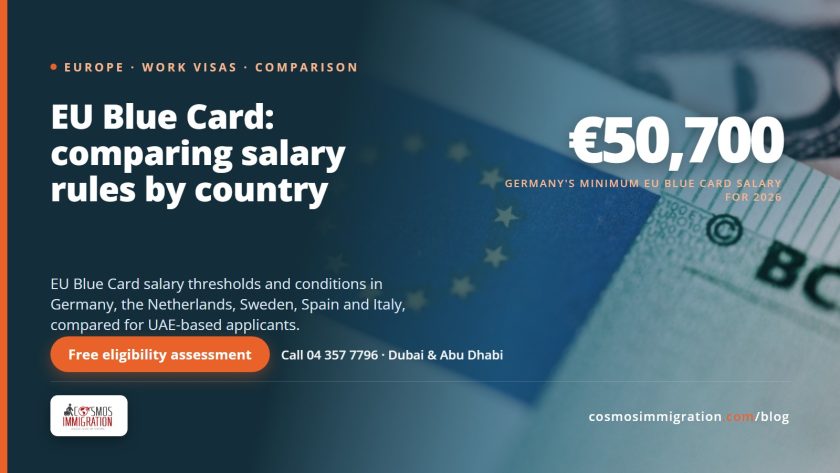
The EU Blue Card is for people who already hold a job offer in Germany in a role matching their university degree. For 2026 the general minimum gross annual salary is €50,700, and €45,934.20 for shortage occupations (IT, engineering, health and some others) and for recent graduates. The thresholds are published each year by the Federal Ministry of the Interior, so check the current figure on make-it-in-germany.com before relying on it. The employer’s contract is the foundation of the application.
The Opportunity Card (Chancenkarte) is a residence permit for job-seeking. It allows up to twelve months in Germany to find qualified work, with part-time work of up to 20 hours a week and trial employment allowed while you search. You qualify either as a recognised skilled worker (your qualification is fully recognised in Germany) or, more commonly, through a points system. For the points route you need a foreign degree or a vocational qualification of at least two years that is state-recognised in the country where you obtained it, German at level A1 or English at level B2, proof that you can support yourself, and at least six points. Points come from partial recognition of your qualification, language skills beyond the minimum, years of experience, age (two points under 35, one point from 35 to 39), previous stays in Germany and a qualified partner.
The Opportunity Card is the only route on this page where no employer is needed on the day you apply. It is still not a “work permit”; once you find a job you switch to the appropriate work residence title. Our German Opportunity Card page sets out the points table and the evidence needed.
Netherlands: the highly skilled migrant permit
The Dutch highly skilled migrant (kennismigrant) permit is applied for by the employer, who must be a recognised sponsor registered with the Immigration and Naturalisation Service (IND). There is no points test. Instead there is a salary test, set every January and published by the IND. For 2026 the required amounts are €5,942 gross per month for applicants aged 30 and over, €4,357 for applicants under 30, and a reduced criterion of €3,122 for graduates of Dutch institutions within their orientation year. The salary must be market-conforming and paid monthly into your account. Without a recognised sponsor, there is no application.
Ireland: Critical Skills Employment Permit
Ireland’s Critical Skills Employment Permit is designed for occupations on the Critical Skills Occupations List and requires a job offer of at least two years from an Irish employer. The current minimum annual salary is €40,904 for occupations on the Critical Skills list, €36,848 for applicants who qualified within the previous 12 months, and €68,911 for most other occupations; the Department of Enterprise publishes the current thresholds, which are revised periodically. Either the employer or the employee may lodge the application, but the employer must be registered and the contract must exist first. It is an attractive permit because it leads to residence without an employment permit after two years, but it is not something a consultant can obtain for you in the absence of an Irish employer.
Sweden: a salary tied to the national median
Sweden issues work permits on the basis of an offer from a Swedish employer that has advertised the role within the EU. New rules from the Swedish Migration Agency came into force on 1 June 2026: a first-time applicant’s salary must be at least 90 per cent of the Swedish median salary at the time of application, which the agency currently states as SEK 34,470 per month (based on a median of SEK 38,300 from 16 June 2026). People who already held a permit before 1 June keep the previous 80 per cent rule for extensions until 1 December 2026. The terms must also match Swedish collective agreements or what is customary in the industry, and the agency can now refuse an application because of problems on the employer’s side. None of this is something a consultant in Dubai can arrange for you; it starts with a Swedish employer choosing to hire you.
Switzerland: quotas, and priority for locals
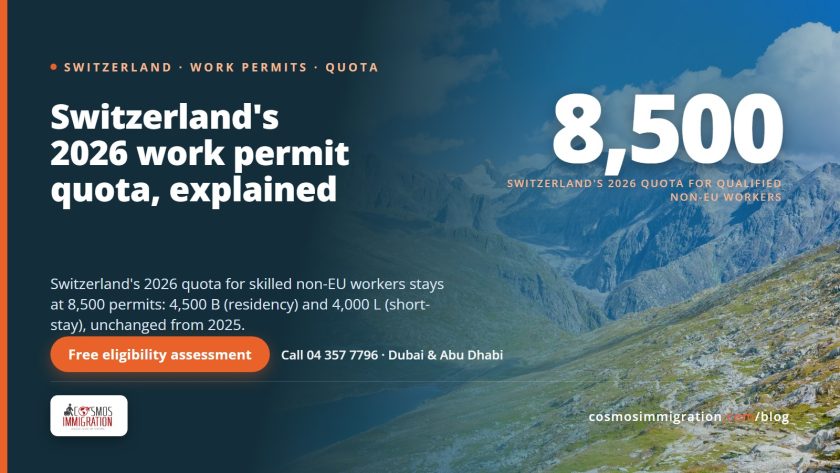
Switzerland admits non-EU/EFTA workers only within annual quotas and only for qualified specialists. For 2026 the Federal Council kept the quotas unchanged at 8,500 permits for third-country nationals, made up of 4,500 residence permits (B) and 4,000 short-term permits (L). The employer applies to the cantonal authority, must show that no Swiss or EU/EFTA candidate was available, and must offer conditions in line with the local market. The rules are on the State Secretariat for Migration site. A worker in Dubai cannot apply for a Swiss work permit directly.
United Kingdom, for comparison
The UK’s Skilled Worker visa requires a certificate of sponsorship from an approved sponsor employer for an eligible occupation at or above the required salary. The Global Talent visa does not require an employer, but it requires endorsement by a recognised body as a leader or potential leader in academia, research, arts or digital technology, which is a high bar and not a job-search visa.
What this means for a UAE applicant
- If you have an offer from a real European employer, the permit is their process. A consultant can help you assemble your side of the file, but the employer drives it.
- If you do not have an offer, the only European route you can start yourself is the Opportunity Card, and only if you hold a recognised qualification of at least two years and can meet the language and funds requirements.
- If you have no post-school qualification, none of these routes is open. Vocational study in the destination country is the realistic bridge.
- Any “Europe work permit” sold without the employer’s name, registration number and signed contract is not a permit. Ask for those three things before you pay anyone.
What to do next
- Check whether you reach six points for the German Opportunity Card.
- Use the eligibility tools to see whether Canada or Australia, which do not need an employer, might suit you better.
- Before paying any consultant for a European route, read our guide to verifying an immigration consultant in Dubai.
Not sure which route fits you? Book a free eligibility assessment with our Dubai or Abu Dhabi team. No obligation.
Call +971 4 357 7796WhatsApp us