In 2026, IRCC expects to issue up to 408,000 study permits. Only 155,000 are for newly arriving students; the other 253,000 are extensions. That total is 7% lower than the 2025 target and 16% lower than 2024’s. And every permit carries a condition many applicants skim past: you must prove to an officer that you will leave Canada when it expires.
We hear it every week in our Dubai office: a student visa is a side entrance to permanent residence. It is not. It is a temporary permit, and PR is a separate application with its own rules and no promise at the end. For a skilled professional already working in the UAE, the real question is whether studying gives you anything that applying directly would not. Here is how the two routes compare as at September 2026.
At a glance
- A study permit is temporary residence. You must show you will leave Canada when it expires.
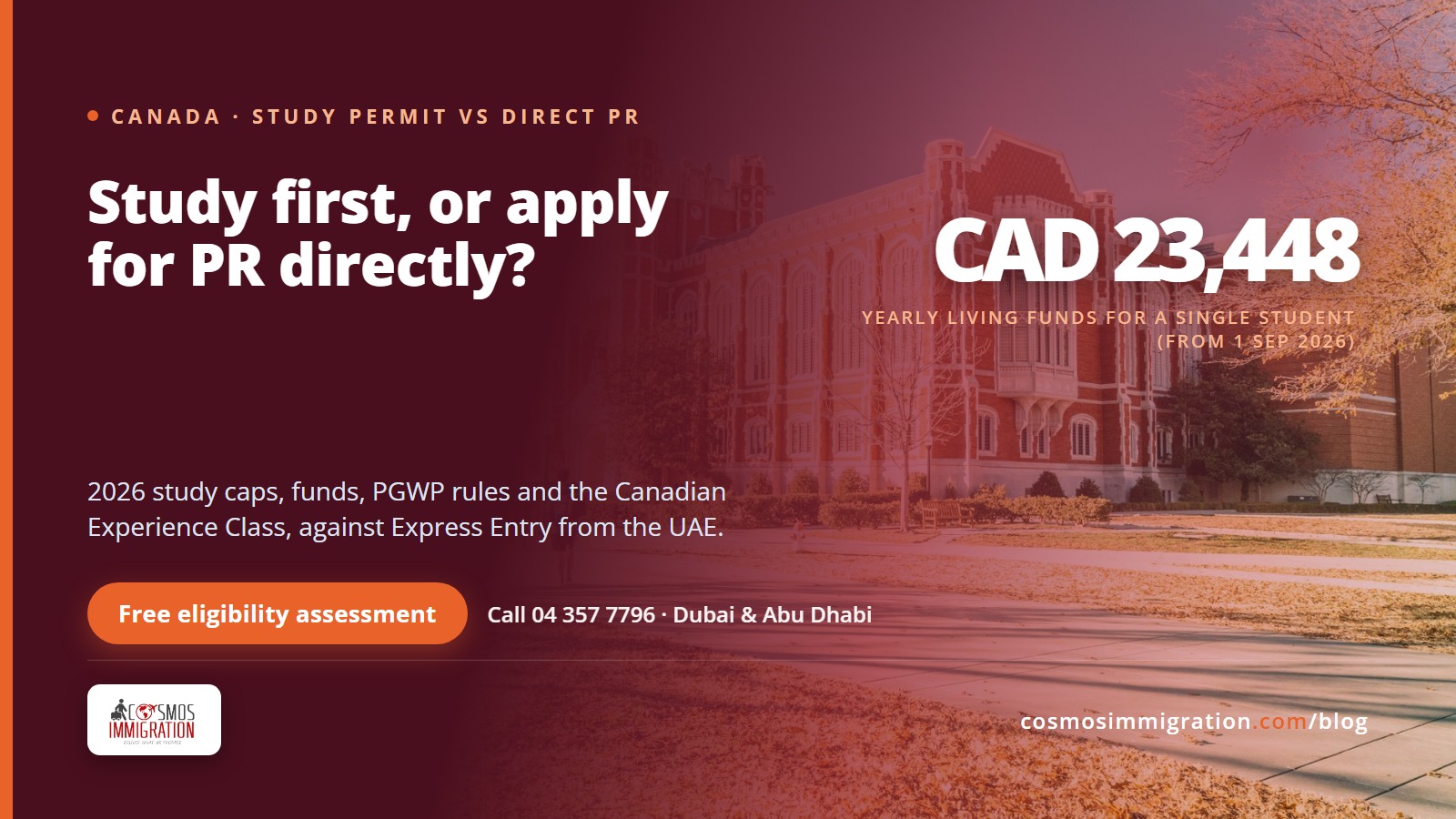
- From 1 September 2026, a single student outside Quebec must show CAD 23,448 a year for living costs, plus tuition and return travel.
- The Canadian Experience Class needs 1 year of skilled Canadian work. Work done while studying full-time does not count.
- The direct Federal Skilled Worker route counts skilled work done abroad, including in the UAE.
- On both routes, entering the Express Entry pool does not mean you will be invited to apply for PR.
Study permit or direct PR: what is the real difference?
One is a temporary permit to study; the other is an application aimed at permanent residence, and neither comes with a promised outcome.
| Study permit route | Direct PR (Federal Skilled Worker) | |
|---|---|---|
| What you apply for first | A temporary study permit | An Express Entry profile |
| Key first documents | Letter of acceptance; a PAL/TAL in most cases (a CAQ for Quebec) | Language test results; an Educational Credential Assessment |
| Language minimum | Later PGWP: CLB 7 for degrees, CLB 5 for college programs | CLB 7 |
| Work experience that counts | For CEC: 1 year of skilled work in Canada, after full-time study | 1 year of continuous skilled work in the last 10 years, in Canada or abroad |
| Steps before a PR invitation is possible | Study, PGWP, a year of skilled Canadian work, then a CEC profile | Meet the criteria, then create a profile |
This is the misconception we correct most often. A study permit depends on convincing an officer that you are a genuine temporary resident. Treating it as a PR application in disguise misreads what the officer is assessing.
What does the study route ask of you in 2026, and what comes after?
An accepted offer, usually a provincial letter, proof of funds, and then several more steps before PR is even on the table.
Acceptance and the PAL/TAL
You always need a letter of acceptance, and your school will be asked to confirm it is valid. In most cases you also need a provincial or territorial attestation letter (PAL/TAL), which confirms there is space for you in that province or territory. To get one, most students must accept their offer and pay tuition, in part or in full. Money leaves your account before any permit decision.
Two exceptions matter here. Since 1 January 2026, master’s and doctoral students at a public designated learning institution (DLI) do not need a PAL/TAL. And for Quebec, you need an attestation of issuance of your Quebec Acceptance Certificate (CAQ) instead.
The new funds figure
You must prove you can pay tuition, living expenses and return transportation for yourself and any family members who come with you. For applications on or after 1 September 2026, the living amount for a single student outside Quebec is CAD 23,448 a year. It was CAD 22,895 for applications from 1 January 2025 to 31 August 2026, so older articles quoting that number are out of date. The living amount excludes tuition and transportation. Accepted proof includes bank statements for the past 6 months, GICs, a scholarship, or a letter from the person or institution giving you money.
The long road from graduation to PR
- Complete a program of at least 8 months at a PGWP-eligible DLI, full-time each semester.
- Apply for a post-graduation work permit (PGWP) within 180 days of confirmation that you finished. Degree graduates have no field-of-study requirement but need CLB 7. College graduates who applied for their study permit on or after 1 November 2024 need an eligible field, linked to occupations in long-term shortage, and CLB 5. IRCC will not change that field list during 2026.
- A PGWP may be valid for 3 years if your program lasted 2 years or more; master’s graduates can apply for 3 years even after a shorter program. You only ever get one PGWP.
- Build 1 year of skilled Canadian work (1,560 hours, TEER 0 to 3) in the 3 years before you apply, and meet the CEC language minimum: CLB 7 for TEER 0 or 1, CLB 5 for TEER 2 or 3.
- Enter the Express Entry pool. IRCC invites the highest-ranking eligible candidates in each round, and states that entering the pool does not mean you will be invited.
Think of it as a relay in which every leg is judged by a different official under different rules. Running the first leg well does not carry you to the finish.
Can you skip the student years and apply directly from Dubai?
If you already have skilled experience and strong language scores, the Federal Skilled Worker Program lets work done outside Canada count.
FSW asks for at least 1 year of continuous skilled work (TEER 0 to 3), or 1,560 hours at 30 hours a week, within the last 10 years, in Canada or abroad. You also need at least CLB 7, an Educational Credential Assessment for foreign education, and 67 points or more on the selection factors grid. Our Canada PR points calculator is a sensible first check.
Here is what many people miss. If you have years of work in Dubai or Abu Dhabi, that history is the core of an FSW profile. The Canadian Experience Class is built on work in Canada, so studying first can mean setting that experience aside and starting a new clock.
The direct route is not easier, only more direct. The same pool applies, and nothing promises an invitation. Our Canada skilled migration visa page sets out the stages.
Which should you choose?
Start with what you already have: if your UAE career is solid, test the direct route first; study makes sense when the qualification itself is the goal.
Lean towards the study permit if…
- You want the Canadian qualification for its own sake, and would return home if PR does not follow.
- You can show tuition, return travel and CAD 23,448 a year in living costs, and pay tuition up front where a PAL/TAL requires it.
- A master’s or doctoral program at a public DLI fits your plans, so no PAL/TAL is needed.
- You accept a sequence of study, a PGWP and a year of Canadian work before you can enter the pool through CEC.
Lean towards direct PR if…
- You have 1 year of continuous skilled work in the last 10 years, in the UAE or elsewhere.
- You can reach CLB 7 and score 67 points or more on the FSW grid.
- Your degree can be assessed through an Educational Credential Assessment.
- You want an application about permanent residence from the start, not one about proving you will leave.
If your FSW profile falls short today, the honest next step is often to strengthen the weakest factor, such as your language score, before committing money to tuition. More routes are on our Canada immigration page.
From the UAE: what this means for you
On the study route, costs arrive early: you usually pay tuition before the PAL/TAL is issued and before any permit decision. Plan that cash flow alongside the living-funds figure.
IRCC accepts statements from a foreign bank account for the past 6 months, so a UAE salary account can serve, but those six months need to show the funds clearly. If family members come with you, the amount rises: for a family of two it is CAD 29,192 a year, before tuition and travel.
On the direct route, start gathering evidence of your work history, such as reference letters from former employers, and begin your Educational Credential Assessment early. Book your language test with time to retake it if your first score falls short of CLB 7. Whichever route you pick, keep job titles, dates and employer names consistent across every document.
Frequently asked questions
Does studying in Canada make PR more likely?
We cannot tell you it does, and IRCC does not say so either. PR after study means meeting the Canadian Experience Class rules and being invited from the pool, and IRCC states that entering the pool does not mean you will be invited.
Does work while I study count towards the Canadian Experience Class?
No. Work done while studying full-time, including co-op terms, does not count. In practice, the clock starts after you graduate, for example while you hold a PGWP.
Do I need a PAL/TAL for a master’s degree?
Not at a public DLI. Since 1 January 2026, master’s and doctoral students there are exempt. Most other students need one, and Quebec requires a CAQ instead.
What to do next
If you are weighing these two routes, start with a free eligibility assessment. We check your work history, language scores and education against the Federal Skilled Worker criteria before you commit money to tuition. Call us on 04 357 7796, or book a 20-minute review through our contact page, with offices in Dubai and Abu Dhabi. More Canada articles are on our guides page. We do not promise outcomes; every decision rests with IRCC.
Sources
- IRCC: 2026 provincial and territorial allocations under the international student cap — accessed 26 Sep 2026
- IRCC: Provincial attestation letter or territorial attestation letter — accessed 26 Sep 2026
- IRCC: Study permit – Get the right documents — accessed 26 Sep 2026
- IRCC: Study permit – Who can apply — accessed 26 Sep 2026
- IRCC: Study permit – Proof of financial support — accessed 26 Sep 2026
- IRCC: Post-graduation work permit – Who can apply — accessed 26 Sep 2026
- IRCC: PGWP field of study requirements — accessed 26 Sep 2026
- IRCC: Post-graduation work permit – About — accessed 26 Sep 2026
- IRCC: Express Entry – Canadian Experience Class — accessed 26 Sep 2026
- IRCC: Express Entry – Language requirements — accessed 26 Sep 2026
- IRCC: Express Entry – Submit a profile — accessed 26 Sep 2026
- IRCC: Express Entry – Rounds of invitations — accessed 26 Sep 2026
- IRCC: Express Entry – Federal Skilled Worker Program — accessed 26 Sep 2026
Not sure which route fits you? Book a free eligibility assessment with our Dubai or Abu Dhabi team. No obligation.
Call +971 4 357 7796WhatsApp us