Last reviewed 26 October 2026 against IRCC pages and the Express Entry rounds table.
For most people living in Dubai or Abu Dhabi, moving to Canada means applying for permanent residence through Express Entry, usually as a Federal Skilled Worker, or through a provincial nomination. Both are open. The catch in 2026 is that IRCC has not held a general Express Entry round all year: invitations have gone to provincial nominees, people with Canadian work experience, strong French speakers and a set of occupation categories. So the realistic question is not “can I apply” but “which of these routes can my profile actually reach”.
From 3 November 2026, Express Entry also starts awarding points for qualifying job offers and Canadian work experience in high-wage occupations. For a UAE applicant with neither, that change alone does not move the score.
At a glance
| Route | Status, 26 Oct 2026 | Who it suits from the UAE |
|---|---|---|
| 1. Express Entry: Federal Skilled Worker | Open | Graduates with a year or more of skilled work |
| 2. Express Entry: Federal Skilled Trades | Open | Tradespeople, often with a Canadian job offer or certificate |
| 3. Canadian Experience Class | Open | Only people who already worked in Canada |
| 4. Provincial Nominee Programs | Open, province by province | Profiles that match a province’s needs |
| 5. Atlantic Immigration Program | Open | Anyone with a designated Atlantic employer’s job offer |
| 6. Rural Community Immigration Pilot | Open | Job offers from approved employers in 14 communities |
| 7. Quebec selection | Separate system | People who intend to live in Quebec |
| 8. Family sponsorship | Open | Spouses, partners, children, some parents |
| 9. Study, then work, then PR | Open but capped | Younger applicants willing to study first |
| 10. Work permits | Open | People with an employer-backed offer |
| Start-up Visa | Paused | |
| Self-Employed Persons | Paused | |
| Caregiver pilots | Closed to new PR applications |
1. Express Entry: Federal Skilled Worker Program
This is the main route for UAE residents with no Canadian history. To enter the pool as a Federal Skilled Worker you need:
- at least one year of continuous, paid, skilled work (1,560 hours) in a TEER 0 to 3 occupation in the last 10 years;
- CLB 7 or higher in all four abilities on an approved test (CELPIP-General, IELTS General Training or PTE Core for English; TEF Canada or TCF Canada for French);
- an Educational Credential Assessment (ECA) for education gained outside Canada, less than five years old;
- at least 67 points on the FSW selection grid, which is scored out of 100 and is separate from your CRS score (IRCC’s 2026 Express Entry consultation asked whether to drop this grid, so watch for changes);
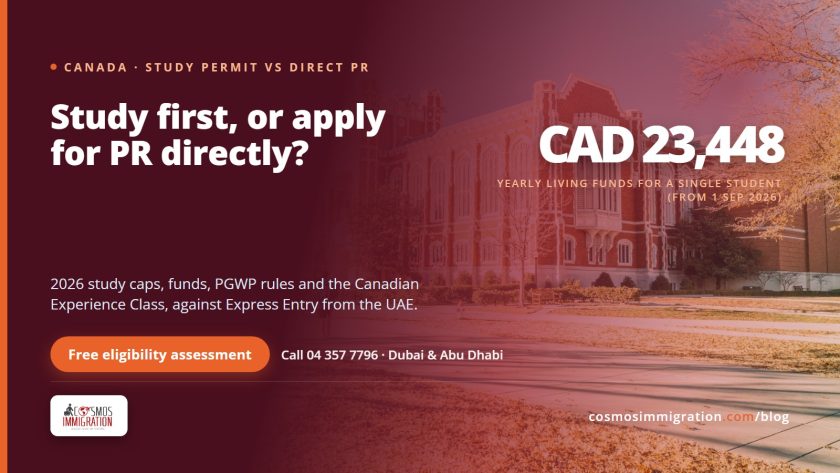
- proof of funds, unless you are exempt. IRCC’s table, updated 7 July 2025, asks for CAD 15,263 for one person, 19,001 for two, 23,360 for three and 28,362 for four.
Once in the pool, you are ranked by your Comprehensive Ranking System (CRS) score. Our CRS score explainer shows where each point comes from, and our guide to proof of funds with UAE bank statements covers the letter format.
What the 2026 rounds tell you
IRCC’s rounds table shows 63 rounds from 5 January to 26 October 2026 and none of them general. The most recent:
| Date (2026) | Round type | Invitations | Lowest CRS invited |
|---|---|---|---|
| 26 October | Provincial Nominee Program | 792 | 761 |
| 16 October | French-language proficiency | 5,000 | 435 |
| 15 October | Canadian Experience Class | 2,500 | 519 |
| 13 October | Provincial Nominee Program | 752 | 772 |
| 1 October | Trade occupations | 3,500 | 476 |
On 25 October 2026 the pool held 228,724 profiles, about 71,000 of them between 451 and 500.
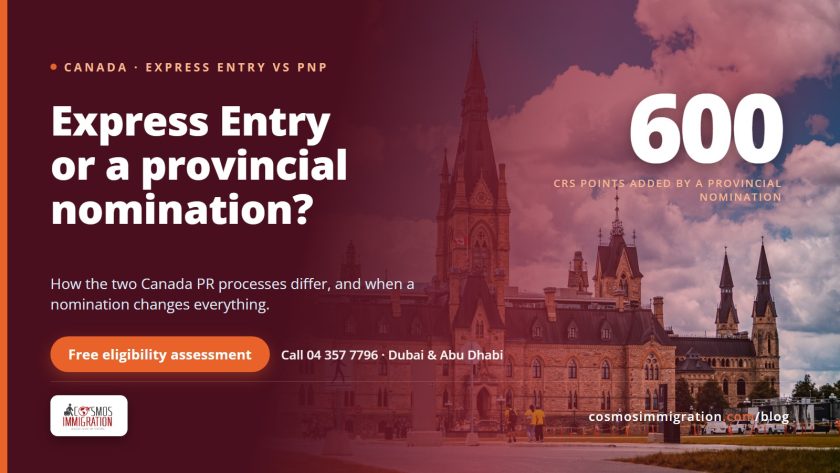
For a UAE applicant, that means three levers matter more than anything else: a provincial nomination (600 points), French at NCLC 7 or higher (up to 50 extra points and access to French rounds, which have cut off between 382 and 435 since August), and an occupation in one of IRCC’s categories. The current categories are French-language proficiency, healthcare and social services, STEM, trades, education, transport, physicians with Canadian work experience, senior managers with Canadian work experience, researchers with Canadian work experience, and skilled military recruits. Our post on category-based draws covers each one.
The 3 November 2026 change, accurately
IRCC’s backgrounder of October 2026 sets out what changes on 3 November:
- A qualifying job offer in a high-wage occupation earns CRS points: 100 at two times the median wage or more, 70 at 1.5 times, 50 at 1.3 times. It must generally be full-time and continuous for at least one year after you become a permanent resident.
- No Labour Market Impact Assessment (LMIA) is needed for a qualifying job offer to earn these points. A temporary public policy also removes LMIA requirements for job offers used to meet FSW and Federal Skilled Trades eligibility, for candidates invited on or after 3 November.
- At least 12 months of Canadian work experience in a high-wage occupation earns 20, 40 or 70 extra points in addition to the normal points for its length, up to 150 in total.
- You get whichever of the two is higher, never both. The cap is 150 points without an accompanying spouse and 140 with one.
- IRCC will recalculate every profile, which could take up to two weeks, and will pause invitation rounds while it does.
An IRCC officer must find the job offer genuine, and a revoked offer stops counting. If you hold a valid offer, IRCC asks you to add it to your profile before 3 November.
2. Express Entry: Federal Skilled Trades Program
For electricians, welders, plumbers, heavy-equipment technicians and other trades. The language bar is lower (CLB 5 for speaking and listening, CLB 4 for reading and writing), but you need either a qualifying Canadian job offer or a certificate of qualification issued by a Canadian province or territory. Trades also have their own Express Entry category; the 1 October 2026 trades round cut off at 476.
3. Canadian Experience Class
Only for people with at least one year of skilled work in Canada. Work done in the UAE does not count. It matters to UAE families mainly as the second step after a work permit or a study-and-work period.
4. Provincial Nominee Programs
Every province and territory except Quebec and Nunavut runs its own nominee program. Express Entry-linked streams pick from the federal pool and add 600 CRS points on nomination; base streams run outside Express Entry. Provinces select for their own labour needs, so a profile that is mid-pack federally can still be picked.
Some provinces changed sharply in 2026. Ontario replaced its eight streams on 25 June 2026 with a single Ontario Workforce Priority stream, built mainly around employer job offers (source: ontario.ca, 2026 OINP updates, checked 27 October 2026). Our guide to PNPs without a job offer sets out which provinces still nominate without an employer. The 2026-2028 Immigration Levels Plan gives the PNP 91,500 admissions in 2026, close to the 109,000 for Express Entry’s federal programs.
5. Atlantic Immigration Program
A permanent residence route for skilled workers and international graduates who want to live in New Brunswick, Nova Scotia, Prince Edward Island or Newfoundland and Labrador. You need a job offer from an employer designated by the province, and you can be living abroad, including in the UAE, when you take part. The levels plan allows 4,000 admissions a year.
6. Rural Community Immigration Pilot
This pilot replaced the Rural and Northern Immigration Pilot, whose remaining applications are being processed to completion. IRCC lists it as open. Fourteen communities approve local employers to hire for jobs they cannot fill locally, and a job offer from one of those employers is the entry point.
7. Quebec is a separate system
Quebec selects its own economic immigrants, with its own programs, criteria and French requirements. If you plan to settle in Quebec you do not go through Express Entry or a PNP; check Quebec’s own immigration site for what is open.
8. Family sponsorship
Canadian citizens and permanent residents can sponsor a spouse, partner or dependent child. The 2026 plan allows 69,000 admissions for that group and 15,000 for parents and grandparents, whose program runs through managed intakes rather than year-round applications. Sponsors take on financial obligations, and applicants pass medical and security checks.
9. Study first, then work, then apply for PR
Studying in Canada can still lead to permanent residence, usually through a post-graduation work permit and then the Canadian Experience Class or a provincial stream. It is slower and costlier than it looks, and it is tighter than it was: the levels plan targets 155,000 new international student arrivals in 2026, falling to 150,000 in 2027 and 2028. Check that your institution is a designated learning institution and that your specific program leads to a post-graduation work permit before paying fees. Our Canada student visa page covers the application.
10. Work permits
Employer-specific permits usually need an LMIA from Employment and Social Development Canada. International Mobility Program permits are LMIA-exempt and cover cases such as intra-company transfers. The levels plan cuts new temporary arrivals to 385,000 in 2026 and 370,000 in 2027 and 2028, and plans to move up to 33,000 temporary workers already in Canada to permanent residence over 2026 and 2027. We do not arrange jobs or employer offers; if someone offers to sell you a Canadian job or an LMIA, treat it as a warning sign.
Paused and closed routes
- Start-up Visa: IRCC lists the program as paused and closed to new applications.
- Self-Employed Persons Program: paused.
- Caregivers: the Home Care Worker Immigration pilots are closed, and the Home Child Care Provider and Home Support Worker pilots took their last applications on 17 June 2024. Temporary work as a home care worker remains an option.
From the UAE: how to start
- Score yourself on today’s facts. Use your real age, education and current language level, not the score you hope for.
- Book a language test and prepare for it. For most applicants this is the step that moves the most points, and the one people postpone. IELTS One Skill Retake is not accepted for Express Entry.
- Order your ECA early. It takes weeks, and it must be under five years old when you enter the pool and when you apply.
- Check your occupation against the categories and the provincial lists before you build a plan.
- Collect reference letters from current and former UAE employers that describe duties, hours, pay and dates, matched to the NOC code you will claim.
- Plan police certificates for the UAE and every country where you spent six months or more in a row since age 18.
If you live in the UAE and want the Express Entry route mapped against your own numbers, our Canada PR from Dubai page is the place to start.
Frequently asked questions
What is the easiest way to immigrate to Canada from the UAE?
There is no easy route, but for a graduate with skilled UAE work experience the usual path is Express Entry as a Federal Skilled Worker, combined with a push for a provincial nomination or French. Without one of those, 2026 rounds have not reached general profiles.
Do I need a job offer to move to Canada?
Not for the Federal Skilled Worker Program or most Express Entry-linked provincial streams. The Atlantic program, the rural pilot and most work permits do need one. From 3 November 2026 a qualifying high-wage job offer can add 50 to 100 CRS points.
Can I apply for Canadian PR while living in Dubai?
Yes. Express Entry, most PNP streams and the Atlantic program all accept applicants living abroad.
How much money do I need?
For Express Entry, IRCC’s minimum is CAD 15,263 for one person and CAD 28,362 for a family of four (table updated 7 July 2025). Government fees for the application itself are separate and listed on IRCC’s fee page.
Is the Start-up Visa still an option?
No. IRCC lists it as paused and closed to new applications.
What to do next
If you would like a clear view of which of these routes your profile can reach, start with a free assessment on our Canada page or call 04 357 7796. We work with CICC-registered advisers. IRCC and the provinces make every decision; we make sure your file is complete.
What was folded in from older posts
This page now covers two older posts that will redirect here. From the older post on easy ways to immigrate to Canada (431) we kept the study permit to post-graduation work permit to PR sequence and the Start-up Visa and PNP summaries, updated to 2026 status. From the older guide to migrating to Canada (404) we kept the 2026-2028 levels plan figures, the work permit (LMIA and IMP) section, the family sponsorship allocations, the Quebec note and the getting-started checklist.
Sources
All accessed 26 October 2026.
- Express Entry rounds of invitations, all rounds (IRCC)
- Changes to Express Entry for high-wage occupations, backgrounder (IRCC, October 2026)
- Comprehensive Ranking System (CRS) criteria (IRCC)
- Express Entry: Category-based selection (IRCC)
- Federal Skilled Worker Program (IRCC)
- Express Entry: Language test results (IRCC)
- Educational credential assessment (IRCC)
- Proof of funds (IRCC)
- Supplementary Information for the 2026-2028 Immigration Levels Plan (IRCC)
- Atlantic Immigration Program (IRCC)
- Rural Community Immigration Pilot (IRCC)
- Start-up Visa Program (IRCC)
- Self-Employed Persons Program (IRCC)
- Home care workers (caregivers) (IRCC)
- 2026 consultation on Express Entry, including the FSW 67-point grid (IRCC)
- Federal Skilled Trades Program (IRCC)
- Provincial Nominee Program: eligibility (IRCC)
This article is general information, not advice on your individual case.
Not sure which route fits you? Book a free eligibility assessment with our Dubai or Abu Dhabi team. No obligation.
Call +971 4 357 7796WhatsApp us